Thursday, 2 December 2010

Settle Telephone Box Star

This is the telephone box in Settle next to the Cenotaph. Churches Together in Settle now rent it from the Council. We hope to follow the example of Gallery on the Green  in upper Settle which maintain the telephone box there as an art gallery.

The star started shining ready for Settle Lights-On on Saturday 27 November. Inside there are some of the cards listing the Christmas time services of all the churches in Settle.

I hope we may get some positive involvement of the people/children in the neighbouring Northfields estate


Same pictures but bigger:


And here are pictures of the Gallery on the Green in Upper Settle taken on 14th November. They have an excellent exhibition about 3D photography


Sunday, 28 November 2010

CoolEarth Coffee at Foxglove Covert Nature Reserve


 Wednesday 25 November:  A visit to Foxglove Covert Nature Reserve at Caterick Garrison near Richmond. I arrvied at 12.30 but there were so many paths to explore I didn't get back till almost dark - and then shared a drink of Cool Earth Coffee with one of the volunteers there, and left them a jar to enjoy.


I'd had a good day. At the far end of this pool is the tower hide (above) and a rounder brand new hide below.


Inside it was delightful - brand new wood, not yet made dirty by birdwatchers feet. The building was so symmetrical and peaceful.


There were new paths and new benches.
and new pools and scrapes:-


I
 I found the Open air classroom being built ..

Here is a flush area (they called it raised fen ) - with Quaking grass and Grass of Parnassus.


Thursday, 25 November 2010

CoolEarth Coffee at St John's Coffee Mornings

We had some of the Cool Earth Coffee at the regular Tuesday Morning Coffee Morning at St John's Methodist Church this week -23 November. There is a choice and this week we could also have FairTrade Percol cafetiere coffee.

Wednesday, 17 November 2010

CoolEarth Coffee at Skipton - Craven Speakers Club


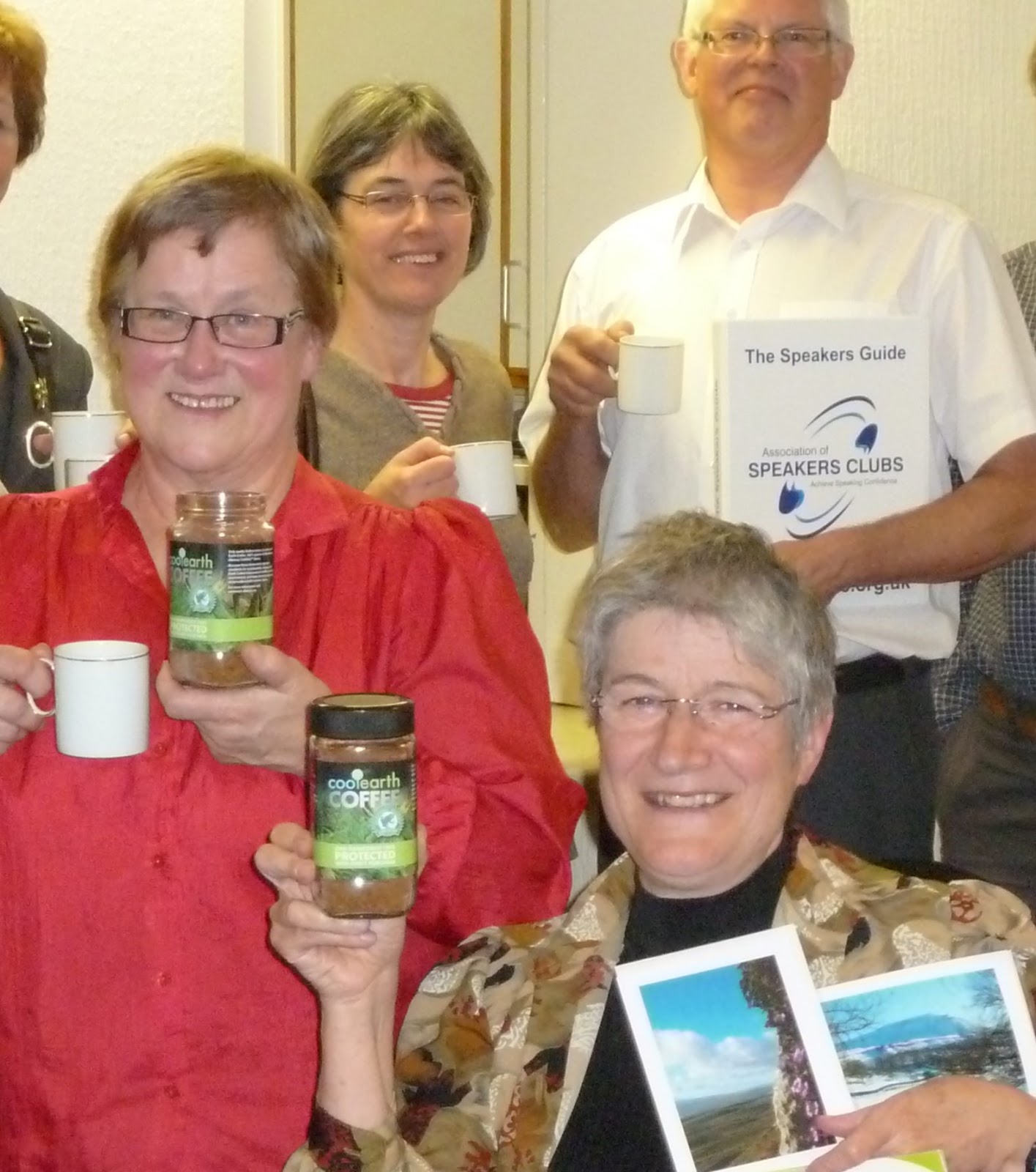
On 15th November at Craven Speakers Club (at Skipton, North Yorkshire) we chose to drink Cool Earth Coffee, to support CoolEarth  and their coffee morning that day


CoolEarth coffee has been launched recently. The sale of each jar of CoolEarth coffee protects a tree at risk of being logged in the Amazon rainforest.

You can read about Craven speakers club at www.craven-speakers.org.uk


 Here you can see I am  (as usual!) promoting the beautiful cards I make to sell in aid of the Rainforest.


 This is the manual we use at Speakers club.


These are apples that Eileen brought as a gift for anyone to take. They are delicious
I had had to make a special trip to Tesco's to buy the coffee beforehand, as I understood that this is the only place you can buy the Cool Earth Coffee. I would rather support other shops as well as Tesco's.


I bought four jars £2.99 each. But I have made good use of the four jars
A friend at Speakers Club bought one jar from me.

I took the coffee to Craven Conservation Group's AGM on Tuesday Evening and told everyone we would be drinking it. Unfortunately the meeting went on so long that we abandoned coffee and the mince pies that I had brought too.  However one member was keen to buy a jar and did!

I took a jar to show Settle Spinner's group on Tuesday.  And gave a jar to St John's Church for their Tuesday Coffee Mornings.


Cheers!

Tuesday, 9 November 2010

Autumn 2010 Views + St John's Church Settle


Here is a picture of St John's on 30th October. In the background above the railway bridge you can see Castleberg rock with the flag flying


On 3 November I walked up through Castleberg Woods


..over the fallen leaves


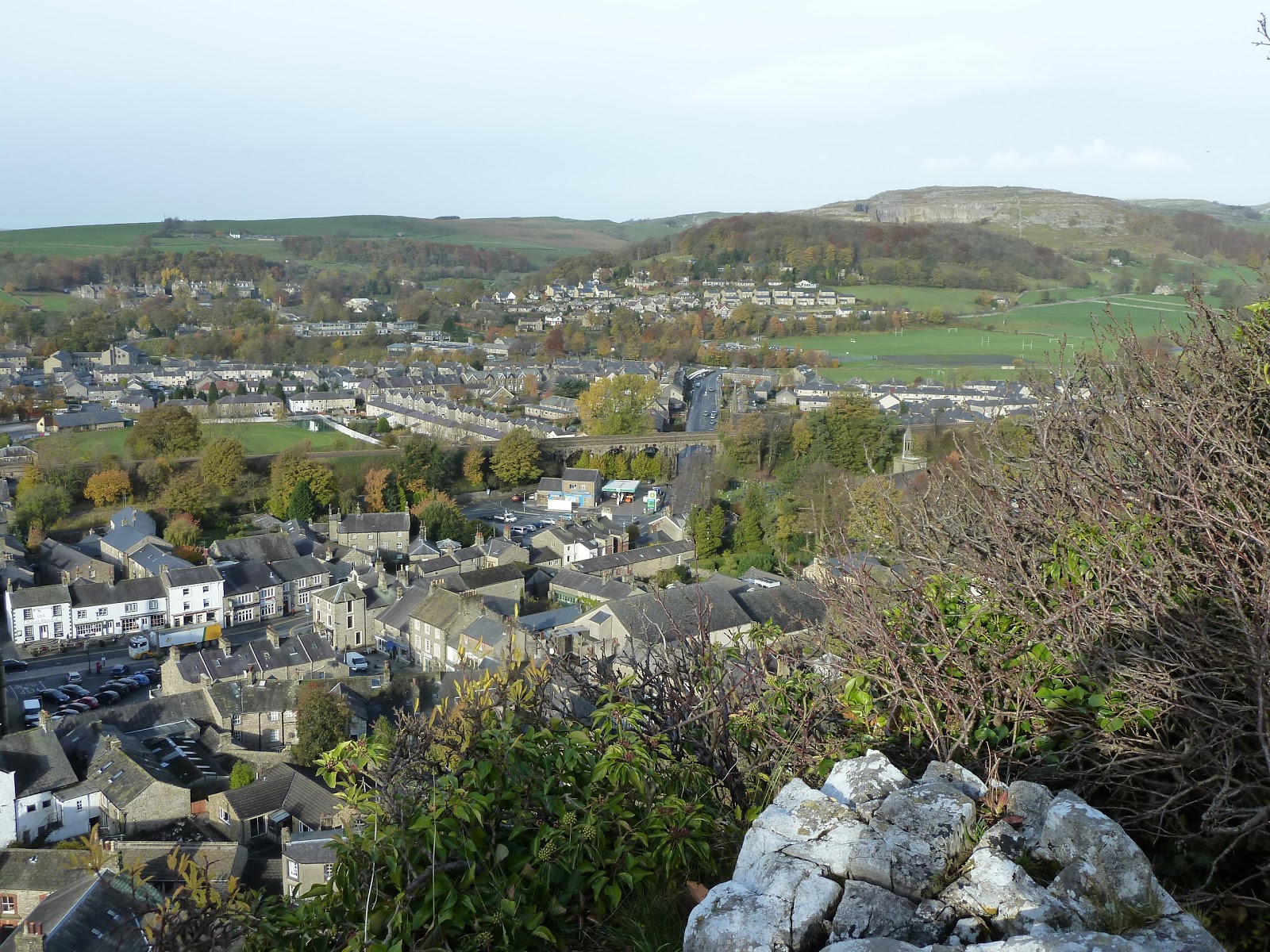
..to Castleberg Rock. From Here you can see St John's in the distance, bang in the centre and a little to the right


But from the top of the rock you get a better view of Settle - I should try and join these three pictures to make a panorama. The church is on the right side of the right picture.


 Here is the right picture enlarged

 You see the road in the centre above, and being crossed by the railway?

To the left of the road is St John's Methodist Church Hall

and to the right is the church (Remember you can click on the pictures to get large versions)


At road level,  the Settle Carlisle arch frames the church.


I enjoyed making the most of the autumn colours.


Sunday, 7 November 2010

Nagoya Poster at Allhallowgate

Here is a Nagoya poster on the display board at Allhallowgate Methodist Church in Ripon on Thursday 4 November. This church had a float on the theme "Noah's Ark" for the St Wilfrid Festival in Ripon in summer and you can see some of the models of animal heads on the window sill.

Monday, 1 November 2010

Molina caerulea - Purple Moor-grass

Newby Moor Looking to Ingleborough
 Late Novemeber 2009


Purple Moor-grass leaves start to die in October.

By November hillsides dominated by Purple Morr-grass appear white in the distance.


I love to plunge my hands into the dead leaves and lift a pile high in the air, scattering the leaves in the wind. The blades are spiralled  like spiral wood savings, like curly ribbon prepared for a parcel.


"This is Britain's only deciduous grass" I say and watch as the leaves flutter away.


In autumn the nutrients go down from the leaves to the swollen shoot bases and shoot dies.


The nutrients are there  for use in future years. And the wide flat leaves which would otherwise loose water through transpiration, at a time when it is too cold for photosynthesis, are gone.


 You can see a swollen shoot base on the right.


Sit on the ground and pat the ground. The  Molina feels like a hedgehog - there are the remains of the shoots from previous years

I examined this "hedgehog".  Look also at the very thick whitish roots. I took the photo on the right two days ago (30 Oct) as I drove over from Settle towards Airton


View from Settle-Airton road
.  The grass in the foreground is mostly Mat-grass but the pinker patches are the Purple Moor-grass.

In the back ground (centre) you can see the far hillside is whitish and has similar vegetation. This is The Weets. To the left of the Weets is the road going up from Gordale to Lee Gate/Newhouses and to the left of that green grassland with limestone outcrops.


Grassland dominated by Purple Moor-grass with few other species is difficult to walk on because of the tussocky nature. In the National Vegetation Classification system this type is given the number M25 - Purple Moor-grass Tormentil grassland. - easy to remember this number as the M25 motorway round London is usually very slow progress too.


Wetter areas of M25 can reveal interesting Bog-mosses - this red one on the right (back at Newby Moor again) is Sphagnum capillifolium.


Purple Moor-grass can grow in basic flushes and then accompany plants such as Quaking Grass, Northern Marsh orchid and Bird's-eye Primrose.

Purple Moor-grass flowers late - July - August and has purple anthers.


In September through to November I look out for Ergot of purple Moor-grass - this is a fungus disease. Where the grain should be instead there is a large purple fruiting body (Sclerotium). these are poisonous and can cause madness and gangrene.


It will be another five months till the green leaves of next year's Purple  Moor-grass appear.  On the right you see a group of students looking at a tuft in late May at Headley Heath - In Surrey it is an uncommon plant. - Even here you can see last November's dead leaves scattered like wood shavings in the foreground.


Saturday, 30 October 2010

Nagoya

In the period 18th-29th October representatives of 192 countries met at Nagoya in Japan to make a treaty about saving  Biodoversity, (about saving our Life Support systems.)

A treaty had been made in 2002 with aims to reduce biodiversity loss by 2010 and all countries had failed in these targets. 2010 had been planned then to be the International year of Biodiversity.

In December 2009 there had been a similar international meeting at Copenhagen to make a treaty about Climate change but no agreement had been reached, which was disappointing. There had been lots of media publicity about this.

There has been disappointingly  little media publicity about the Nagoya Convention.

CEL made posters and invited churches to display them.

Now people are asking what were the results of the conference?

Well there was an agreements and there are results!!
There was a lot of brinkmanship - not agreement had been reached by 28th. The last day on the 29th the meeting was extended into the early hours of the 30th.

The sticking point had been the third aim of the process:- The Nagoya Protocol on genetic resources. This  has taken nearly 20 years to agree and sets rules governing how nations manage and share benefits derived from forests and seas to create new drugs, crops or cosmetics.


Once that was agreed then the other decisions could be agreed too.


 In the Strategic Plan there are 20 targets arranged under 5 goals and 3 0bjectives:


Objectives:-

  1. Conservation of biodiversity itself
  2. Sustainable use of the components of that biodiversity
  3. The fair and equitable sharing of benefits from using genetic resources (So if a plant is discovered that is a good medicine the pahrmacutical company would have to share the profits with the country and the local people where the plant came from.

Some of the targets:
Most interesting:) By 2020 at the latest, people should be aware of biodiversity and the steps they can take to conserve it and use it sustainably - that's a huge educational programme that is going to have to be done - It's about making sure governments are aware and the people that elect them about the value of biodiversity.


I am hapy they have come to some agreements at Nagoya. It is a beginning. We will have to see how the countries implement the decisions they have made.

The most understandable comments were from the BBC radio programme "Saving Species"
http://downloads.bbc.co.uk/podcasts/radio4/nathistory/nathistory_20101102-1644a.mp3 - if you download this fast forward to 4/5 of the way through the programme to 23 minutes

Three objectives:

  1. Conservation of biodiversity itself
  2. Sustainable use of the components of that biodiversity
  3. The fair and equitable sharing of benefits from using genetic resources (So if a plant is discovered that is a good medicine the pharmaceutical company would have to share the profits with the country where the plant came from.
the whole of the rest of the agreements depended on number 3 being agreeed.
5 goals
20 Targets within those goals
The most interesting target 1. By 2020 at the latest - people are aware of biodiversity and how they can use it sustainably.

Target 3: Incentives including subsidies harmful to biodiversity should be illuminated, phased out, or reformed (Amazing - it includes subsidies  on fisheries, subisidies to forestry, to biofuels - politaically it is a hot potatoe )
Number 5. By 2020 the rate of loss of all natural habitats will be significantly reduced.

17% of land habitats and 10% of marine habitats should be protected . (The conservation agencies wanted these figures to be much bigger - we already have 12% of terrestrial and well, only 1% of coastal/marine habitats. e.g. Greenpeace is campaigning for 40% of the world's oceans to be protected). But these figures are a start.

reuters:
Delegates agreed to a 20-point strategic plan to protect fish stocks, fight the loss and degradation of natural habitats and to conserve larger land and marine areas.

They also set a broader 2020 "mission" to take urgent action to halt the loss of biodiversity.

Nations agreed to protect 17 percent of land and inland waters and 10 percent of coastal and marine areas by 2020. Currently, 13 percent of land and 1 percent of oceans are protected for conservation.

The third part of the deal, the Nagoya Protocol on genetic resources, has taken nearly 20 years to agree and sets rules governing how nations manage and share benefits derived from forests and seas to create new drugs, crops or cosmetics.

http://boingboing.net/2010/11/03/the-nagoya-protocol.html
to at least halve and where feasible bring close to zero the rate of loss of natural habitats including forests (by 2020) - 
good list of references


http://www.scq.ubc.ca/dnghub/?p=450 humerous article trying to explain all the terms - worth reading.


http://www.cbd.int/doc/press/2010/pr-2010-10-29-cop-10-en.pdf for use by the media

http://www.cbd.int/cop/cop-10/songs/welcome-to-cop10.mp3


http://www.bbc.co.uk/news/science-environment-11655925

http://www.guardian.co.uk/environment/2010/oct/29/nagoya-biodiversity-summit-deal :-
Some key goals have been set, including a plan to expand nature reserves to 17% of the world's land and 10% of the planet's waters.


http://www.dw-world.de/dw/article/0,,6169314,00.html :-
The eventual success of the summit came down to three pieces of legislation: a strategic plan for reversing the decline of the world's species by 2020; the finance for that plan; and what proved the thorniest problem of all – a deal to prevent the misappropriation of genetic resources.


The ABS protocol, now renamed the Nagoya Protocol, was not the only qualified success of the night. The strategic plan for 2011-2020 set out goals for the preservation and protection of nature, even though many of the goals from the previous plan were not met.
The new plan contains both new targets, like stopping the extinction of known endangered species by 2020, and old, unfulfilled promises, like such as the aim of designating 10 percent of all oceans as protected areas.
Delegates also agreed on a plan to set up an international body to provide governments with better information for making decisions that can impact on the environment.

The body is to be called the Intergovernmental Platform on Biodiversity and Ecosystem Services and will serve a similar function to the Intergovernmental Panel on Climate Change. It only awaits approval by the United Nations General Assembly.

“Greenpeace welcomes the beginning of the end of bio piracy through the adoption of the Aichi-Nagoya Protocol on Access and Benefits Sharing, and a moratorium on strange climate techno-fixes called geo-engineering. Nagoya is not another Copenhagen.”


I put our posters up on the Church Hall Wall  - and also put up posters about Crayfish

I


Saturday, 16 October 2010

Methodist Recorder, Nagoya and Biodiversity Targets

The Methodist Recorder featured an article on the upcoming conference at Nagoya on 7th October. Here is a copy of the article:-


www.christian-ecology.org.uk/nagoya.htm

..The importance of this issue has been highlighted by CEL team member Judith Allinson who, along with a group at Settle Methodist Church and Settle Churches Together, has been raising money for three habitat conservation charities. She said "Christians have sometimes tithed their money and given one tenth to the church. Should we not also consider giving one tenth of our money to conservation charities to protect habitats for future generations?

---------------------

We have given posters to most of the churches in Settle. Here is the prayer:-

A quarter of the world's mammals, and one fifth of the world's plants are under threat of extinction.

Lord we thank you for this beautiful world with its amazing variety of animals and plants.

Be with those meeting at the Nagoya Conference in Japan, 18-29 October as they seek to find ways of preserving your world . . ..

 . . ways of preventing the destruction of habitats and soil, and of saving species from extinction.

Please help us to understand your world more - to appreciate the beauty of nature.

Encourage us to make wildlife conservation areas in our churchyards, gardens, parks and farms and to take part in local nature surveys.

Help us to support wildlife conservation charities with our money and our words.

May we never forget that we are stewards of your creation and that we hold it in trust for future generations.


Thursday, 7 October 2010

Arrhenatherum elatius - False Oat-grass

Arrhenatherum at Langcliffe churchyard 2009 late Sept
I have a love-hate relationship with Arrhenatherum elatius

Sometimes I feel like instead of calling it "Arrh  enatherum,", I could call it "Arrh anathema"
(Anathema means detested person or object).
"Arrh...". anyway.

On the other hand elatius (which means "tall" in Latin) sounds like "elated" . Hey, I feel elated and happy!

Read on to find out about the dilemma with this plant,

Before nearly every course I teach, I search for its big, jolly spikelets, easily recognisable by their one long awn per spikelet. I am so grateful when I find them.
It is easy for students to open the big spikelets and find the different parts of the grass flowers.


It is a very common grass - If you live in the UK I am sure some will grow very near you


This article will help you to learn to recognise it.
It is a tufted plant.
It is growing at the edge of my garden - in full flower. I have just been weeding it on 6th October!. Here is the root.. freshly picked from the garden 30 minutes ago..
Note how knobbly the shoot base is. And at the point where the roots emerge there is a rusty orange colour. 90% of Aarrhenatherums have this rusty orange colour at the shoot base.


 Arrhenatherum elatius spikelet
Labelled Arrhenatherum spikelet


Here is a spikelet open, with the translucent paleas back to back, the white feathery stigmas poking out, and a dark purple anther visible.


I now paste the article I wrote last October in the North Ribblesdale Parish Magazine -comprising three parishes - Langcliffe, Stainforth and Horton in Ribblesdale


October’s grass:  False Oat-grass Arrhenatherum elatius

Did you know that you can still see a big grass in flower in each of our three churchyards in October?

Yes – have a look for a tall grass at the borders of Horton, Stainforth and Langcliffe churchyards and you’ll find a few flowering shoots of False Oat-grass – Arrhenatherum elatius. Its Latin name “elatius” mans tall.

Arrhenatherum at Stainforth 
I have a “love-hate” relationship with this grass -. First the bad bit – it grows well when there is no or little mowing or grazing. So we see it on our road verges and on the railway. It can start to swamp out smaller species. I used to carry out botanical surveys of grasslands in Humberside and sometimes I found small fields – that still had some traditional hay meadow meadows flowers - but which were being taken over by this grass as they were being neglected and not both cut for hay and grazed by cattle.


On the positive side, False Oat-grass has big flowers that are easy to dissect and it can be found in flower from early May to (at a stretch) December – so it’s an excellent plant to show people.


Arrhenatherum at Horton in Ribblesdale
In grasses, if the flower-head is branched it is called a panicle, and the “blobs” on the panicle are called spikelets. In False Oat-grass the spikelets have two flowers and they are big - 1.5cm long. You can recognise false oat grass because it is the only common grass with one long bristle (awn) per spikelet. The papery scales on the outside of a spikelet are called glumes. If you pull these off, then you are left with the two flowers. The individual spikelets only open for a few hours as in the pictures below when conditions are right, and then you can see the beautiful feathery stigmas.


The awns have a kink/sharp bend in them when they are dry and the awns arise in the middle of the back of the lemma. this is a feature of a group of grasses known in English as "Oat grasses" or as subtribe Aveninae


The emerging leaf is rolled. the bases of the leaf blades are slightly uneven.

Tussock in early morning
What vegetation type does abundant Arrhenatherum indicate?

If the verge/railway/field has Arrhenatherum growing nearly everywhere, the vegetation type in the National Vegetation classification is MG1 - Mesotrophic Grassland number 1.- Which is a very common grassland type usually of low conservation value.

The picture on the right was taken in early morning in late August 2010 in a field that has had very low grazing over the past few years. The leaves die an orangy brown

It can be found in well lit areas at the edge of ungrazed woodlands.

If the same grass is found growing on ledges on our limestone cliffs with other rare plants it then counts as a rare community of high conservation importance  MG2.

Go out for a walk and check if you can find a tall grass still flowering on waste ground with big spikelets - and if you suspect it is Arrhenatherum, check the root shoot junction for the rusty orange colour.

Well, go out for a walk anyway.