Wednesday, 15 October 2014

Lichens of Horton-in-Ribblesdale Churchyard with Mothers Union


Here's Horton in Ribblesdale churchyard, on a sunny day..

Here's Horton, Stainforth and Langcliffe Mothers Union
on 13 October, on not quite such a sunny day inside the church.

Here we are looking at the boundary wall in the north.
You can see we are holding the
"Guide to the Top Twenty lichens of Horton churchyard"
 that I had prepared


Lichen number 1 was on the porch wall.
One member even mentioned this one before I started

Can you see it here? The bright orange one.
I decided to call it "Limestone orange lichen"
 in the absence of any other English name "
in

Its Latin name is Caloplaca flavescens.
It is a crustose lichen. The edge of the lichen has narrow, pleated lobes
and this feature is referred to as "placodioid".

You'll recognise it again at the stile at the east.
Same view of stile but from a distance.

This gravestone is location number 4 in the guide.
On the top of the stone is "Shiny Brown Shield Lichen",
  Melanelia fuliginosa. Looks as if someone has tried to
remove it from the top of this gravestone in the fairly recent past.
And lower down covering the majority of the stone
is this green filamentous alga "Klebsormidium crenulaturm"
- an indicator of of Nitrogen compounds polluting the air
(and also heavy rainfall and an acid rock substratum).

Klebsormidium crenulatum - "Nuisance Alga"


Do you know this lichen?
(lichen number 3 on the map on the Horton churchyard guide).
There is lots of it on the slaty cliffs  above at
Wharf in Crummackdale 3 miles away.
And lots in the Lake District and North Wales.


Yes, It's Map Lichen Rhizocarpon geographicum


Seen in the foreground above: and also below:  the Rusty Shielded Lichen Caloplaca crenularia 


Caloplaca crenularia is a new species for me.
It grows inland and at the seaside.
Later that evening I was delighted to receive
by email from the British Lichen Society
a list of lichens that had been recorded
in this churchyard in 1993 by Don Smith.
He found 46. And Caloplaca crenularia was listed amongst them.


You can see me on the right.
We are admiring the lichens on a gravestone made
of a natural piece of local limestone

Nearby, in the corner  is Anthony Greenbank's gravestone.  It had a variety of lichens including the big white patches of Aspicilia calcarea  and, shown below, "The Fire Dot Lichen ": Caloplaca holocarpa


Fire Dot Lichen

A warm cup of tea is welcome inside afterwards.

One I didn't show them,  as it involved walking
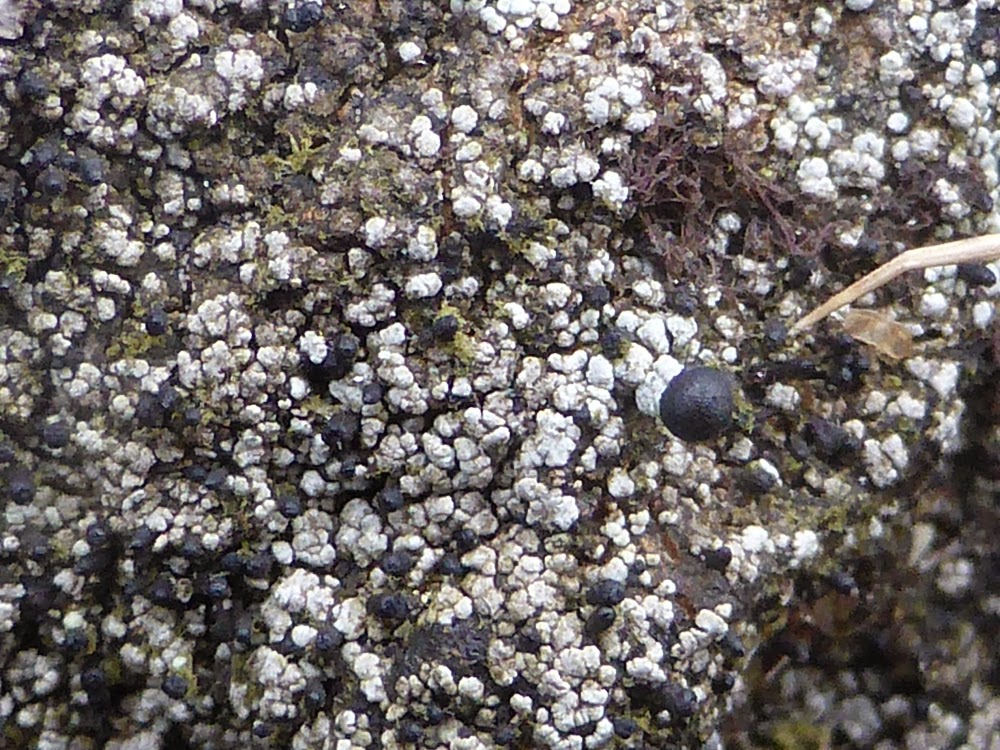
through lumpy grass and then getting down to ground level:  Lecanora campestris  (see below)


Leaflet Part 2: How to write a leaflet that will be irresistible for people to: a) Pick up, b) Read & c) Act on

Back to Part 1  (Intro).

Part 2: How to write a leaflet that people will ...
Pick up

So.
I had my leaflet on biodiversity. 
Called "Biodiversity"
I emailed it to several interested friends.

One suggested calling it "Conserving Biodiversity". He said: "I think it would be good if the title was active (ie we need to do something) rather than passive ( ie we can read it for information or general interest)

One person wasn't keen on the  animal Word-Search - but I LIKED that - word searches are fun.
Along with a sentence about Harlow Carr, Harrogate, hosting the national Rhubarb collection (possibly  not the most vital sentence in World Conservation affairs, I decided  I would leave them in for the moment.  They could be removed in future if I was desperate for space.

But would people REALLY go for a title Biodiversity?

I made four versions of the leaflet and took them to coffee morning.

entitled:

Biodiversity

Conserving
Biodiversty

Saving 
Nature

Saving 
Wildlife 
and biodiversity


I asked seven different people.

It was a really good exercise - I discovered - a chance to discuss the topic in a non-teaching, non-propogandist way. I recommend the exercise.

Only seven people, but I got a 100% rejection of Biodiversity.


Well that was pretty definite.

Two people balked at Conserving. "Sounds like the Conservative Party"
"Sounds like conserving jam"

I had to wait a few minutes before I could interrupt two more people to show them the  leaflets. They were busy discussing their holidays.. one to Africa - to a game reserve where they discussed the stupidity of other tourists there - and were concerned about the effects of tourism on wildlife. 
(Carbon footprint? I wondered - but at least they would have sympathy for the topic of the leaflet)

"Could do with a more lively active picture on the front" said one, referring to the peaceful heron, "maybe an otter".. and then very helpfully:

"But what are you trying to achieve?"


Ah, what am I trying to achieve, beyond a respectable leaflet?, and something that will make them want to pick up the leaflet and read it.

I thought of my advice to a speaker at last weeks' Speakers Club "It is very important close to the beginning of a speech to give the audience a "What's in it for me" - tell them why it is worth their listening to you.

Had I done this for my leaflet?

No.

I would do that. 

And as advised to so often at Speakers Club I would write 3 points (not 2 or 4 ).

And write them big and     LEAVE WHITE SPACE

Here is a picture of an early version  and the latest version of the leaflet so far.. 


 I would take them with me to the Mothers Union Meeting at Horton in Ribblesdale the next day
where I would be the guest speaker leading a workshop on Lichens of Horton churchyard.
What would their comments be?

Come back for Part 3 next week.

Back to Part 1  (Intro).

Forward to Part 3 (Leaflet irresistible to read)

See Green Christian/Christian Ecology Link Website where a "current" version of the leaflet is housed


Tuesday, 14 October 2014

Leaflet Part 1: How to write a leaflet that will be irresistible for people to: a) Pick up, b) Read & c) Act on

This is part 1.

Would you like to write a leaflet that people will

  1.   Pick up,
  2.   Read, &
  3.   Act on      ?
I would.. 

and these three articles show my effort to do so.
I hope you enjoy learning from them


I may edit it in future remove some of the glooooooimier parts.. Have to be positive you know. But for the moment here it is at it is.

Are you sitting comfortably? then I will begin

Eons ago, in the mists of time, before most people had personal computers, never mid laptops, tablets or smartphones, a Leaflet on Biodiversity was written for CEL (Christian Ecology Link).

 It was an extra leaflet to be added to those in the the Sustainability Pack  (1994) - a whole set of different coloured A5 leaflets for use in churches on a variety of sustainability topics: orange for Recycling, green for Ethical investment, pink for Sustainable economics, and so on. In those distant days many people had not made the link between their faith and care for the natural world - natural capital that is being lost and will not be available to our grandchildren. (Plus ça change..)

The set of leaflets was welcomed in many churches... well, by some churches .. well, by the green activists in a few.

The biodiversity leaflet was updated slightly and you can see one archive version   on CEL's old website.

Fast forward 20 years to to 2014.. by which time another 30% (ish) of the world's biodiversity has gone.

(Forest burnt down, species rich haymeadows reseeded, streams polluted, rivers deoxygenated,  invasive species eating or outcompeting native species, wild animals poached, wetlands drained, genetic variation in potential food crops lost, world population increased 40% by 2 billion,)
.
This is a chance to promote the CEL Rainforest Fund. Could you help?
We are seeking 100 churches to raise £100 each  for "Habitat Conservation Projects" .. to show that Christians do care about keeping the variety of life or future generations on this planet.(rather than us all living in concrete and eating soya beans and green algal soup.. my pessimistic view of the  future). .. And to show our gratefulness to God (..however we perceive God..) for having created it.

Well, two weeks ago, not quite a church, but with several churches represented within it, Settle Spinning Club has just raised another £35.. in the same week that the Living Planet Report 2014 declared that
"in the last 40 years, the population sizes of vertebrate species have dropped by half"

"Perhaps," I thought "Perhaps I could write a press release about the £35 that had been raised and link it to the WWF report. (teeny weeny small, I know, I know, I know, but not bad for the little Spinners Group.. What has any other church (that I have heard of) -(that you know of?) done recently?).

"But," I thought, "but, it would be good to have an up to date Biodiversity Leaflet that I could quote - one with with the correct facts about our organisation, its membership subscription fees and, from the 1st Jan next year its new working name "Green Christian".

So   AIM Number 1    was born: :
To produce a new Biodiverstiy Leaflet based on the old one.

It would look respectable and have up to date facts in it (especially our new subscription rate)

It would have its tittle very,very, very high in the front page so that if stacked its name would show above the leaflet in front (See an old display of leaflets:)


There would be a triptych version (A4 folded in 3), because often when I go searching for a place to put leaflets there are only narrow slots available. (An A4 sheet of facts would not be suitable, or legible from a distance.)


So I went ahead and did this.

I had achieved point 0 of this title .. to write a leaflet.
It looked respectable and would  show that the church had a leaflet on biodiversity (whether or not you knew what biodiversity meant)

But how could I make it so that people would actually ......

      ***      PICK -  IT  - UP ????   ***

Read on to Part 2 to find out about audience research to find this out:

Part 2 


.

Thursday, 9 October 2014

Settle Community Christmas Meal 2014: in St John's Church Hall - all welcome.

I've just been to put the poster up in the Settle Co-op so that people can know it will take place again, and can have it as an option.

Helpers  welcome.
Please book to come on the meal - but we can if necessary accept bookings very late. Please tell friends and acquaintances you know who might appreciate coming.

Friday, 3 October 2014

Settle Spinners raise £35 to add to the £200 they have already given


A big thank you to the Spinning Club that meets at St John's Church Hall on Tuesday afternoon at 1.30pm . They have a jam jar and each week collect loose change for the Rainforest Fund. I went to empty the jam jar for this summer at the end of September and we found they had collected £35...

That represents 1/3 of an acre. i.e. just more than the area of the church hall and car park and garden

THANK YOU.

Added to the money they have given in the past, it comes to £235

THANK YOU. Every bit counts.

And this was given in the same week that the WWF Living Planet Report 2014 came out - stating that wild animal populations had decreased by over 50% in the last 40 years.

Fifty percent! I recommend looking at the report.


The group welcome now members.

More about the rainforest fund at
http://www.greenchristian.org.uk/100churches
and

Sunday, 14 September 2014

Lichens at Wrynose Pass


Here are some lichens I found on rocks at the summit of Wrynose Pass on 5 Sept 2014
N.B. I am only a beginner and am still waiting for some of these lichens to be checked. Comments welcome.
For scale, my finger nail is just over 1cm wide.. c.11mm


Baeomyces rufus - the scale has 1 mm units


Baeomyces rufus -
Porpidia cinereoatra
Porpidia macrocarpa


Porpidai macrocarpa or Toninia????

Porpidia tuberosa

The next one is tiny - 

Pilophorus strumatica - means Carrying a ball or ball bearing.
The black globe-shaped reproductive body is on a tiny stalk

Pilophorus strumatica seen closer

Pilophorus strumatica  You can see how tiny they are, when you comapre the size of the black balls on the stalks (well not yet grown fully into balls)  with the size of the moss.


Lecanora soralifera


On top of this boulder (bird perch position) is this yellow lichen:

Candelariella coralliza
(From Dobson 2005) This is similar to C vitellina but has a thick aereolate thallus with deep cracking and more rounded even-sized and compacted granules.. Habitat: uncommon on acid rocks that form well-lit, often isolated bird perching sites) 

Also on this rock was Parmeilia saxatilis

And Lasallia pustulata - Rock tripe

Lasallia pustulata - Rock tripe


Some of the rock had the filamentous alga Klebsormidium crenulatum

Tremolechia atrata

Tremolechia atrata

Stereocaulon vesuvianum var nodulosum

Pertusaria corallina
Pseudevernia fufuracea

Tephromela atra


The lichens below still require some thought.

Miriquidica leucophaea

Miriquidica leucophaea


Thanks to members of the British Lichen Society who introduced me to  me many of these species in the south Lake district in the previous few days.

Monday, 28 July 2014

Wildflowers of Settle and Area - Talk by Judith Allinson at Settle - 14 August 7.30pm

Craven Conservation Group

Thur 14 Aug: 7.30pm

St John's Methodist Church Hall, Church Street, Settle, BD24 9JH

Wild Flowers
of Settle & area
Illustrated presentation by Dr Judith Allinson.

Through beautiful slides of flowers that are blooming both now and earlier in the year, be led through special places such as Long Preston Deeps, Cleatop Park Wood and Winskill Stones Reserve - Find out what unusual plants grow in our area. – and the names of some of the common ones we see flowering on our roadsides now.

Adults £5-00, Children £1-00 - 
(fundraising event for Rainforest Fund)