Sunday, 10 May 2020

Settle Wildflowers - Day 20 - Blue 5 - Speedwells

Twitter #WildflowerHour set the challenge to look for Speedwells this week. I have already found five and a search brought the total to eight - (one in bud)

I have already recorded and shown
1. Slender speedwell
2. Ivy-leaved speedwell
3. Wall speedwell
4. Thyme-leaved speedwell
5. Field speedwell - Admittedly I wasn't sure which - I planned to check the fruit on Sunday - but most likely V. persica Common Field Speedwell. ) 
I did check on Sunday and found they had weeded my photographed plant out! Completely
But see below I found a splendid specimen nearer home.

The only speedwell of conservation interest around here at this time of year is Wood Speedwell, Veronica montana as it is a possible indicator of old woodland - 
So I was delighted on Wednesday when I found it growing in quantity along Watery Lane at Settle.
1


1. Wood Speedwell
Wood Speedwell. This has the flowers arranged in groups like Germander (AKA Bird's-eye) Speedwell, but there are hairs all round the plant stem, not just in two rows as in Germander Speedwell. The flowers are a paler colour blue than Germander Speedwell


Wood Speedwell


2. Brooklime - Veronica becca bunga

I found a little Veronica becca bunga too in a ditch at the side of the lane but it was not flowering.  The track was very dry.


3. Common Field Speedwell - Veronica persica

On Saturday morning (9 May) the sun tempted me out to walk up the road from my house and in 1/4 mile away beside a row of houses I found ALL the above  first five species. with  V persica with its fruit well developed.


Common Field Speedwell


Fruit of Veronica persica, Common Field Speedwell- the two lobes are at an angle slightly larger than 90 degrees to each other


-----------------------------------

4.  Germander Speedwell , aka Bird's-eye Speedwell

"Germander speedwell should be around somewhere"


Young Germander Speedwell plants growing in the very dry pasture beside Langcliffe Quarry
Germander Speedwell sent in by member of Craven Conservation Group
   
Click here for  more flowers coming out around Settle

Settle Wildflowers - Day 20 - Blue 4 - Speedwells

Twitter #WildflowerHour set the challenge to look for Speedwells this week. I have already found five and a search brought the total to eight - (one in bud)

I have already recorded and shown
1. Slender speedwell
2. Ivy-leaved speedwell
3. Wall speedwell
4. Thyme-leaved speedwell
5. Field speedwell - Admittedly I wasn't sure which - I planned to check the fruit on Sunday - but most likely V. persica Common Field Speedwell. ) 
I did check on Sunday and found they had weeded my photographed plant out! Completely
But see below I found a splendid specimen nearer home.

The only speedwell of conservation interest around here at this time of year is Wood Speedwell, Veronica montana as it is a possible indicator of old woodland - 
So I was delighted on Wednesday when I found it growing in quantity along Watery Lane at Settle.
1


1. Wood Speedwell
Wood Speedwell. This has the flowers arranged in groups like Germander (AKA Bird's-eye) Speedwell, but there are hairs all round the plant stem, not just in two rows as in Germander Speedwell. The flowers are a paler colour blue than Germander Speedwell


Wood Speedwell


2. Brooklime - Veronica becca bunga

I found a little Veronica becca bunga too in a ditch at the side of the lane but it was not flowering.  The track was very dry.


3. Common Field Speedwell - Veronica persica

On Saturday morning (9 May) the sun tempted me out to walk up the road from my house and in 1/4 mile away beside a row of houses I found ALL the above  first five species. with  V persica with its fruit well developed.


Common Field Speedwell


Fruit of Veronica persica, Common Field Speedwell- the two lobes are at an angle slightly larger than 90 degrees to each other


-----------------------------------

4.  Germander Speedwell , aka Bird's-eye Speedwell

"Germander speedwell should be around somewhere"


Young Germander Speedwell plants growing in the very dry pasture beside Langcliffe Quarry
Germander Speedwell sent in by member of Craven Conservation Group


Saturday, 9 May 2020

Settle Wildflowers - Day 19 - Green - 4 - grasses

Annual Meadow Grass delights to flower all year.  
It  has has been around since 1 January 


Our speciality Blue Moorgrass appears on the limestone at Settle in March. (See Day 11 Blue flowers 3  )


The first two "ordinary" haymeadow grasses to appear in most of the UK are:
 Sweet Vernal Grass (Anthoxanthum odoratum) 


l

and then  


Meadow Foxtail (Alopecurus prantensis) 


Meadow Foxtail. There are hundreds of spikelets in this inflorescence, and each spikelet has one inflorescence. Each floret has an awn (hair) so the whole head looks soft and furry like a tail.


Meadow Foxtail. When it is time to shed pollen, the anther stalks (filaments) elongate and the anthers hang out and release the pollen.


A little more on Anthoxanthum  odoratum

If you look at the blade sheath junction closely with a handlens


You will see that at the base of the blade there are some hairs whihc stick out - "whiskers".


This feature, especially if accompanied by a smell of coumarin (coconut / TCP / creosote) from the roots means it is easy to identify Sweet vernal grass even when it is not flowering.


By mid-May a host of other grasses will start to appear. Read about these in detail in my Grasses section of this blog, written in previous years..


Click here for  more flowers coming out around Settle

Tuesday, 5 May 2020

Settle Wildflowers - Day 18 - Green - 3 (- yellow) trees

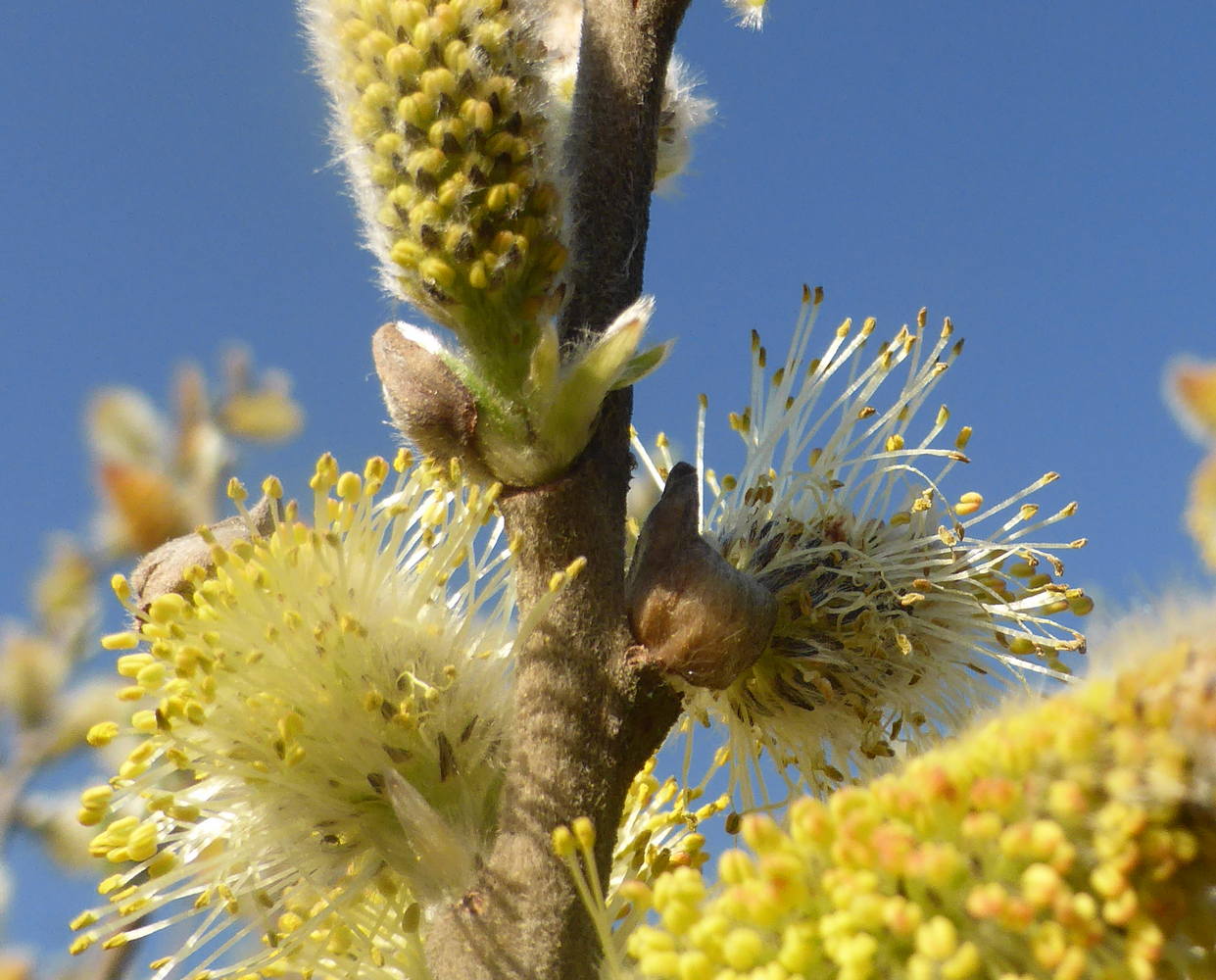
Oak, Field Maple, Purple Willow and Goat Willow.
6 Weeks ago - 8 April - Goat Willow
4 Weeks ago -  16-24 April Purple Willow
2 weeks ago - 24 April Field Maple
0.0 weeks ago - Oak


1 Oak. 
These are the male flowers . You can see the anthers.


No 2: Field Maple
Field Maple - Giggleswick's public children's playground field  24 April.

Field Maple is at the northern edge of its natural distribution around here, but many have been planted as a recommended "natural tree to plant".


Field Maple - Giggleswick's public children's playground field  24 April.


 No 3: Purple Willow: 
This grows in gravel/shingle beside the Ribble
Salix purpurea 


I can think of ten or eleven different species of willow  which grow withing exercise distance of Settle!!! Many of these hybridise. They are not easy.

It is easy to recognise a willow- They have simple leaves (i.e. not divided). The buds just have one budscale covering the whole bud.  Other trees have several bud scales covering the buds.

The two  willow here do have distinguishing features: 

In willows the leaves are arranged alternate to each other, and so therefore are the buds. But in The Purple willow, the buds and leaves often look opposite.

The flowers of Purple Willow can look purple - but I failed to catch them looking purple. So I have put them under yellow green

Plan No 4:  Goat Willow: Salix caprea 8 April


These are pictures of male trees near Stainforth. When young, before the anthers stick out they are used as "Pussy willow" in flower arrangements.


Goat willow has much broader leaves than other species. They are felty under the leaves. They can grow in ordinary dry soil whereas most other willows grow in wetter places.


Sunday, 3 May 2020

Settle Wildflowers - Day 17 - Yellow - 3

Three common flowers seen through most of the UK
Cowslips, Dandelions and Crosswort.

Flower No 1: Cowslip


Cowslips have been coming out for a couple of weeks. This year in open grassland they are small and suffering  because the ground is so dry. In a  month they will all be in seed.


-----------------------
Flower No 2: Dandelion

The dandelions by the roadside (which close up at night) are just unfurling (this one 9.15am Wed 6 May)  as the sun comes over the hill and reaches them this morning. A fly comes looking for food and warmth: 


Dandelion


Dandelions - there are actually many species or at least subspecies of dandelions. They look glorious this week. By next week they will be a mass of white dandelion heads. Odd ones will continue all year.


Guest photo: Dandelions in the Churnett Valley Cheadle, Staffs.  Sent in by Heather Bates


-----------------------------------------
 Flower No 3: Crosswort


Crosswort at Langcliffe Hoffmann Kiln


Crosswort is only just coming out.. and it will be there all summer in verges and hedgerows. It is rare/absent from West Wales, SW England/West and North Scotland and all Ireland. 


Crosswort at Langcliffe Hoffmann Kiln


Crosswort at Langcliffe Hoffmann Kiln

Next week's yellow flowers in the rainbow cycle will be three species that are are special and only grow in relatively few parts of Britain. They are just coming out now... So come back and see them.. 

Click here for  more flowers coming out around Settle

Saturday, 2 May 2020

Settle Wildflowers - Day 16 - Orange 1


Welsh Poppy - Mecanopsis cambrica
One orange wildflower, two brownish ones and a bright  orange rust fungus:

Welsh Poppy - Mecanopsis cambrica


Gooseberry - Ribes uva-crispa  This has increased  in abundance in the wild since the 1960s.  This one is growing on Craven Bank Lane, leading out of Giggleswick


Ribwort plantain  Plantago lanceolata
  
Look at the beautiful stigmas and anthers.
G.W. writes: Cycling around the delightful hamlets near me of Ireby and Cowan Bridge, even the commonest wayside plants delight. The plantain's long stems with little circlet of stamens like a halo around the head has long been a favourite. Many many years ago, living in a London suburb . I walked past an elderly gardener and got into conversation briefly. I commented on the plantains and I will always remember his fond answer..."like little ballerinas they are."

Tom Lord at Lower Winskill who has manged manages some of his hay meadows to increase wildflowers and butterflies observed that when Yellow-rattle appeared and reduced the growth rate of some of the grasses then Ribwort Plantain appeared. 

It grows beside footpaths - maybe it does well because it has a taproot.
The very young leaves are edible (Older ones get very fibrous). there are some uses here
In pollen analysis its appearance has been used to indicate the appearance of agriculture.

Here is a picture by Yanny Peters I found on the internet that I like:


Ribwort Plantain provides food for many moths and butterflies. 


------------------------------

I discovered this gall cause by Rust  growing on Dog's Mercury. It also grows on poplars


Melampsora rostrupii


Melampsora rostrupii

Click here for  more flowers coming out around Settle