Thursday, 29 April 2010

Learn to Speak like Clegg Cameron and Brown - ASC national conference

27-29 April 2018 is the 2018 national Association of Speakers Clubs Conference. in York.
it is eight years since it was last held in York.. and here are pictures from 2010


Left: The Park Inn Hotel;
Right rowing boats on the Ouse.

The national Speakers Club (ASC) Weekend Conference and Competitions

York 2010

impressions of a “Newbie”


Have you been watching the media analyse the speaking abilities of Clegg, Cameron and Brown?

Could you make a speech yourself?

Do you know in the UK there is an organisation with over 100 clubs where people meet fortnightly to learn how to make a better job of giving speeches? – whether as beginners, learning how to get over their nerves and just say a few sentences – or as ace speakers.. entering competitions .. such as the ones I attended this weekend.

It is the first time I have been to an ASC (Association of Speakers Clubs) Finals and Weekend Conference - Would you like to hear about my trip there, to York? - You may if -

1. If you are a person who attended the conference - so you can enjoy reminiscing

2. If you are a Speakers-club person who missed the conference – so you can see what you missed

3. Most important – if you are a person who doesn't know anything about speakers clubs but who might become more interested and take the plunge in a local club – I recommend it!

Five years ago I joined Craven Speakers Club in Skipton, Yorkshire, and became “hooked”. (Craven is the name of our area – our group of 15 people are not at all craven – indeed, after a attending a few meetings, however shy initially, our members all become very brave. Well braver.)

What happens at a Speakers Club? Members of speakers clubs practise giving mini-prepared speeches and three minute unprepared “on the spot” speeches, like the radio programme “just a minute”. Then the more experienced members evaluate the speeches. They give really helpful tips showing how presentation can be improved, such as:

“More pauses - ”

“Look at the audience -”,

“Gestures- Don't clutch the lectern – don't wave your arms around all the time – but do use gestures to illustrate points.”

“Use more word pictures- similes, more adventurous vocabulary” etc”.


We learn from seeing other speeches analysed and by preparing speeches ourselves with the aid of a helpful manual. Skipton is a small friendly club and each fortnight there is opportunity for nearly everyone to perform or carry out some job if they wish, from operating the lights to manning the raffle, from delivering a speech to evaluating a session.


There are Speakers Clubs throughout the country linked within The Association of Speakers Clubs:- 115 clubs in England, Scotland and Wales..


We all have annual competitions in our club and the winners then go onto competitions at Area level and District level and then the finalists from the eight Districts compete at the National Conference. This year the conference was being hosted by our District – the Eastern District - which has nine clubs and stretches from us in Skipton, via Bradford and Leeds and York all the way up to Newcastle.


Now I just love going to our local meetings, but have not had much interest in the area and district meetings –due to time constraints and distance. However when the National Conference was to be held in our district, and when I could see how much it meant to the more experienced members of our club, who had been looking forward to it over a year in advance, I changed my work arrangements specially so that I would be free to go this weekend, the 23rd April 2010.


So, after a hard morning sorting my calendar and other last minute jobs,: .. Friday afternoon found me driving the two hours from Settle to York, wondering if I would find somewhere to park close to the hotel without having to pay more than £10, and hoping I could be helpful to my club and region by carrying out my allotted job of helping steward the tombola.


The traffic built up.. and up..and the roads became more and more urbanised as I progressed east, away from quiet Settle and Skipton. More and more stressful - Would I get caught by speed-cameras as a struggled to remember whether I was in a 20, 30, 40, or 50 miles an hour zone? I kept braking every time I drove over those wretched white lines with a yellow box nearby. I had chosen to go via Ilkley, Otley and Tadcaster. (Should I have gone by train? – but no – then I would have been stuck with no transport at night.)


Two years previously I had travelled with ASC friends to the same Park Inn Hotel. It is on the bank of the River Ouse in the centre of York. It was to an ASC meeting to hear Archbishop John Sentamu who was then the “ASC Speaker of the Year”. I approached York along the A64. Would I would miss the turnoff as had one of our members who had overshot and almost reached Scarborough? (I have to include this - it is part of the folklore of our club). I turned off, one turning too early, but no matter, it brought me safely to the same NCP Carpark just before the station that we had used on that occasion – and arriving at 4.05 pm meant that I would only have to pay £2-40 the night rate. The car parking man was helpful and friendly


The tombola stand
Relief!

I was here.

I slipped into the hotel, registered, and found the Tombola Stand.

Yes, I was needed on the stand, and would just have time to go and find a bite to eat in York before starting at 6pm. It was nice to have a roll and be needed. Sorry, I mean a role. I actually bought a packet of chips and tomato ketchup. And I found a superb shop called “Hawkins Bazaar – because life is too serious” Selling tricks, optical illusions and fun games -more of that on Saturday. Back to the conference for my stint on the tombola stand.


“Five tickets for £1-00. Roll up, roll up. Lots of valuable prizes. Tickets ending in five or nought.” Eileen showed me a box of spare prizes for situations when we could not find the relevantly labelled prize. Our stall was at the top of the entrance stairs we saw people as they stepped up, and we welcomed them.


At 8pm the topics competition started. Over 200 people packed into the large hall to watch ..

The eight contestants were introduced and then all except the first person, taken out.

The topic that each person had to speak on was ...


The Eight Topics Speech Contestants
“ Happy returns”.

It was fascinating to discover the different interpretations each speaker gave for this topic especially as each had not heard the previous speakers.

How many different themes can you think of based on “ Happy Returns” – apart from the obvious “Many happy returns” for a birthday?

…. (Long pause while I let you think)

As each person stepped up on to the end of the very wide stage they were told the title. I scrutinized each speaker as they were being told. Their composed, smiling expressions did not change. If it was me I would be grimacing or rolling my eyes, or closing them as I desperately tried to think of something vaguely relevant to this topic. If they were following the standard recommended advice, they would be thinking up an aim for their speech, a punch line finish and a punch line start, all as they stepped up onto the stage, and walked to wards the chairman who showed them a card with the words HAPPY RETURNS.

“Mr Chairman, Ladies and Gentlemen...” The first speaker started and the time keepers set the two clocks going to time the speech – It should be exactly 3 minutes long. The speakers could see the lights but the audience could not easily see the lights which was a shame – if the speaker over runs or under runs they are penalised. I find, as member of the audience, that watching the lights adds to the excitement. Will the person manage to keep going for thee minutes? Will they get carried away and overrun... and as the time is nearly up, how are they going to finish?

Well, did you think of eight variations on Happy returns?

1. The first lady spoke about bank interest rates. “We are not getting happy returns a the moment,” she sadly said, which brought a supportive laugh.

2. The second, Dilwyn, spoke about Biggles – I am still not quite sure of the link – was it that there had been lots of Biggles annuals so that Biggles was now very old – hence lots of birthdays. Or was it because Dilwyn liked to read Biggles books. Or was it because the aircraft returned safely. (I have since been onto the internet – yes there is one book “Biggles fails to return”. Anyway Dilwyn waxed lyrical about Biggles Books. He had a strong Welsh speaking voice with lots of pauses and drama and we enjoyed hearing him.

3.The third, a lady, started talking about the people unable to return to the UK by air because of volcano dust but then switched to the upcoming Football Competition in South Africa and hoped “our boys” would win and so have a happy return. (She won!)

4. The fourth talked about returning to places you had been before – but that returning to the past too much is not  wise  and it is better to look forward. A car has a big front windscreen, but only a small mirror for looking backwards – It is more important to look forward. (This one came second)

5. The fifth - a lady with dark hair - Can someone remind me of her slant on the subject?

6. The sixth, a man, talked about why a person would be happy to return to the UK from Australia or Canada

7. The seventh talked about leaving things on trains, and about their sentimental value and the relief if the item was returned – that struck a chord for me.

8. The eighth talked about buying birthday cards that were small enough to fit into you jacket pocket, got onto shop lifting and then somehow got onto “Manual Handling Regulations” (MHR).

Eight different interpretations of the one phrase!

Scattered amongst the audience were eight judges with forms to fill in for each contestant – I really admire the judges – a three minutes speech, 30 seconds silence afterwards to write notes, then another two minutes of so whilst the next contestant entered and put on a microphone – how did they sort it all out!!!

They had 15 minutes to confer, then the chief judge came back and gave a report on how the topic speeches could have been improved in general and announced the three winners. All eight were winners in that they had all won their regional competitions.
The contestants were videoed, and if I send off for the CD, I can watch them all over again.


The three topics winners receive their trophies (Order: third, first, second)

I helped sell some more tombola tickets then collected my car and drove to where I was staying, reflecting that I had had a productive evening.


Saturday


I'll keep Saturday short – unlike the AGM


Saturday morning was the AGM. I won't go into the business- someone, somewhere, will write up the minutes. We were introduced to the new committee. It was going to be a 2 ¾ hour session with no breaks. Someone asked for a break but we were told just to take comfort breaks when we individually needed one. After about an hour and a half I decided that I needed one ..and having got the flavour of the AGM, had seen the new committee, and was very grateful for the committee for doing the work for the ASC, I  escaped into the sunlight.


I spent two hours in the sun exploring York. A quiche and a mushroom and beansprout salad in an ancient church used as a restaurant sustained me and then I walked beside the river, watching the oars-ladies in their rowing boats. I visited the Observatory in the Museum Gardens which has a telescope built in 1850. I watched the people sunbathing in the gardens. I reached an open area of grassland beside the river. . Then I returned ...via the Hawkin's Bazaar.

I had fun. I bought a variety of objects (mostly small and plastic and made in China, I am afraid) - objects that school children use to drive their teachers/parents up the wall: Colourful plastic tubing woven springs that shoot across the room when released; Paper rolls on a stick that flick out into a wand and flick back again. I bought a mirascope - an optical illusions toy that I had wanted to buy for a long time. I bought a little box that makes a variety of sounds -including wolf whistles, a door bell, “bing”, a burp “burp” and clapping (clapping) – “This sound will do at the ASC conference,” I thought, “if my hands were getting tired of clapping”.


In the afternoon I watched the speech competition.

I attended the dinner with speeches. The food was tasty – Lamb shank - established to be British lamb after we had politically asked the waiter.

There were some well thought out speeches. The new Chairman's son gave a speech – He had just joined his local speakers club last year, so was full of enthusiasm about speakers clubs.


Yes, pleased though I was to have seen the committee, heard some superb speeches and heard the judges comments, the best part was to have met people from other ordinary clubs from all over the country and to know they are enjoying their regular club meetings as much as I do.


So find out if there is a local Speakers Club near you! Invite your friends to it! Join - and may be you will enjoy it and have many happy returns.


http://www.the-asc.org.uk/

And if you live near Skipton: http://www.craven-speakers.org.uk

Tuesday, 27 April 2010

Political Candidates and Election hustings at Settle

Today - 27 April - Churches Together in Settle oganised an election forum for our three main candidates and it was held in St John's Methodist Church.
Here they are - thirsty - and the questioning has not even started!
Father Tony Boylan (second from left) was in the chair and he chaired it efficiently.
We had had to submit our questions by yesterday, and this morning he and Sally Waterson and another lady (C) sorted the questions. C sat in the front row with a clock and a very large green card saying "30 seconds" and a red card saying "Time", which she held up after each candidate had spoken for about 2 minutes.
Third from the left above, is Helen Flynn, the Liberal Candidate. The man on the right was standing in for the Labour Candidate who could not come, and the man on the left is the Conservative Candidate, Julian Smith.
 The question they allowed me to ask (out of the three I submitted), and which I was able to present as the penultimate question was:

"The main wildlife charities in the UK have drawn up a pledge saying "I pledge that if I am elected, I will do all I can to help to stop and reverse the decline in wildlife", and the list includes 10 ways/pledges .

Nine of the sub pledges are about British Wildlife. The tenth is:
'I pledge to reduce our damaging impacts overseas by working to end the destruction of tropical rainforests and protecting the wildlife of the UK Overseas Territories.'
On the website that describes these pledges I notice that the Liberal candidate has signed the pledge, but that the Labout and conservative candidates have not sidgned the pledge. I wonder if the Labout and conservative candidates will read and sign this pledge of at least sections of it."

Both Conservative and Labour people said what a lot of emails they were getting asking them to sign so very many pledges but yes they would look at it and would most very probably sign once they had read it.
http://www.wildlifepledges2010.org.uk/
In the foyer afterwards I talked to Robert who had had a much stronger question about biodiversity he would have liked to ask.  But he was then able to ask Julian Smith a question which I had also submitted but which I had not been able to put:
"What should we be doing about population?. The world population and our population is increasing, it cannot do this forever..."
Julian Smith threw the question back at us and genuinely wanted an answer.  (The Liberal Lady had mentioned in one of her answers, in challenging capitalism - that we needed to rethink "Growth")
"At least we need to discuss it more" I said. People don't even discuss it.


I have been on the internet and see from this page that we actually have 8 candidates in our Skipton and Ripon constituency http://news.bbc.co.uk/nol/shared/election2010/results/constituency/e03.stm
Bernard Allen British National Party
Roger Bell Independent
Helen Flynn Liberal Democrat
Dylan Gilligan Youth Party [The] - age 17
Claire Hazelgrove Labour - age 21
Robert Leakey Virtue Currency Cognitive Appraisal Party
- age 95
Rodney Mills UK Independence Party
Julian Smith Conservative


The Day the Trees start to go Green

I always remember each the date April 27th as the date that the trees are significantly coming into leaf down at Settle. (the by May 27th -or is it 17th - the leaves are out fully. But his year as we approached 27th April the trees, with the exception of some hawthorns, have remained very ungreen. So spring is really late (as if lots of people have not been saying this anyway)

The daffodils have been splendid in lots of places - Ripon Daffodil Bends, round Pately Bridge, at the two Langcliffe road signs.  It is mainly because they were held back by the cold weather and now that they have come there have been no stong winds to flatten them. but i also wonder if it is a result of lots of plnating in the last few years.

Today I went up to Colt Park Wood, which is quite a bit higher than Settle - the Ash flowers were just coming out. We found Moschatel and Alternate-leaved Golden-saxifrage in flower. The Bird-Cherry buds were just swelling and starting to open.

The rooks in the rookery were contributing to the nitrogen content of the soil.. I can see why nettles do so well in some parts of the wood!

The Hawthorn buds were just starting to open - I tried eating one.

Monday, 19 April 2010

Anthoxanthum odoratum - Sweet vernal-grass

Grass of the Month


I'm going to tell you a poem .. one that not only has secret hidden tips on how to identify this grass of flower rich hay meadows .. but also revels in the joy of finding it.


Sweet Vernal-grass, which starts to flower at the end of April or beginning of May, is one of the first grasses to flower -  apart from Annual Meadow-grass which flowers all year and Blue Moor-grass which in England only grows  in northern limestone areas, such as near Settle

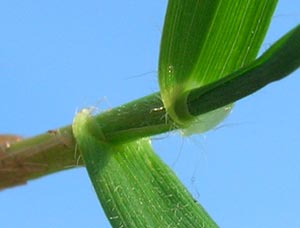
It has small flat leaves and the emerging leaf rolled - like Common Bent-grass, and several other common pasture grasses - but it is distinctive in having hairs at the edge of the base of the leaf blade.


 April: Sweet Vernal-grass (Anthoxanthum odoratum)

I spy you in the meadow
I spy you in the wood
I scent you in the hay stack
You make me smile -It's good.
Small upright head you greet me
With dandruff-like white flecks
I see your flag leaf waving
What will you think of next?


And when you try to hide you
In grazed and grassy glades
That golden green it sparkles,
Under your drooping blades.

I pounce, lens at the ready,
to see if I am right
I look at blade base edges
Yes - whiskers there alright.


With shoot held close to my eye
Your roots are close to nose
That coconuty coumarin
Smell slowly on me grows


I spy you in the meadow
I spy you in the wood
I scent you in the hay stack
You make me smile -It's good.

Explanation: -
1 I spy you in the meadow
I spy you in the wood
I scent you in the hay stack
You make me smile -It's good.
Sweet vernal-grass is the only common grass to have a smell, and it gives the scent to hay.
It grows in traditional flower rich hay meadows - but will grow in other places too such as woods, road verges and your garden
2 Your upright head it greets me
With dandruff-like white flecks
I see your flag leaf waving
What will you think of next?
It has a long oval/obovate head. There is an appearence of dandruff on the inflorescence head. This is due to the long white stigmas and also the filament stalks of the white anthers get left behind. It has a short flag leaf half way up the plant.
3 And when you try to hide you
In grazed and grassy glades
That golden green it sparkles
Under your spiral blades.
It is a small tufted plant with flat blades and the emerging leaf rolled, so could look like the very common grass Common Bent (Agrostis capillaris) with which it grows. But its blades are a little bit wider and the under surface of the blades are a slightly orangish shining green. The blades spiral very slightly on their own axis, and droop very slightly so it is possible to see both surfaces at once.
4 I pounce, lens at the ready,
to see if I am right
I look at blade base edges
Yes - whiskers there alright.
What it says.
5. With shoot held close to eye
Your roots are close to nose
That coconuty coumarin
Smell slowly on me grows
The smell of coumarin can be described as like coconut but also like creosote. The smell gets stronger as the plant dries.
Sweet Woodruff, a white flower found in ancient woodlands has shoots with this small too and it is/was sometimes picked and dried and stored with linen to keep it smelling nice.


6. I spy you in the meadow
I spy you in the wood
I scent you in the hay stack
You make me smile -It's good.


An individual shoot held up to the light.
See the hairs at the base of the leaf blade.
You can see here that the emerging leaf is rolled - the part on the right is not a stem coming out but a blade rolled up.


Above:- View through Swiss army penknife-lens.
See the hairs at the base of the leaf blade.
The hairs show up well in the shadow.
1mm squares on the graph paper.


Mountain Pansy and Sweet Vernal-grass at Malham Tarn

Tuesday, 30 March 2010

Sesleria caerulea - Blue Moor-grass

Grass of the Month- March

I started the grasses section of this blog in 2010 -  in the International Year of Biodiversity, this blog is featuring a different British Grass each month - Follow these pages and you will be come an expert in grasses too... well, a little more knowledgeable maybe!! See grasses index 
Grass of the month 1: January - Reed Canary Grass - Phalaris arundinacea
Grass of the month 2: February - The Common Reed - Phragmites australis
Grass of the month 3: March - Blue Moor-grass Sesleria caerulea
Grass of the month 4: April - Sweet Vernal Grass - Anthoxanthum odoratum

 March: Blue Moor-grass (Sesleria caerulea)


17 Feb 2023 - carpark Winskill Stones Pavement - the flowerhead is just emerging

Blue Moor-grass in May- growing with my favourite moss - Breutelia chrysocoma


Blue Moor-grass grows on limestone cliffs and scree slopes in NW Yorkshire (especially the Craven Area), Cumbria and Lancashire, in a few places in Scotland and in the limestone areas of Ireland, and in the Alps...

Blue Moor-grass does not grow in the south of England so botanists come all the way up here from London to see this Craven speciality.

Until recently, it had not been found south of Yorkshire , but now a site has been found for it in Derbyshire. It seems to grow in base-rich areas once covered by glaciers.


It is the first grass to come out into flower (apart from annual meadow-grass which flowers all year). 
For six months of the year - October to April the temperature is too cold for plants to grow in Craven. Growth requires a temperature of 6º C.

However, this special grass is starting to put it bluey-purple head out in March. Indeed, if you split open a Blue Moor-grass shoot in November or December you will find the baby flower inside - it is the only grass in the UK to do that. The
limestone places where Sesleria grows can become very dry in summer as water sinks through the cracks in the limestone. The plant puts resources into getting the plant to flower and fruit early before there is a drought.
Any grass in flower in March or early April growing in limestone pavement or on our limestone cliffs in Craven  must be Blue Moor-grass.
How to  recognise Sesleria before it is in flower:-
 Go to limestone cliffs in Craven or Cumbria or Lancashire: e.g. Winskill Stones, Gordale Scar, and look for:-

  • a tufted grass that has leaves about 6mm wide;
  •  that are folded as they emerge and have slightly boat shaped tips. 
  • There are whitish persistent sheaths at the base of the shoot. 
  • The blades curve like a scythe - sometimes upwards, sometimes downwards, and often bluish
  • .They have a little point on the tip of the leaf.

Here you can see I had fun taking pictures of Blue Moor-grass with a scanner.
coming shortly

 
One of the beautiful plants that can grow with Blue Moor-grass is Purple Saxifrage.Two years ago it was in flower by March 5th. This year, with more snow still forecast we will be lucky if it is out by April 5th.
coming shortly


By midsummer the stems have grown tall and the flower has faded to fawn.  


The Common Reed - Phragmites australis

February's Grass of the Month

See January's entry for an Introduction to to "Grass of the Month" . This is February's contribution, even though just put up in March

Grass of the month 1: January - Reed Canary Grass - Phalaris arundinacea
Grass of the month 2: February - The Common Reed - Phragmites australis
Grass of the month 3: March - Blue Moor-grass Sesleria caerulea
  
ReedsThe Common Reed - see right (Phragmites australis)
As most people who have studied grasses will tell you, you can distinguish Reed Canary-grass from the Reed by looking at the ligule - the little membrane that sticks up at the blade sheath junction. In the Canary-grass (left) it IS a membrane. In the Reed (Right) it is a row of hairs.
Phalaris ligule      Phragmites
 ligule
sorry.. writing up this page has got interrupted..
I just bought the latest book "Grasses of the British Isles" by Tom Cope and Alan Gray in 2009- which may be meant to replace the last comprehensive book on British Grasses which was written by Hubbard in 1954 with a third edition in 1984, but I think I will say, complements it, and has extra species in.
The Latin names of some grasses have changed YET again. Hey ho. I teach Grass ID courses - and up till now have been giving a students a sheet with the English names, and three columns for the Latin names. Now I will have to have four columns..
Still Phragmites australis is still called Phragmites australis (though long ago it was called Phragmites communis).
The Reed is a lowland plant of wetland habitats but grows at 470m on Brown Clee Hill (Salop) and at 375m at Malham Tarn Fen. Here are some facts I have just learned from this book: Some populations may be long lived perhaps 1000 years old..
Common reed was one of the first grasses to reach Krakatau. There is a basal tuft of long silky hairs on the light "seed" helping its dispersal by wind. It is said by Ridley (1930) to be the most widely distributed of all flowering plants in the world.

Reeds are used for thatching and reed beds make good nature reserves.
Here reeds have been used to screen the path at the RSPB Nature Reserve on Morcambe Bay. (photo 30th Jan)


29 Jan 2010 Here are Reeds at Malham Tarn fen at 385 m above Sea Level. Their growth was restricted to an old trout breeding pool but inthe last 15 years they have started marching out across the botanically very rich fen..

Saturday, 27 February 2010

Cameroon Wildlife - Ten "must know" features - and Women's World Day of Prayer

Women’s World Day of Prayer

Ten "must know" features about Cameroon Wildlife
Why Cameroon is a Biodiversity Hotspot?
This year The Women’s World Day of Prayer is on Friday 5th March.

This day happens every year and is celebrated in countries throughout the world. Denominations join together for this. This year the Women of Cameroon have written the service. The theme is: Let Everything that has Breath Praise God

Look out for a service held near you wherever you live in the world. In Settle our service will be held at the Settle Christian Fellowship Church on Duke Street at 7.30pm. – 

I have seen this year’s service: The text of the songs and prayers is mostly very happy and upbeat (as are so many West African people themselves) and I thoroughly recommend you go an enjoy it, joining with women (and men) around the world for this service.

One paragraph of the service says: 
    “We praise God for the beauty of our countries. In Cameroon ..we praise God for the mines, for the forest, for the Dja, Limbe and Campo nature reserves, for the rich wildlife, and for the variety of landscapes. "

I would like to tell you more about the wildlife and conservation importance of Cameroon and say a little about these three reserves…
  1. So that when we sing the songs about “Creation’s voice declares it” we can think of some of the wonderful wild plants and animals that live there, as well as the domesticated ones mentioned in the text.
  2. So that you might be moved to support financially some conservation project in Cameroon and I list some that I have found at the end.
  3. So that we can pray for the people working for conservation in Cameroon (see end) – the government officials , the politicians, the wildlife rangers, the poachers, the farmers, the locals, the local rulers, – that they think not just of short term gains but of long term  sustainable and biodiverse future

Here I present some facts I have found by searching the Internet, and from my own visit there in 1987. I visited  Korup, a Nature Reserve in Cameroon  ( – lowland tropical rainforest on very poor soil on the border with Nigeria, and  Mount Oku/Kupe (montane forest).  I stayed with a botanist friend who worked collecting plants and who (as I later found out) discovered a new species  has potential in the quest for a cure for HIV/AIDs. I also visited Mt Cameroon which is an active volcano, and at 4095 m high, the highest mountain in West and Central Africa.


so, blog style, here are
Ten "must know" features about Cameroon Wildlife 

1. Cameroon’s size and position means it has a range of habitats

from Tropical Rainforest in the south, just north of the Equator  to  hot dry savannah grasslands (almost desert) in the north.. From the marine life (such as the bay rich in prawns which led the Portuguese in the 15th century to give Cameroon the name Rio dos Camaröes – River of Prawns) to the highest Mountain in West Africa, Mount Cameroon at 4095m.  Each has its own animal and plant species and different threats.

Cameroon is on the boundary between West Africa and Central Africa. It covers 47,544 square miles -  twice the area of the UK.  The commerce language is English (or pidgin English) in the South West, and French in the rest of Cameroon. Cameroon also has a wide diversity of people – with  240 different tribal groups and over 25 main languages. Some of the oldest tribes include  the Baka Pygmy people of the forests in the south.

2. Some rainforests are 60 million years old

The Rainforests are very special because they are very old – In most of West Africa the forests retreated and were replaced by grassland as climate conditions changed, and then the forests expanded again., but pockets of forest stayed there all the time and could have been growing for 60 million years. (Pretty impressive when you think that just 20,000 years ago we in the North of England lost all our vegetation as out land was covered by ice).

3. Individual mountains have their own species

 In the highland forest some individual mountains have acted as islands with species evolving separately on separate mountains. These species are much newer in Evolutionary terms. These mountains have become taller due to volcanic activity..
You can read about Biodiversity hotspots here: http://bit.ly/avxPnm

The forest in the west of Cameroon is part of the area classified as "Guniean Forest of West Africa Biodiversity Hotspot"  http://bit.ly/ceghWO which stretches from the Sanaga river in Cameroon, eastwards to Sierra Leone and Guinea


4. Plants

Here are some interesting facts about plants in Cameroon

About two percent of the plant species which grow in Cameroon only grow in Cameroon - i.e. they are endemic to Cameroon. There were 8260 species of higher plant in Cameroon (in 2004) of which 334 arre threatened, and 156 endemic. (This compares with 1,623 in UK of which 13 are threatened) There must be many undiscovered plant species still in Cameroon.
There are 600 native tree species of which 50 are critically endangered, 27 endangered and 106 vulnerable

Oil Palm - Oil Palm trees evolved in this part of Africa, and have since been taken and cultivated in other parts of the world. (Palm Oil palm is used for soap, cosmetics, and is in about 10% of the food products we buy in the supermarket or 50% of our packaged food. Vast quantities of forest in Indonesia and other countries are being cut down and replaced with Oil  Palm monocultures for vegetable oil and for biofuel). In Cameroon the Oil Palm is mostly used for local consumption as cooking oil.

Strophanthus is a creeper that can be used as arrow poison -While in Korup I took a good photo See  http://rainforest/save.blogspot.com/2008/09/strophanthus.html

A species of wild coffee found on Mount Oku is said to be of more value than the robusta aned arabica species common in Cameroon http://bit.ly/c6sXyD

When I first went to West Africa - ALL the plants looked different to those I knew in the UK. the only plants I recognised were Maize and Poincettia. Near the top of mount Cameroon I recognised European families such as St John's-wort.

Allanblackia - a good news story on 24 Feb 2010! this wild tree has nuts that can be used instead of Palm Oil. IUCN reports a new project which is successful in Ghana, and which will be spread to neighbouring countries including Cameroon: In Ghana alone, there are about 4,000 Allanblackia collectors. It is expected that by 2012, 20,000 individuals will be supplying Allanblackia oil in five countries generating a potential total rural income of US$ 2 million. This translates into an average small-scale farmer earning an additional US$ 100 per year. On the biodiversity front, each tree provides an ‘anchor’, helping to restore forest landscapes.

5. Mammals

Cameroon has 322 different species of wild mammal. Of these 15 do not live outside Cameroon. 42 of them (i.e. one eighth of them) are under threat of extinction. http://bit.ly/9QFDud

Species most under threat include:
    Black Rhino 
    Three species of shrew.
    Oh, a web page written in 12 July 2006 states: West African Black Rhino Extinct: "The West African black rhino is now feared extinct," the Switzerland-based environmental group IUCN said, and Africa's northern white rhino could soon follow. Extensive surveys in northern Cameroon, the animals' last known refuge, found no trace of the rhino subspecies. Poachers have hunted the animals for decades for their horns to supply markets in Yemen and Asia

Followed by
    Gorilla African Elephant Oku Mountain Shrew

Then
    Chimpanzee - Although not quite under threat of world extinction yet, Chimpanzee numbers have been vastly reduced, the largest remaining populations occur in central Africa, mainly Gabon, Democratic Republic of Congo (DRC), and Cameroon.  Chimpanzees once inhabited 25 African countries. Now, they are extinct in 3 or 4 and nearing extinction in many others. Deforestation and commercial hunting for bushmeat are taking a terrible toll on most populations.
http://www.worldwildlife.org/who/media/press/2009/WWFPrescongobushmeat.html

6. Threats to Cameroon wildlife: 

Deforestation, desertification, overgrazing, poaching, and overfishing are all problems. The population of Cameroon is now estimated to be c.20,000,000 and has doubled since I was there in 1987 when it was 10.000,000 - so pressure on land is increasing.  The median age is 18.6 years, and the average number of children per woman is 4.6

Cameroon has one of the highest deforestation rates in Africa, losing some 220,000 hectares of forest per year (i.e. 2,200 sq km), mostly to logging and agriculture. Between 1990 and 2005 Cameroon
lost 13.4% of its Forest Cover, or around 33,000 sq km


Cameroon has some 1661 known species of amphibians, birds, mammals and reptiles according to the World Conservation Monitoring Centre. Of these 7.2% are endemic.

Another threat to biodiversity is overfishing:   Overfishing in the sea by foreign trawlers with nets with tiny gaps that catch even the small fish  - Hence fishing stocks are plummeting, local fishermen can no longer catch fish, local people miss out on protein in their diet.

-----------------

What is special about the Dja, Limbe and Campo Reserves, that these should be singled out by the Women of Cameroon who wrote the service? Perhaps it is because they are all in the south of the country.

7. The Dja reserve

The Dja lies in the south east, almost completely surrounded by the river Dja which forms a natural boundary. It has a wide range of primates and 107 mammal speicies, five of which are threatened. A paper by Jean Lagarde Betti  states that it is the home of forest elephants, chimpanzees and gorillas. . The major ethnic groups, the Bantus and Baka Pygmies, live side by side inside and outside the reserve. (The Baka have been here since the Neolithic, before other tribes came) The reserve itself has not yet been subject to forest logging, but there are eight forest logging Companies working around the reserve. This is a serious problem as it reduces the wild fruits for local people and large mammals. Animals are being hunted in the reserve for sale in towns. More than 70% of the plant species logged in the Dja region are scattered mostly by animals.


8. The Limbe Reserve
The Limbe Reserve is beside the sea in the South west (and a fine beach there is there too!)  There is a Botanical Garden here started in 1892  
The Limbe Wildlife Centre, a wildlife rescue and rehabilitation project started in 1993 –animals rescued from Cameroon’s bushmeat trade. This gives an opportunity to see animals. Sadly there are few places in the wild where it is safe to release them. Only 120,000 chimpanzees remain in the wild in central Africa and every day 100s more are shot.

9. The Campo Ma’an Reserve
The Campo ma'an reserve is in the extreme south west, beside the sea and Equatorial Guinea.  It is tropical forest with gorillas, mandrills, chimpanzees and other primates. It is the home of the Bagyeli Pygmy people


10. How you can help:-
A.
Here are some charities and conservation organisations involved in  conservation work in Cameroon.

It is important that the local people are involved with the management of the forests and other nature reserves, and that they benefit from its conservation.. It is important to find solution to the problems of  poaching and commercial shooting of bushmeat, of overgrazing by goats, of logging and clearence of forest  for agriculture or moncultures of Eucalyptus trees, and of accepting bribes and turning a blind eye to some of these problems. It is important to find sustainable uses of the forest

www.panda.org  World Wildlife Fund
Birdlife International and Cameroon Biodiversity Conservation Society
IUCN - the International Union for Conservation of Nature


B
We can pray for the people working for conservation in Cameroon
– the government officials , the politicians, the wildlife rangers, the poachers, the farmers, the local rulers, – that they think not just of short term gains but of long term rewards. We can pray that  – that the species will still be here in another 20 years time, that more trees can be planted to stop soil erosion, that goats can be kept under control,  that wild species of tree can be kept (and their associated wildlife)  rather than replaced with monoculture of fast growing Eucalyptus that do not give homes to wildlife. We can pray that people in Britain will use timber that has the FSC label - Forest Stewardship Council.  The forest is worth far more standing than it is cut down.
We can pray that children can be educated to appreciate their wildlife.

Suggestions and Feedback Welcome

.

Sunday, 31 January 2010

What a Biodiversity Action Support Group would invovle

As I said in my previous posting "Ten Top Tips" on 23 Jan, a friend asked "What changes to our lives do we need to make to avoid to contributing to species extinction?" and "What would this mean for action on a group environmental action programme and assessment of that action?"

Just "not harming species on an individual level" whilst "living in a society whose growth is causing biodiversity loss" does not seem right. (And remember a good definition of Biodiversity is "The variety of genes, species and ecosystems on the planet")

I would like to propose a CEL "Biodiversity Action Self  Help Group", or a "Biodiversity Support Group". I propose that the group has 6 – 12 people, and we run it for a year and a quarter, starting from February – (i.e. a year but with a bit at the beginning to get going and a bit at the end to “Measure” what we have achieved.).     

Each person could commit to 6 hours a fortnight.
That might mean getting up half an hour earlier each day- or have a blitz one long evening a fortnight. (It may be that people are doing several of the things below already:       
The members of the group could have the tick list below and once a
fortnight check that they had done everything: Being part of the group would be an encouragement to get everything done.

1.      1 hour of prayer/ meditation/thought (even if that is included in going out for a walk in nature)    

2.      1 hour of communicating with the group – this could be by phone conference (we could do it by Skype and then it would be free, or we could arrange some tele-conferences, and it could be by a private Ning group or a private Google group)

3.      1 hour preparing for communicating (e.g. making coffee, deciding what we want to say, filling in tick list, showing what we have done this fortnight)

4.      1 hour “doing natural history”(Number 7 in "Ten Top Tips  post")

5.      2 hours campaigning (Number 3 in "Ten Top Tips  post")

By filling in the tick list, after a few weeks this list will be our "Assessment of Action"

People who are members of the group would not have to commit to all of points 1-10 in ten top tips, but  I would hope that they would be committed towards working towards these goals to some extent, and be able to contribute to, and give and gain encouragement from the group.

Once we've "met" we might discuss and decide to alter our commitments slightly.  We might find that we have very varying interests. But by forming a group we would get encouragement.


If anyone is interested do contact me.

.

Saturday, 23 January 2010

Ten Top Tips for Saving Biodiversity in the Next Ten Years

Are you concerned about wildlife loss?-
  1.  Species are becoming extinct at a rate 1000 to 10,000 times the “natural rate” leaflet
  2. At current rate of forest loss in Borneo and Sumatra, orang-utans will be extinct in  the wild within 10 years. (FOE Report from 3 years ago).
  3. 1/4 world mammals and 1/8th of the birds and higher plants are under threat of extinction by 2050..

A friend coordinating writing a Group Environmental Action Programme -"Ecocell"asked me

     “What changes to our lives do we need to make  to avoid  contributing to species extinction?”

     “What would this mean for action on a group environmental action programme, and assessment of that action?”

That got me thinking..
 I write this blog post and at the end give suggestions for a support group:

Good definition: -
Biodiversity -:  the variety of genes, species and ecosystems on the planet


Ten Top tips for reducing our “Biodiversity Bootprint” (Or bulldozerprint?)

Here are ten things we can do in our own personal lives that will reduce the rate of species loss.

1.      Pray about it. (Even if you have entirely secular views, time spent meditating / thinking about some species/wildlife problem will lead somewhere)  (even if only up the garden path ...to feed the birds...)

2.      Join a wildlife organisation – or better, several. Why not subscribe life membership each year to a new organisation – Yes that is £500 a time, but that still works out as £10-00 a week or 4 pints of beer a week. Most of us will have 50 to 90 years to do something useful with our lives – so each year counts. What will you do with this year?     

3.      Set aside two hours a week to campaign on some wildlife issue.  Organisations such as WWF are only too happy to ask you to send emails/write leters on important issues      

4.      Become “more organic vegan”.  The Amazon is being cut down to grow Soya to export to feed out cattle, and thus produce our  milk… If we become “organic vegan” ourselves, it will have a knock on effect on other people.

5.      Buy “Rainforest Certified” and “Fair Trade” products and FSC (Forest Stewardship Council) timber, and make an issue of choosing these products.

6.      If you have savings in stocks and shares type ISAs make sure they are not being invested in industries that are destroying habitats. 

7.      Enjoy nature and take part in some sort of natural history survey work. If a specialist then send in your results to a national survey – If a beginner then attend an event run by a local wildlife group, or record birds in your garden.    
    If we don’t appreciate our own wildlife, (however mundane) how can we expect people who live near rare animals and plants to have a respect for their wildlife?
8.      Lobby your MP and MEP on wildlife issues (See 3 above)

9.      Raise money and have awareness raising events in aid of projects in 3 above. See this guidance for journalists writing about biodiversity

10.     Join a support group to support each other in carrying out items 1-9 above.

I would like to have a biodiversity support group. I propose that the group has 8 – 12 people, and we run it for a year and a quarter, starting from January - We will meet up once a fortnight, having an hour's telephone conference call - If necessary, using skype, and by having a private googlegoup to support each other. We may have different key wildlife concerns, but we can support each other in our enthusiasm for getting things done. More about this in my next blog entry.   Do contact me if you are interested.

Friday, 8 January 2010

Grasses: Monthly tips for becoming an ace at identifying grasses

Grass of the Month

   In this, the International Year of Biodiversity, this blog will feature a different British grass each month - Follow these pages and you will be come an expert in grasses too!

(This material will be partly based on an article I wrote for the North Craven Heritage Trust last year, partly linked to the articles I am writing each month for North Ribblesdale Parish Magazine this year, and also used for the CEL website. But mostly I am writing it because I hope people will then enjoy looking more closely at grasses)

   The major civilizations evolved about 10 thousand (or so) years ago- only in places where species of grass with large seeds had evolved - In South America the Incas had maize. In China people had rice. And in the Fertile Crescent of Mesopotamia and the eastern Mediterranean they had wheat (and barley).

   Remember Joseph and Pharaoh's Dreams?

   The seven cows- cows need grass to eat. (Genesis 41 v 3 - The cows grazed on the reeds.)

   Seven good ears of corn:  Corn - wheat- is a cereal and a type of grass.

    Thus human civilization depended on grasses

   And going back a stage - the herbivores - such as cattle and sheep, which we eat,  need grass, and they only evolved as grasses evolved.


   No grasses - No herbivores .. No humans.


   So hey - Grasses are important!

Reed Canary-grass


January's grass is going to be Reed Canary-grass - Phalaris arundinacea - because it is the only grass near where I live tall enough to stick out above the snow. (Picture below taken on 6 Jan 2010)
Phalaris arundinacea 6 Jan 2010

Phalaris arundinacea 6 Jan 2010 a   It grows beside rivers.   The stems can reach 2m in height.

  Have you ever used a blade of grass for a whistle - by putting the blade between your thumbs and blowing? It works realy well with Phalaris.

  Underground shoots called rhizomes enable it to grow in big patches.

   Sometime variegated forms of this grass are grown in gardens. - wide leaves with longditudinal white stripes

   Could Pharaoh's cows have been eating Reed Canary-grass?

   Well, the Global Invasive species Data base of IUCN base says it is an invasive species in Egypt now and it may or may not be native - and that it is native in Iraq near by. So let's assume they did. It produces nutritious, Phalaris arundinacea 6 Jan 2010 bpalatable, succulent herbage for pasture, silage, and hay.

   So if you see a tall grass beside a river, sticking out of the snow it has a good chance of being Reed Canary-grass.
 
   Easy!


Reeds   Of course, when looking for "the largest grass beside a river or marsh" you just might just come across one of two other much much less common plants, but which fit the description "big" and "grass-like"


1.) The Common Reed (another type of grass) - see right
   As most people who have studied grasses will tell you, you can distinguish Reed Canary-grass from the Reed by looking at the ligule - the little membrane that sticks up at the blade sheath junction. In the Canary-grass (left) it IS a membrane. In the reed (Right) it is a row of hairs.
Phalaris ligule      Phragmites ligule

2.) The Reed-mace (wrongly called Bulrush) (which is not a grass at all.)

   I would have to walk 7 km east or 4 km north respectively to find these plants - which I am not going to do - not in this snow anyway. So maybe I'll talk about these in January 2011 (or if the snow is still covering the smaller grasses I may be forced to in February this year.!)

   Put on your wellies or hiking boots and go for a walk beside a river near you and see if you can see some Reed Canary-grass

.

Friday, 1 January 2010

New Year Night UFOs


On New Year's Eve, just before midnight, I walked along the black road, bordered by snow white fields filled with.. snow.  A thin sprinkling of sparkling new snow covered the parked car, the wall tops and all the old snow. Suddnely fireworks went off in the distance towards Settle. Some birds flew up.

At 00.15am  on Friday 1st 2010  I looked up the valley and in the sky saw a procession of lights  approaching. Three ..four.. eventually about seven. they were too low down to be aeroplanes on their way from America. I could tell they were low because of their relative speed, the size and brightness of the lights. Yet I could hear no sound.


The picture, with the camera placed on the wall and set on self timer shows three of them. They feature as lines rather than oval lights because of the show shutter - but this shows the direction they were each taking.

If they were planes, why no sound? Is it something to do with the very cold air in the valley which somehow reflects the sound back up?

Here are three more scenic pictures taken by the light of the full moon.


  My first pictures in 2010!

I wish you a Happy New Year

.

Thursday, 31 December 2009

Calendars for 2010

I have been selling calendars in aid of the rainforest fund, as well as greetings cards and Christmas Cards. the calendars cost £2-00 - They can also be used as greetings cards.


.

Tuesday, 22 December 2009