Showing posts with label flowers. Show all posts

Thursday, 7 June 2012

Malham Tarn and Moor - 6 June - Flowers - Scargill House Group


Lisa Chadwick asked me to take the holiday group she was leading at Scargill House round Malham Tarn Fen. Knowing what an excellent time this is for flowers I was doubly pleased to agree.


(Wildlife Walks - Mon 4 to Fri 8 June - Hugh and Lisa Chadwick-Firman)

The group bought £18 of greeting cards towards the Rainforest Fund - Thanks.

Come and share the day with us:
First we have coffee in the car park

Lunch on the boardwalk


Lunch as seen from a Polytrichum commune hummock


Lunch, looking toward the peat pools which were dug  for
student pond-dipping exercises -
and to give dragonfly nymphs more place to grow - 

Charles Kinsley
In the background is the field with the stream next to the Field Centre road and beyond that the building used as the Estate School in the time of Walter Morrison (former owner of the Malham Tarn Estate), when there were many  families working on the estate. Charles Kingsley used to come and visit Walter Morrison, and (we say) used to take the children from the school and take them to the stream and tell them stories about the Water Babies.
"Charles Kingsley wrote some hymns" I say - "I must look them up". (No-one knew which one). "He wrote a good poem about the water going to the sea - pure and clean at the source, dank and foul as it went through the cities, then it became purified and free in the sea.... though I wonder if the pollution was just spread out.. or made the sea more polluted..  Must look up the hymn."

I did so in the evening and found an excellent green sermon by him and lot on his history - this is now in a separate post.


Photographing sundew and cranberry
We had a rest and at Malham Tarn House and then continued
Walking towards Ha Mire

Examining flowers beside the stream

Yellow mountain pansies on Malham Lings

Photographing the pansies

Yellow Mountain Pansies with the Field Centre in the Background

Photographing more yellow mountain pansies

Butterwort

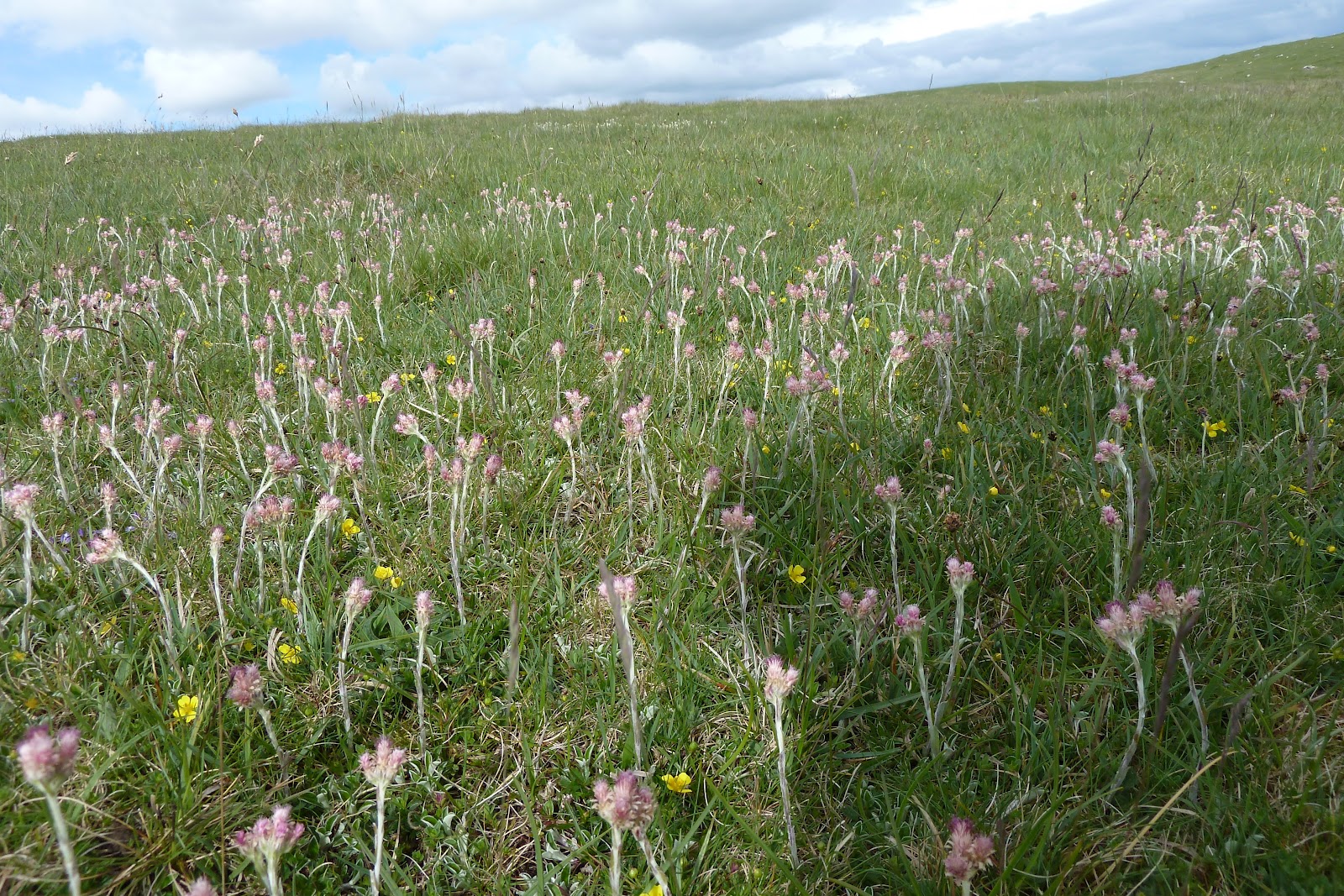
Photographing Mountain everlasting flower or Cat's-paw
After the group left I walked around Malham Moor taking more pictures
A pink version of Mountain Everlasting -
I have walked over these hills many times before
but not seen them flowering in abundance
like this - we had just hit the time right. - 


Algae on a post. Growing richly here due to the bird droppings -
It is the highest fence post by a wall and the highest wall for miles around


Lichen
A good day.
I hope the group enjoyed the rest of their holiday.


Saturday, 13 September 2008

Strophanthus

What do you think this beautiful flower is called?

We found it growing as a creeper/bush in a clearing when Duncan and Ferdinand took us to Korup - tropical rainforest in Cameroon in West Africa (but that's another story)

It is Strophanthus.

It is used by some people in Africa for arrow poison.

Poison? The poison is called Strophanthin, and it acts a bit like Digitoxin or digitalin (the drug that comes from foxgloves) in that it affects the rate of heart beat and is a cardiac stimulant.

Its name comes from the words strophos (twisted cord or belt - referring to the tapering, twisted ends of the petals) and anthos - flower.

And it is indeed beautiful.

Thursday, 11 September 2008

Greenbelt 2008

Fri 22- Mon 25 Aug 2008 (link to longer picture report)

I had never been to Greenbelt.
I have never been to ANY festival - (three folkmusic festivals, but they are different.)

Christian Ecology Link has had a stall at Greenbelt for quite a few years and people had asked me if I was going. Brendan Bowles of A Rocha Climate Stewards who had promised to send me new information on A Rocha Ghana asked if I was going.

I looked at my calendar and thought "I could go"
I looked at the Weather forecast and thought "I could go"
I read a self-help book advocating doing exciting things even if outside your normal comfort zone - so that you don't regret not doing them later. "I could go"

I phoned JB a contact who lives two miles away to see if he had floor space. - He had relatives staying. "You can borrow our tent" he said. "Uhh," I thought.
I looked at the damp wet ground at Settle. "Uhh," I thought.
I looked at the price of a cheap tent in Settle - "Uhh - it will just be "stuff" in my house afterwards." I thought.

Fortunately - thank you J.B. - the relatives would not be coming till later, and he offered a bed.

So off I went.
Settle to Cheltenham by train is about 170 miles (340 miles return) and this would produce 80kg of CO2. Some websites say we should only produce 2000kg CO2 each per year to be fair to everyone else in the world. That's 6kg a day - Hmmm.

But once there mine host lent me his bike.

I had a great time at Greenbelt and have written about it with pictures here

What has this got to do with habitats, species and forests?
Well, I spent a very happy Sunday moring up on Cleeve Hill, away from the Festival, finding wild flowers including the stemless thistle (below) and harebells with the festival in the distance(left). - If everyone valued wild flowers perhaps we could protect them better.

I put a few leaflets out on our CEL stall and hung up one of my instant folders. We collected signatures of people who would like to receive CEL news emails. - I would be able to tell them about the rainforest project later.

I heard little bits of two A Rocha Talks. David Bookless stresses important things about protecting species. People said his talks were good. Some children did a play about Creation. I am not sure if that had anything to do with the environment.

A girl from the USPG stall came to our stall and took the CEL email address - she has contacts in Brazil.

The Wild Life Trusts with a stall. They were doing a good job getting people to join their local Wildlife Trust.

I went to a workshop by Generous and have since been in contact with a girl who ran it. She has a blog

There were lots of items for sale on stalls from third world countries. I bought a mini-music instrument- talking drum and wonder if hardwood was used to make it...

I attended many worthy workshops and talks.

I met Brendan. He had emailed me the list of items that would be useful to fundraise for for the A Rocha Ghana Project - So I would read these when I got home.. see next blog entry.

Sunday, 13 April 2008

A Rocha Ghana - what projects could we support?


19 March

What is A Rocha Ghana doing, that we may be able to, and interested to help with?

Recently (19 March) I had a useful talk over the phone with Jenny Bowles. She visited the A Rocha Ghana Project in 2006, under the auspices of the “Climate Stewards Project” of A Rocha. Her trip included a visit to the project with people near the Mole National Park.

She told me about

1. The tree nurseries
2. The bee keeping projects
3. The two schools workers – one in the north, one in the south.
4. The story/parable of the disappearing wildlife.


1. The tree nurseries (See picture of girls carrying seedlings above)

The tree nurseries are run by local people. In the south they are attached to schools or universities. there are 11 sites. The nurseries are planted with 90% native trees that can eventually be used for timber – e.g. mahogany, kapok. Then there are 10% fruit or nut trees and the people chose which ones they want. It is important that the nurseries are designed and manged by the locals so they “own it”

As soon as the people see the benefit of the ownership of the nursery they get on board, and the attitude extends beyond looking after the nursery, to looking after the forest..
The people at the Mole reserve live in a remote place, and they are keen to be part of a bigger project..

In remote areas people do not have the resources to improve degraded land. “We used to have trees” they say.

2. The bee keeping projects

Bees need trees. So if people get involved in the production or honey they see the need for trees.

3. The two schools workers – one in the north, one in the south.

Jenny told me how exciting and thrilling it was to see the caliber and quality of the two schools workers, Emmanuel Akom in the south and Daryl Bosu in the north.
In a primary school classroom – tin roof, mud walls and no decorations on the walls and eager children packed behind the desks, the worker asks

“What happens when the last tree dies?”

“The last man dies” the children chant back.

Daryl was able to arrange for one school group to go for a day field trip to the National Park.

I wonder if we could sponsor another such trip?

Or I wonder if we could sponsor some plant identification books. I remember when I was in West Africa (long ago) how useful I found a book called "A Handbook of West African" flowers by Harold Saunders. We are spoilt for choice in the UK for wild flowers books and other natural history books.

I have written to A Rocha to see what they most need.

And the story of the disappearing wildlife? - That will have to wait for the next blog entry.