Showing posts with label lichen. Show all posts

Sunday, 25 March 2012

Lichens on location - Booths Supermarket Settle

Ochrolechia parella 


Is it because I have been on Allan's course, or is it because I have some new glasses which once again let me focus on objects a hand's distance away rather than an arms length distance - that I am noticing lichens again?

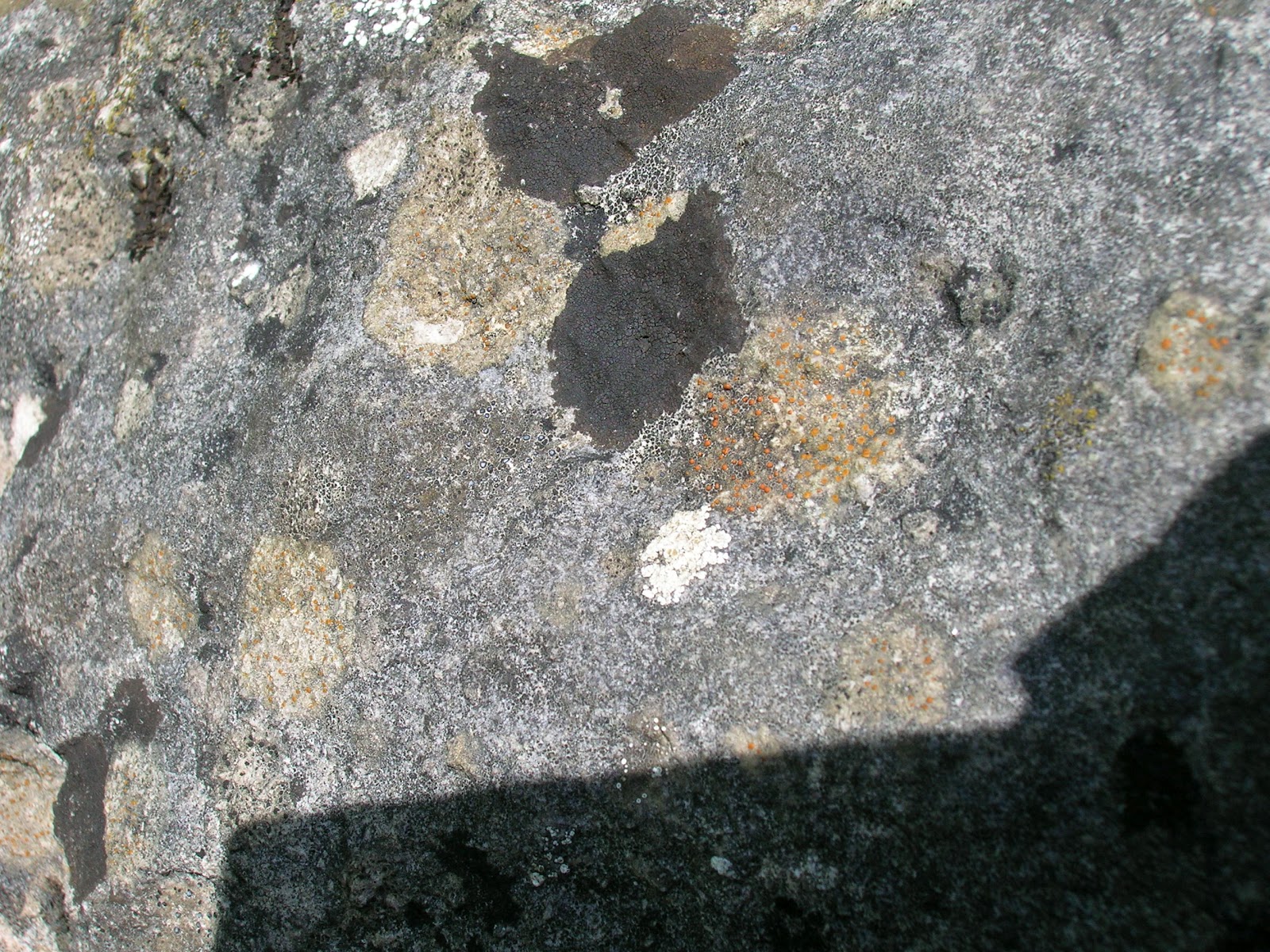
Here we are at the Millennium Gardens at Booths (see the sign) looking at the millstone grit/coarse sandstone capstones of the wall. The rest of the wall is mostly acid sandstone too, but there are a few limestone rocks.

This big splodge is Ochrolechia parella


The diameter of my black pen end  in the pictures below is 8mm - just less than 1cm wide.

Ochrolechia parella 


This big lichen with a fimbriate edge, and no visible fruiting bodies on this specimen, is also growing on the grit capstones. It  is not possible to identify without fruiting bodies.  It must be growing quickly because it has grown over the edge of the moss (Grimmia pulvinata)


Candelariella vitelina

lecidella stigmatea

Lecanora polytropa  - On acid grit.

These next three pictures are al on hard limestone and they are a Verrucaria. The fruiting bodies make holes in the rock. They maybe Verrucaria baldensis since the fruitting bodies are less than 0.3mm diameter. remember the pen end is 8mm.


For more lichens pages see Lichens

Sunday, 18 March 2012

Ecology near Yate and Stoke Gifford


You might be wondering what I got up to this weekend, when I went down on the Thursday night to the Bristol Area for the CEL Committee meeting on the Friday and the Conference on the Saturday.

The picture on the right shows some of us in an extremely noisy pub on the Friday night -

You might ask "How is life different in Stoke Gifford and Yate near Bristol comapared to Yorkshire?"  (or you might not... but I'm going to describe it anyway)

About ten members of Christian Ecology Link   stayed at Yate, about 10 miles from Stoke Gifford / Bristol Parkway.

So:-

CEL's conference on 10 March - stimulating talks and workshops on sustainability, ethics and theology -and meeting old friends (30 seconds per friend in the lunch break) and new interesting people - but all indoors..

Yate Common
CEL's Steering Committee Meeting on 9 March - useful planning and updating of ideas, meeting old friends and interesting people -but all indoors.

But what of the wildlife of the area? Would there be any "wild" nature?

Our B&B was on a very straight busy main road just near the railway station.

The half mile walk at 6pm from the B& B to the Fox Inn for a meal, along the road between railway and industrial estate revealed, amongst the gravel and mud of the tamac edge,
1. Spring whitlow-grass, Common stitchwort, Mouse-ear chickweed, Daisy, Red dead-nettle.  I tried to show these to the others. (And for the record later I found in also in flower Spring Scurvy grass and Oxford Ragwort )

2. "I knew she'd start doing this!" cried Chris, delighted that he'd been proved right

3. "Yes  Judith Yes " said Ashley.

Actually, earlier that eveing, on returning to Yate after our committee meeting I went for a walk at 5pm on Yate Common just behind our bed and breakfast. I decided to get up early on Saturday to enjoy the country nature of the flat common. Very flat common

Yate Common

Wooded area near the railway line


Look at the liverworts, mosses and lichens on this fissured bark (of ash?)
Xanthoria parietina
Thallose liverwort Metzgeria furcata


These buds were small -about the size of hazel buds..
and the red on the buds reminded me of hazel
but the see the leaf in the picture below

They are field maple Acer campestris
I now realise all these trees of about the same age must have been planted about 30 years ago.


Physcia tenella and Lecanora chlarotera

The lichen near the top just below the shadow
 - jam tart with a pinky-brown centre  is Lecanora chlarotera
the foliose lichen is Physcia tenella sp.


This could be dead Lecanora chlarotera?? with Orthotrichum sp moss.

Main lichen with black dots:-  Lecidella elaeochroma


The tiny grey folose lichen round it is Physcia tenella

Here is a leafy liverwort in the trunk: Frullania dilatata
In another area of trees labelled Bikers Copse on a map
there was more evidence that the trees had been planted
 - the plastic remains around every base


Lecidella elaeochroma - greenish crust with black fruiting bodies and black edge to thallus


Saying goodbye to the lady who made our breakfast.


 Just before leaving Yate to go to the conference on Saturday morning I found time to go on the Frome Way - A wildlife coridor seems to have been left for the river as it meanders/cuts through the industrial estate.

Seedlings of Himalayn balsom show that there will be tall rank vegetation here by midsummer.

Finally a couple of pictures at Stoke Gifford after the conference
The church at Stoke Gifford was picturesque

The bright green lichene on this gravestone is Psilolechia lucida

The journey home north

The journey home north
Other Lichens Postings

Lichens Day at Giggleswick Churchyard 14 June 2009


The Lichens Day/Wildlife workshop at Giggleswick Church ran under near idyllic conditions- sun - a good turnout of interested people (over eighty) - sun - two good leaders to take people round to see lichens and flowers - teas kindly provided by volunteers at the church - sun - plenty of space in the church for me to set up stalls - with CEL leaflets, and selling lichen colour foldout cards (FSC), and Rainforest project greetings cards. sun.

I sold four handlenses and five rainforest project greetings cards.. and the profit from selling these adds £8-00 to the rainforest fund. 

Over eighty people met at Giggleswick Church and Churchyard in the Yorkshire Dales to study lichens, flowers and other wildlife on Sunday 14th June 2pm-5pm. They came from the Institute of Biology, The Yorkshire Wildlife Trust, the local area and far parts of Yorkshire.

Professor Mark Seaward of Bradford University led two guided tours to show the lichens. Dr Mike Canaway of Giggleswick showed people the flowers. Elizabeth Hardcastle described the Yorkshire Wildlife Trust Living Churchyard Project.

Members of the Church served refreshments. Nigel Mussett of Giggleswick who organised the event and has done much to look after a wildlife area within the churchyard made a photo-display.

I wrote the above description in 2009 but when I came to update the post I could not edit the original page, so am now making a new one here in 2012

Nigel Mussett welcomes
the Institute of Biology Members and other participants

The participants listen 

CEL leaflets and Cards for sale in aid of the rainforest

We went out of the dark church into the bright sunlight. It was a delightful picture with  people in colourful clothes wandering through the churchyard – blue sky, the tall False-oat grass waving in the wind and shimmering in the sun, elderflower blossom just bursting. 

People peered at lichens with their hand lenses. 

Mark Seaward - kneeling - to examine Collema tenax and  Aspicilia contorta  


Mark was on his knees on a slab- which I thought was a tombstone but now realise was a sort of concrete pavingstone.  He showed us some Collema tenax. This is a Cyano-lichen which grows in tropical areas. (To me Collemas are black-jelly lichens which swell and go squidgy when it is wet) Cyano lichens have blue-green bacteria not ordinary algae. Thus they can fix nitrogen and can grow in low nitrogen areas.
Collema tenax has no isidia, it has lobes to 1 cm wide and grows on mortar.
 However the other lichen growing with it, Aspicilia contorta, which is one which grows where there is high nitrogen.
 (Ah I see it was once called Verrucaria contorta Lecanora contorta (Hoffm.J.Steiner
Lecanora calcarea var. contorta (Hoffm.Hepp -  wikispecies English name is Chiseled sunken disk lichen;  or  Contorted rimmed lichen)


Collema tenax
Close up of Collema tenax


Aspicillia contorta


Close up of Aspicillia contorta 


To be described

To be described
We looked at a wooden seat with marks on it. “Can you tell me the names of one of them?” I asked. “They are not in fruit” said Mark. “Aha,” I said “That is a useful professional answer  - like “they are juvenile birds” is the answer I get from  real ornithologists when I ask what squeaky bird sounds are,  or “little brown jobs” when I ask fungi people  names of little brown fungi. “Great, that is a good answer to give with confidence, and I will sound like a professional if I say that”


On a beech tree near the gate into the far graveyard was a lichen. Mark said beech trees don’t have may lichens. This lichen was called “Arthonia radiata
I said to the next person “Look at the Arthonia radiata!” Practice fixes it in the brain.
“Oh, what nice Arthonia radiata” She gamefully replied. 
 This one is called Dot Lichen. I think I will stick to that. 


Mike Canaway shows people a flower