Monday, 1 March 2021

SD86 - 42 - SD8462a Xanthoria ucrainica:

Landmark Lichen 2:

On the road down to Settle from Airton - Black Gill Lane at the corner at little way above Scaleber, with a view to Attermire on the right, and on a clear day straight ahead, the Lake District:
by the gate you can see this golden lichen. (For a similar picture on a clear day  which includes the Lake District see the end of this post)


Growing on the flat top of a sandstone capstone beside the stone gate post is a delicate golden frilly lichen - with no golden jam tart apothecia - Xanthoria ucrainica


Same lichen, but with view towards Attermire: 


This is only the fourth time I have found it. This road is called Black Gill Lane.  Other places were all all tops of acid rock (near Rathmell, Near Helwith Bridge (though maybe out of the hectad), and just below  Cleatop Park.
Sorry fifth time. Just spotted a tiny bit in a photograph with some Physcia on the footpath at the farm above the Craven Arms, Giggleswick.


It is growing next to a Physcia caesia too  here, on Black Gill Lane.

Growing with Physcia caesia 


This is a view of the gate and Passing place sign from higher up the Lane 
The gate with the X ucrainica is growing at the lower "Passing Place" post, at the tip of the arrow in the centre distance.

The thallus lobes are fan shaped and have powdery blastidia round the edges. Blastidia are minute lumps that bulge of the main thallus. You can sometimes get one blastidium bulging off another.

Don't mistake it for Xanthoria parietina the extremely common golden yellow lichen that grows on our tree branches , walls and places that have lots of nutrients- which has lots of yellow apothecia - like marmalade jam tarts. It is VERY common.  The Xanthoria here is different and has a delicate frilly thallus.

It is hard to distinguish  Xanthoria ucrainca from the similar  Xanthoria candelaria  so sometimes they are lumped together and called Xanthoria candelaria senso lato (in the wide sense)  Xanthoria ucrainica has a very delicate frilly thallus, with powdery blastidia at the edges of  the thallus. Xanthoria candelaria sensu stricto.  tends to grow near the sea. It has not been found yet round Settle.

Both look similar to the Candelaria concolor. But the species of Xanthoria turn bright red/crimson when KOH (alkali) is applied, where as Candelaria concolour does not.


There is a good description of the differences of X. ucrainica and X. candelaria at LastDragon site The vertical lobes of the thallus are wider at the top and more fan shaped in X ucrainica. the lobes are very narrow in X candelaria


X ucrainica X candelaria
vertical lobes of thallusfan shaped, overlappingtall narrow
upper width of lobes1mm 0.1-0.5mm
height of lobes1.5mm tall0.6-1.5mm tall

distributionmost common in UKmainly coastal
size of blastidiamargins and undersurface
budding rounded blastidia,
35–65 µm in diameter
20–35 µm in diameter (microscope), 
some agglomerated into larger
'conblastidia', 40-110 µm
rhizines on lower surface:nonenone or few


One month later 2 km to the west and 100 m lower, at evening  time, (but now sunset is after 6pm) 
What do I find on top of a rock: More Xanthoria ucrainica.

View up to Black Gill - you can just see the white passing place sign where the  X ucrainica at the top of this post had been photographed.

View from Xanthoria ucrainica towards Cleatop Wood


Next to it is Lecanora rupicola - Yellow with K

 Xanthoria ucrainica


April 5th 2021: A really clear and cold day, with a wind from the north: I went and revisited the original site so that I could get a view of the Lake District:- See Xanthoria ucrainica on the wall beside the post- 

The arrow shows the gate


Monday, 1 February 2021

Aspicilia calcarea - Big white lichen on top of limestone walls


Are you are in the centre of Settle?

Look up to Castleberg Crag. 

The big white circular patches on the south facing cliff are Aspicilia calcaria.


I would like to give this lichen  the English name: "Big white lichen on top of limestone walls"

Here is a mnemonic to learn scientific name Aspicilia 
 Aspicilia: - pronounced:
 Ass Pee Sillier.
What could be sillier than an Ass  balanced on top of a wall, or on top of a cliff?


I have  learned (January 2021) that this lichen has just had its name changed to Circinaria calcarea. So in five to ten years time when new and revised keys and books to lichens have come into common use, that is the name we will use.. and then instead of Ass Pee Sillier we can be reminded of (big - 30cm) circular patches. 
Circinaria

Till then, keep looking up to Castleberg and imagine the donkey perched next to the flagpole tottering above the crag:
Ass Pee Sillier.  

Climb up through "Settle's town park" to the foot of the Crag and look at it more closely.  Next to the big white patches are medium sized (4cm) yellow patches. The yellow patches are Caloplaca flavescens .. that is for the next species)


On the cap stones on the wall at the summit you can find more Aspicilia.


Distribution map as recorded by 2020 (From the BLS website)


I think of Aspicilia as growing on hard limestone - 
(As in Craven, or the Burren, or the Alps, the Pyrenees or in the island of Öland, Sweden. In this Island scientists found that the snail Balea perversa preferred to eat Aspicilia calcarea)  But what substratum is Aspicilia growing on in SE England?


 (If you visit the Locks, Langcliffe  you can see it on the wall there: (First 30sec of video only)


Here is a description that will help a lichenologist: 

The chalky white to slightly blue-grey thallus is thin, only slightly raised above the surface of the rock.  The areoles and cracks near the edge of the thallus are arranged radially.

The margin of the thallus can sometimes be slightly lobed and has a dark grey/black margin.

 The apothecia, 0.2-1 mm of Ø (diameter), are sunken, round or angular, There are one or several apothecia per areole and are sometimes confluent. They are either black or pruinose.  The surface of the areole is sunken, but raised slightly round the rim of the areole and round the rim of the apothecium. 

This French Website for Lichens has good pictures of  Aspicilia  

This cat is interested too.
 
Here is some on the vertical leg of a tombstone at Horton in Ribblesdale Churchyard, with A.P. 


Left: Verrucaria fusconigrescens 
Right:  Aspicilia calcarea


Aspicilia calcarea on Clouds Pavement on the side of Ingleborough. Have you noticed how it grows especially well under the tree. This is most likely because it benefits from the bird droppings, and/or other nutrients washed down from the leaves.
"Big white lichen on top of limestone walls"
 
leading down to Stainforth


"Big white lichen on top of limestone walls" near Ingleton


Finally...


Castleberg Crag, Settle,  as seen from the mast at Waddington quarry, 19km (12miles as the crow flies) to the south, 
(17 miles by road)   ( on Easington Fell above Clitheroe)
Taken with my Lumix TZ40.  (Not bad eh?)
So the Aspicilia can be seen from 12 miles away.


P.S. If you see a big white lichen growing on sandstone or slate it will usually not be Aspicilia calcarea.. There are several more species to choose from for acid rock.

Some website refer to it as Sunken Disc Lichen. I think that is a good name.


Wednesday, 20 January 2021

SD86 - 13 - SD8163a - Settle - Melanohalia exasperatula - and at Langcliffe and Giggleswick - M laciniatula


Melanohalea exasperatula

There are several brown Parmelioid lichens which grow on trees - (i.e. brown, not grey, foliose lichens with quite a big flattish thallus). The common ones can be split into two genera:  Melanelixia and Malanohalea.

They both used to be called genus Melanelia  Then they were split off from Malanelia.

 The two common ones are Melanelixia glabratula and Melanelixia fuliginosa. Melanelixias  have a dark undersurface to the thallus to the thallus and  if  C (bleach) is applied to the upper part of the medulla, it will go red fleetingly (i.e. cut the surface of the thallus to see the white just under the surface and add bleach). This is because they contain lecanoric acid.

The second group are the Melanohaleas. These do not have the pigment lecanoric acid, so the medulla does not go red with bleach. The undersurface of the thallus is pale brown. The genus name is a mixture Melanelia (meaning black) and Hale from Martin Hale who carried out research on them. 

Melanohalea exasperatula has a thallus to 5 cm diameter lobes to 5mm wide with incised margins, margins only loosely attached to the substratum. Undersurface pale brown. Isidia mainly simple, larger, often randomly decurrent, hollow, shaped like the bowl of a spoon

Melanohalea exasperatula


Melanohalea exasperatula

This one was growing on a garden seat - with plastic weave - in Settle in a garden close to the Water Tower House at Settle Station. (August 2020)

------

The Melanohalea exasperatula seat

The Melanohalea exasperatula was growing with more common things such as  Xanthoria parietina and Physcia tenella 

Another view of Melanohalea exasperatula

---------------------------------------------------------------------
Last month (Christmas Eve 2021 lunchtime) I explored the field 
SD82366500  just east of Langcliffe Church and found some more of what I thought at the time was M exasperatula.  But now I think it is M laciniatula.
Because
the lobes are very frilly
There are no isidia (at least not ordinary sticking up like pegs/fingers ones)


Melanohalea laciniatula 


-------------------

Last 24 April 2020 on a Lockdown walk I visited the tree in the carpark below Giggleswick School on the corner of Church Street and Raines Road.  SD81016400
It definitely had Melanohalia laciniatula.
It had other lichens too.


Melanohalia laciniatula


Melanohalia laciniatula -magnified


Melanohalia laciniatula


These two were on the tree too:


Still working on this..


The lichens here might be:
Physcia tenella
Phaeophyscia orbicualris
(young) - towards top left
Candelariella reflexa


There is a record before of M laciniatula for our hectad, but not of M exasperatula

Saturday, 16 January 2021

Settle Wildflowers Day 102: Langcliffe Churchyard Lichens and Wildflowers on Christmas Eve - SD86 - 35

 24th December was a sunny day.

I enjoyed a walk round the churchyard just after lunchtime, looking closely at the lichens in the sun.

Lichen: Aspicilia contorta

 Black jelly lichen either Collema auriforme or Collema fuscovirens


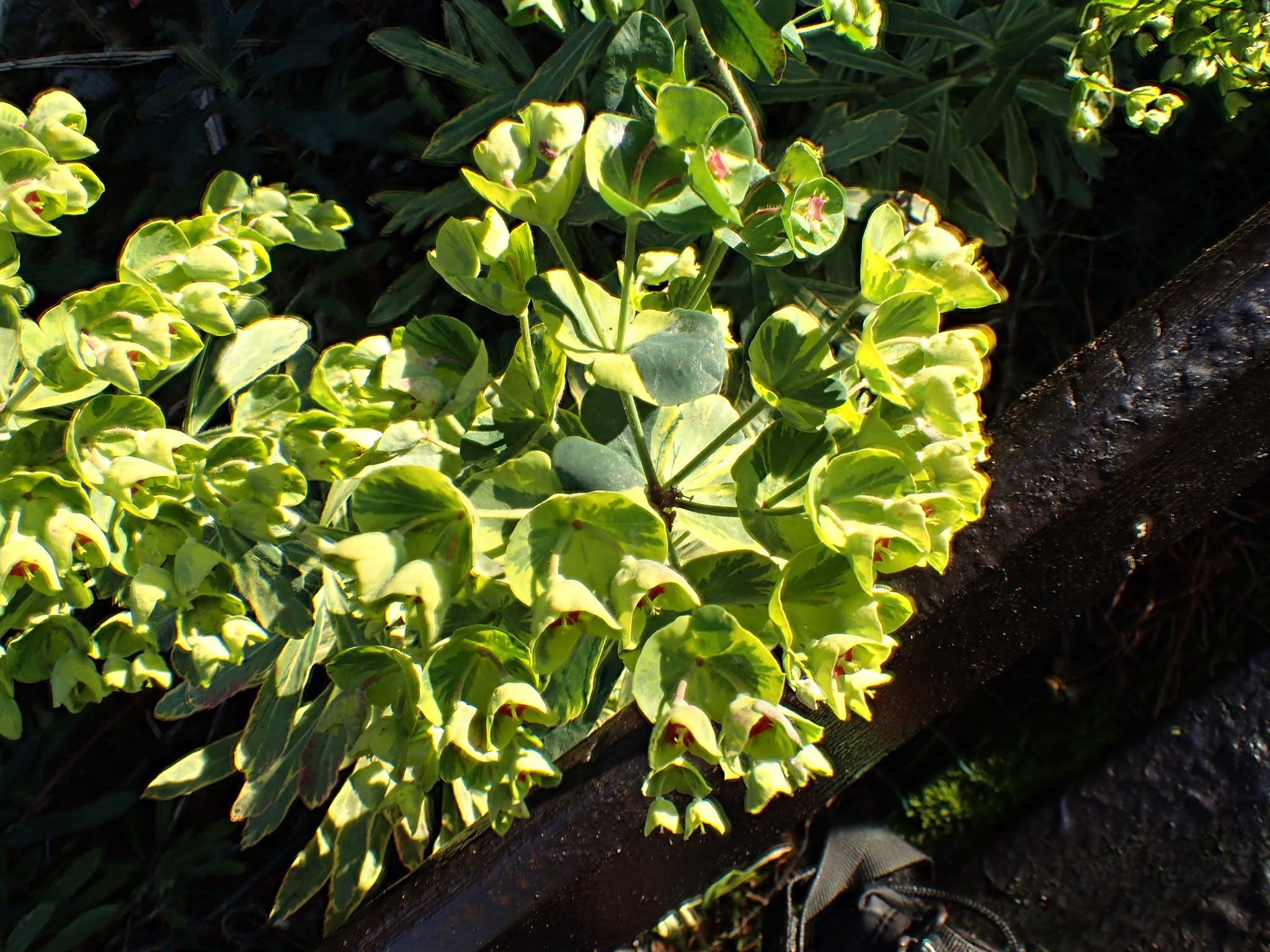
Some species of Spurge (Euphorbia) 

Silky Wall Feather-moss - Homalothecium sericeum

Striking shadow. Come back in two months and see the foreground filled with snowdrops.

Ivy and Hydrangea


Ivy


Melanohalea laciniatula on branch in tree in field to east of churchyard maybe SD82366500 or SD82366499

Feverfew -   Tanacetum parthenium

Feverfew -   Tanacetum parthenium


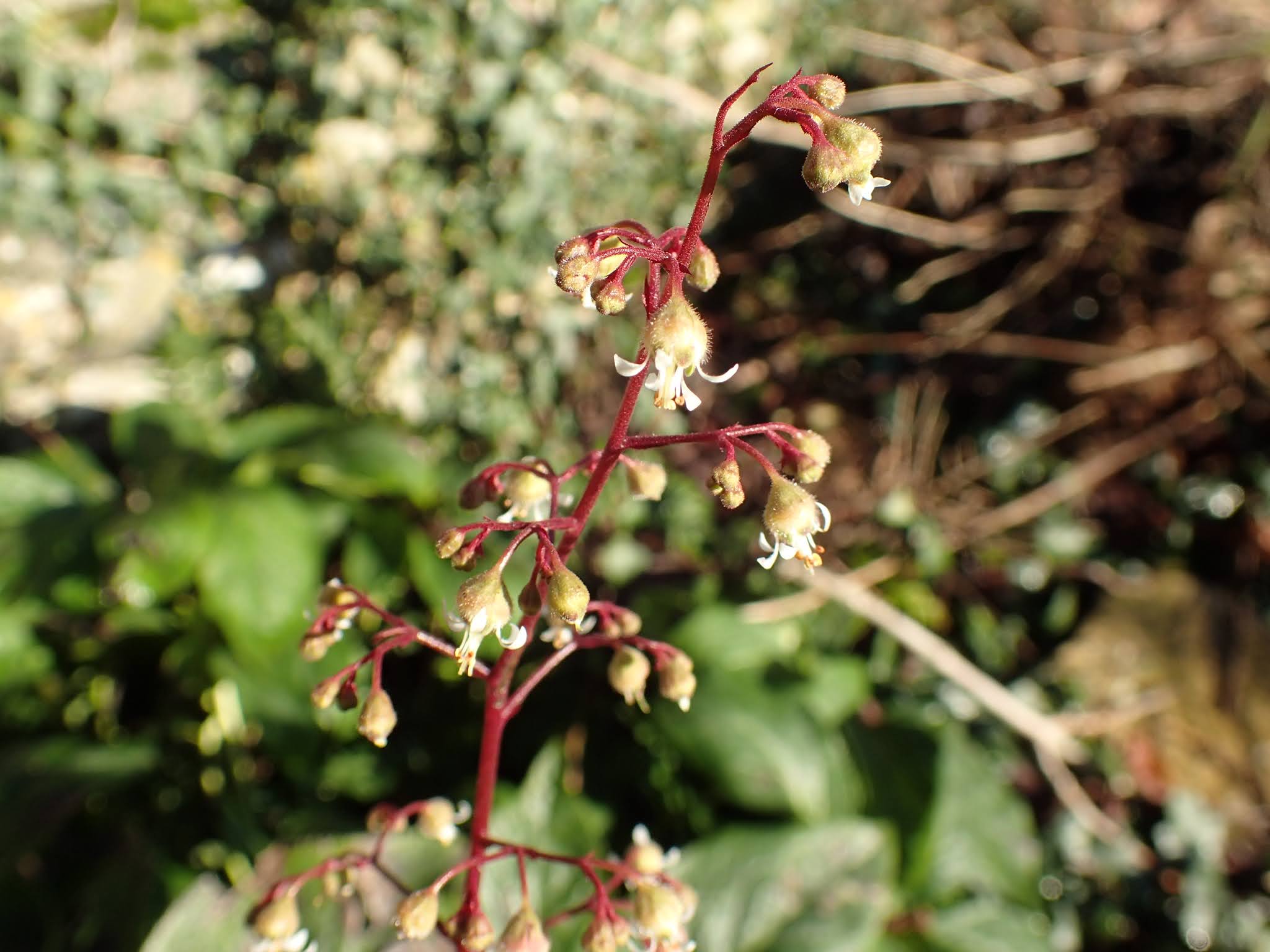
Heuchera species

Heuchera species

Welsh Poppies

Spurge

Lichen: Lecanora albescens


err- need to name this.In tree outside but next to the churchyard wall on the north side.

Lichen on trunk: Phaeophyscia-orbicularis

Primrose

Late blooming Rose - remember it's 24 December!

Intermediate  Screw-moss. Syntrichia montana (intermedia)

I'd really like to know the name of this