Sunday, 2 November 2014

Elusive Liverworts in Ingleton Glens

It was a privilege to join a group from the Yorkshire Naturalists Union Bryophytes Section to part of Ingleton Glens on 1 Nov to make a third attempt in searching for a rare liverwort (very rare in the UK) not seen since 1966/67. - Great to be with people who know their mosses and liverworts!

Tom Blockeel reminded me that the "Atlas of British and Irish Byophytes" will be published later on this month.. and that there are only a few days left in which to buy it at the £20 reduced pre-publication price.

Ingleton Glens is a Site of Special Scientific Interest. It is two deeply cut wooded valleys, the upper part through slate, the lower part through limestone.  The surrounding land use is pasture and quarry.  

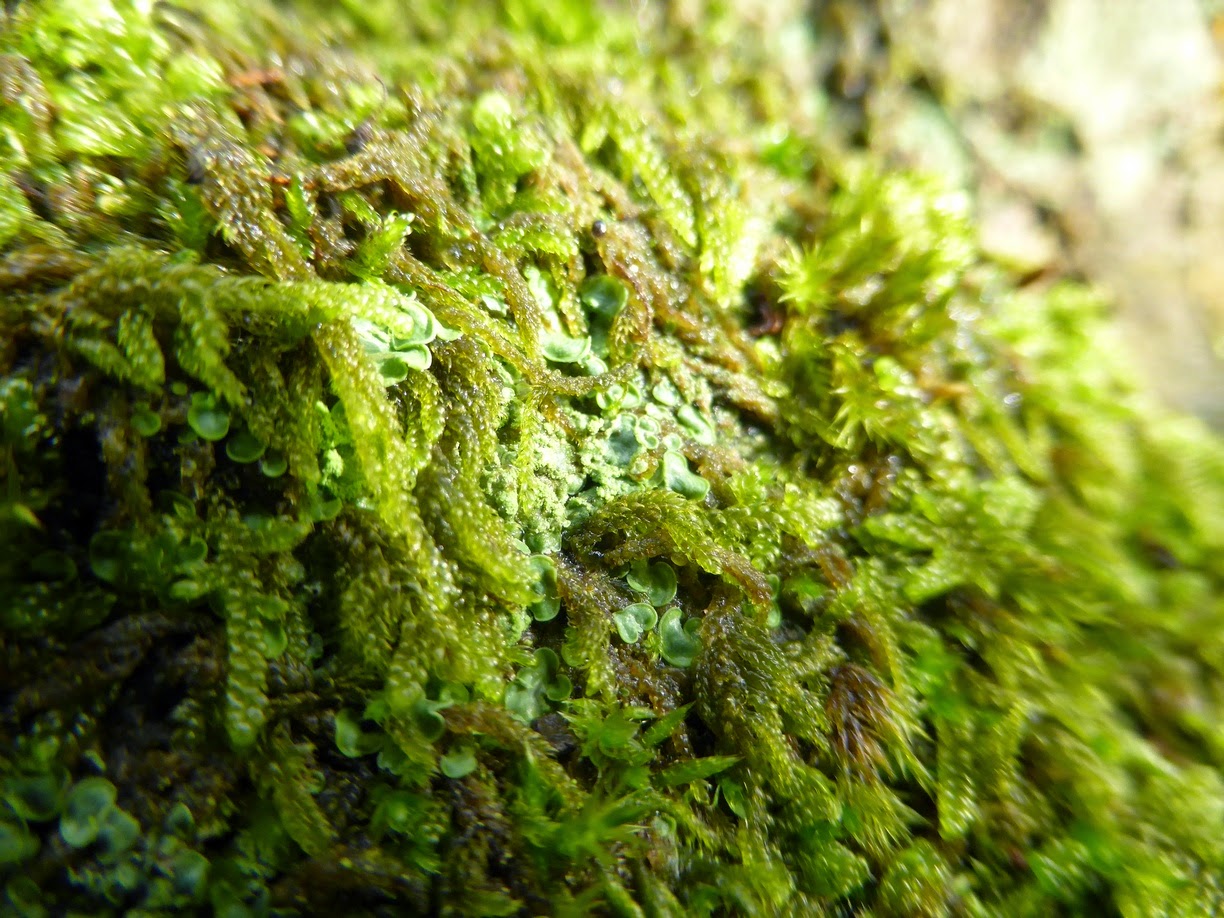
Come and see some of the bryophytes (and lichens) we found.

Amphidium mougeotii - Mougeot's Yoke-moss forms soft round mounds
where there is base enrichment in the water draining over a rock.

Homalia trichomanoides Blunt Feather -moss

Sheets of Homalia and a few mounds of Amphidium

Scapania nemorea

Normandina pulchella
Whoops- that's a lichen not a moss!
This is one that is easily recognnisable, like its name, is beautiful, and is on that needs clean air. .. 
But may be spreading since the SO2 pollution is now less than 30 years ago.
Actually we did fins some in Ingleton churchyard (a mile away) earlier this year


Not sure what this lichen is.   Where this lichen grows the moss does not grow.
It has a black margin round the prothallus.
Are the black dots cephalodia,  parasitic lichens or reproductive bodies?

(cephalodia are parts of a lichen that have blue-green algae in them instead of normal green aglae. Blue-greens can fix atmospheric nitrogen to make their own "fertilizer"
I've put this here in the hope that a lichen friend will be able to help me.


The Normandina is on the moss bottom left.

This mound of Scapania does not have the brown gemmae so is not S nemorea. 
It is S gracile

S gracile

A liverwort, quite a rare on I.. will write up its name once I have checked it under the microscope...
I think it should be a darker green than this.

Same

Autumn colours


Group photo

On a rock face just in a field just outside the wood was this beautiful big Dog Lichen. There are at least 12 species of Dog Lichens in UK. This one is Peltigera leucophlebia. Bright green when wet, frilled at edges;
dark wart like cephalodia which cannot easily be reomoved.

Add caption

Peltigera leucophlebia in foreground on left.

The light starts to dwindle at 3.30pm .. need to head for base soon.
But what a warm mild day it has been for 1 November.

Campylopus atrovirens - looks dark, can look black. More of a mountain species

We did not find our liverwort. But we had a good day.

Thursday, 30 October 2014

Ripon Cathedral - nature on a warm day -and harlequin ladybirds

Midday on 30th October was very warm as the sun tried to burn off the moist cloud and mist. After looking at a display of calligraphy paintings in the Cathedral I walked outside.

This post tells about the many Harlequin ladybirds I found crawling up a tree and flying around outside.

The following day (31 Oct) I visited a groundfloor flat near the Spa Hotel. She said she had had a few in the house, and yes we found some crawling on the window pane. Perhaps they were looking for somewhere to hibernate.

Harlequins were first recorded in 2004 in the UK, having come from the continent, and have been spreading (see maps) ever since. They grow faster than native ladybirds, and may even eat them.


I stopped to look at what I thought was Lepista saeva - Field Blewit


Crawling over one was a Harlequin Ladybird. 

Yes a Harlequin. Harmonia axyridis. It arrived in UK in 2004. Research has previously shown that seven out of eight UK ladybird species studied had declined over five years following the arrival of the harlequin in 2004. I am not sure if I have seen one yet at Settle.

Larva

There were tens, maybe a hundred on the tree in different larval stages and adults.

I tried to work out what this lichen is. there was also lots of Physcia tenella and Physcia adscendens.

More Harlequins

More Harlequins close up


In the children's park below it looked autumnal

More of this lichen there


Oh look they have pulled down the library - old site of

Tuesday, 28 October 2014

Leaflet part 4: how to write a biodiversity leaflet so that people will ACT

Back to Part 1  (Intro).
Back to Part 2 : - A leaflet that people will pick up
Back to Part 3: - A lealflet that people will READ                                


Part 4: A leaflet that people will act on.


I am trying to write a leaflet on biodiversity that people will a) pick up  b) read  and c) act on.

Actually I am still struggling with part 3 - "A leaflet" that people will read... my audience last week having stated that the writing was too small

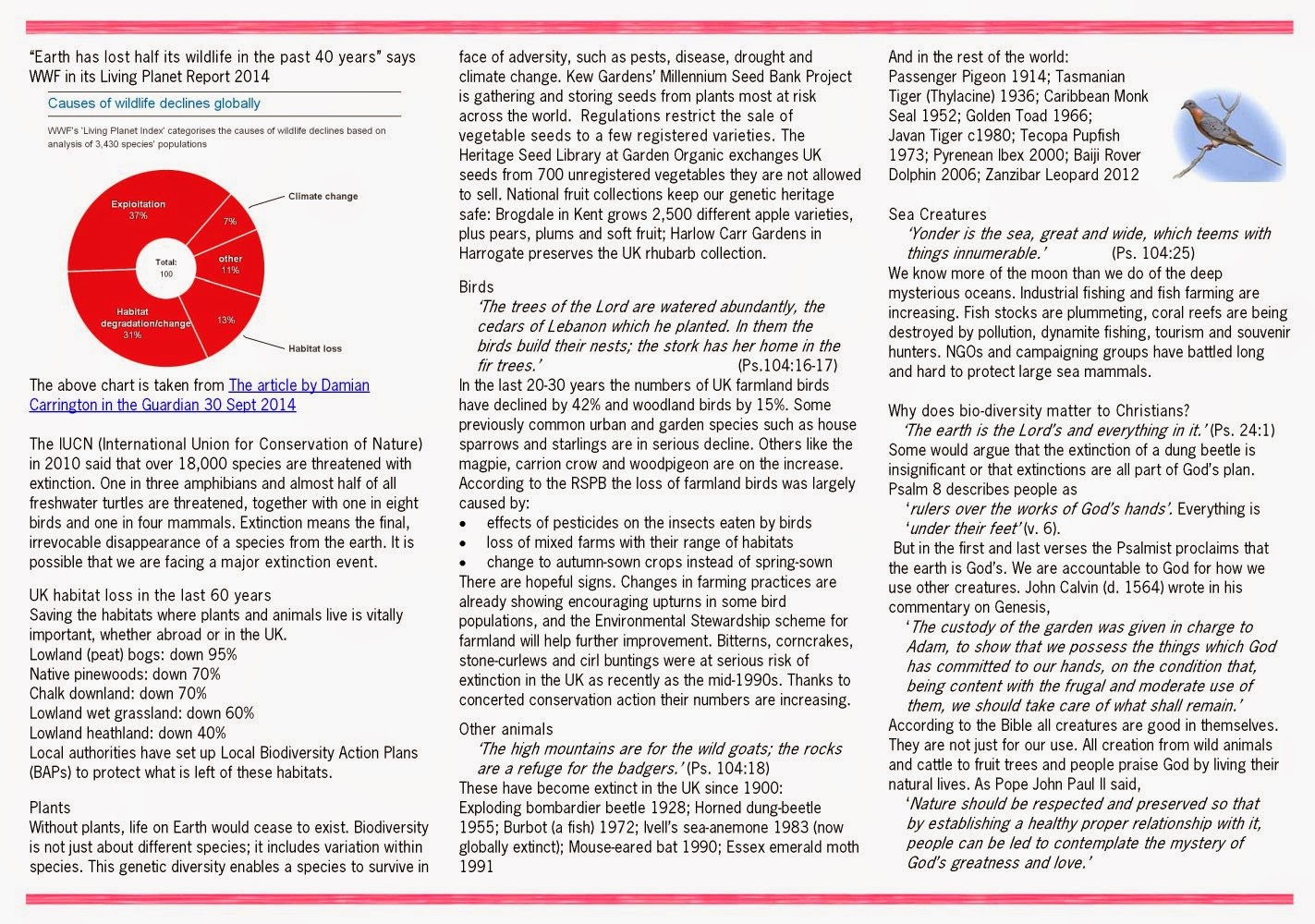
I bit the bullet, and made the print bigger - hence extra columns - so now it is a triptych with an insert. The insert can be a single column, or it can be two columns. The insert is the quotes by Christians.  The people I showed it to (at the meal at the One Climate One World Event at Settle)  did not seem at all phased - "Oh it is useful to have a separate sheet for people to keep" they said.

That's good - I had envisaged myself either having to sellotape all the inserts to the last side of the triptych.. or else going to a commercial printer and getting it printed on odd sized paper and folded mechanically.


...that people will act on.


"But what do you want me to do?" asked one man, turning straight to the end of the back side, and looking at the box which is titled "Join Green Christian"

That was revealing. 

Shows the importance of watching what people do (Just like you are supposed to do when building websites)

ANd it showed that this man went straight to the end.

Well yes, it would be nice if people joined Green Christian. But what I would really like people to do is to act in some way, to protect nature, to save habitats and species.

Having thought of this.. I moved the "Fill in two lines - Write here actions you plan to do to help wildlife/plants" with its trigger -diagram pen to the very end... So that people who read the end first would read that.


and Under "Ten Top Practical Steps  I wrote Circle or tick any you have done.

... You can see the leaflet (as is 27 Oct here) 

What next?

When showing people the leaflet it is much more productive to have several different versions and watch which one they choose.. rather than show them just one version and then they politely say "It is very nice" (whatever they really think) and don't have ideas for improvement

I had boiled it down to two front versions: with the bottom thirds differing. One finished of saying in LARGE print

 "Before it's too late"

The other had three points in not very striking writing:
  • How can we save wildlife for future generations?
  • What is Biodiversity
  • Why does it matter to Christians
I asked people and it was a 50:50 split, with people feeling strongly one or the other. Some people didn't like to be shouted at "Before it's too late"
The other half thought this headline was necessary to get people to notice at all.


I'd have to ask a bigger sample of people.

Meanwhile I went to the church hall where I often do displays on the notice board, and held each version up near the notice board.

hmmm

I didn't really like either.

I wanted something that my Scottish Dancing friends or the Line Dancing People or the Mother and Toddler group would like to see.. something that would make them happy, make me happy. So a third version was designed.


And that's as far as I have got.
But I have just discovered a website called "Branding biodiversity"    www.futerra.co.uk/downloads/Branding_Biodiversity.pdf
   

Tuesday 28th:
Just been into coffee morning.
 One man liked the new leaflet above on the right. (How can we help? and What is biodiversity?)
Two ladies still preferred the "before it's too late leaflet on the left.
Then a third preferred the one on the left and said it was because the "Before it's too lat" was in big writing.
So I've just made another version - on the right.


Come back next week!

Sunday, 26 October 2014

Klebsormidium near Langcliffe Locks


I took these three photos on 16 Oct, just over a week ago. This wall is close to the River Ribble, in the second fiedl above the Locks at Langcliffe. You can see Langclffe Qarry and Scar in the background. It surprised me how much Klebsormidium crenulatum there is on the rocks.

This velvetty filamentous alga is spreading and grows because of nitrogen compounds in the air.

Why is there so much here?

Here are four reasons

1) This field does have cow muck applied in winter
2) On the other side of the river is a large field leading up to a farm that still has dairy cattle. (All the other farms higher up int the valley now only have beef). Perhaps ammonia and nitrogen compounds come from the farm.
3) Most of the walls around here are made of limestone which does not let Klebsormidium grow on it.
but in the soil of the valley floor lots of rocks of the Yoredale series rocks  have been deposited, so the walls have quite a lot of sandstone rocks in them.
4) We are having an amazingly warm autumn - in that we have not had a frost yet. so plants and algae are continuing to grow.


Friday, 24 October 2014

Forest Church - Snapshots of Skipton workshop 23 Oct

You may have heard of Forest Church through Bruce Stanley's book, or have come across Forest Schools which are a little bit related. Or you may have taken part in similar activities in the past.
Quoting from his website:
"Many people can describe transcendent moments in nature where they feel deeply connected to something bigger than themselves and Forest Church is a way to explore that connection within community"
I attended a workshop at Skipton on 23 Oct. Here are literally a few snapshots of the day. There is not space to write about everything.

Thirteen of us were able to come. We met at the Baptist Church in Skipton - interesting in itself for me, because this is where the "Food Bank" food that we collect in Settle goes to be sorted before being redistributed.

One person came from Scotland and one from the deep south of England, and everyone else was from Yorkshire - but that still meant a journey of nearly 3 hours for some, (Sheffield), since Yorkshire is such a big county. One man had cycled from Leeds.  A few people work for the Church of England and the Methodist  Church and one for Christian Aid. Others had different backgrounds. We had all dutifully come with hiking boots and waterproofs.

We met at Skipton Baptist Church.
See how part of the room is used for sorting food for the Food Bank.

We walked up to Skipton Castle Woods.
 At the entrance Bruce stopped. He explained
how it is good to have a special pause/ ritual/
gathering together before entering the area.
While he talked a robin hopped on the wall beside us


Just to prove we were in Skipton Woods.
We were each given 3 coloured pieces of paper
and as we walked we had to look for items that matched the colours.
When we gathered later he explained that we had in our way been "foraging".

We stopped on a promontory next  overlooking some big cliffs with the beds of the rock at a strong angle. I wish I had taken a picture. I would be interested to know more of the geology - it looks complicated on the geological map. So although it looks flat in the following picture, from near where I was standing it was a long way down to the stream below.

We learned about different senses

Culminating in being given some "rose-hip leather" to taste.

 We had lunch back in the church room.(A shared lunch, having been invited to try and bring local food) .The day was a mixture of experiencing some of the activities, - and discussing how you would organise such events, and some of the theory. There are various Forest Church groups and all are different. Some are all Christians, others a mixture of people (Christians, Atheists, Pagans, Druids). The activities will also depend on the interests and experience of the group members, especially the core group.


In the afternoon we set of again, this time up the very long "Short Bank Road" to Skipton Moor / Rombald's Moor.
At the top of the road (entrance to the site) we stopped and had a good discussion about "Reading the Landscape".

"How can you tell the direction if you haven't got a compass and it is cloudy?"

In open land trees will have more branches on the south facing side.
There can be more plants indicative on nutrient enrichment on the north east side or a tree..(e.g. nettles) because sheep and other animals have sheltered here from south westerly winds.
In a town look at the satellite dishes. Most point SE because that is where the main satellite are.


Top of Short Bank Road

The track continued upwards, as a hollaway. 

We stopped an had a tea ceremony.
Nettle, elder and clover tea.


The gritstone wall, I had noticed
was covered with the
filamentous green alga 
(an indicator of nitrogen compounds in the air)
Klebsormidium crenulatum 

and also the nearby tree on the right.
The others were more interested in the tea ceremony 
and maybe the squirrel playing nearby.

We returned to base and had another debrief/ discussion and shared news..


A couple of people had already tried running a Forest Church Meeting.

There is a group in Bradford Soul Space that has Forest Church meeting once a quarter

Since the our workshop, I have learned that there is to be Forest Church meeting based on "Orienteering"  on Wed 29 Oct at Danefield/Otley Chevin.
At a rather extreme end we were told of the Christian Aid 70 Munros Challenge


Wednesday, 22 October 2014

Leaflet Part 3: How to write a leaflet so that people will READ it

Back to Part 1  (Intro).
Back to Part 2 : - A leaflet that people will pick up 

You can lead a horse to water but you can't make it drink.
In Part 1 and part 2 of this series I show how I tried to make the leaflet visible enough to make people want to pick it up. But once they open it up, will they read it?


Part 3: How to write a leaflet that people will ...

Read
So:-

I took my Biodiversity - sorry, "Saving wildlife" leaflet - to the Lichens workshop at Horton and asked three ladies at Horton Mother's Union to have a look at the different versions.

Yes .. they were very positive and  affirmative in saying the cover should say Saving wildlife rather than Biodiversity, and looked at the cover of the three sample leaflets with interest

But when we opened them .... they looked blank.

Thoroughly blank

Silence. 

One lady said "Oh, it's rather dense."

Huh! they didn't even try to read it!!

No point in arguing.

That's why I had asked them to look at the leaflets.  Back to the drawing board.

I had tried to cram material that I had moved from the front cover into the rest of the leaflet, and, because I had wanted to keep the print as big as possible, I had left very little white space.


Back at the computer again.

I made the print smaller,
the margins slightly wider
and made space between paragraphs. That looked better

Then I relearned how to do "Styles" in Word.

I set all the titles to a new style (I called JUD) - and every time I tried a different version, all the titles got changed simultaneously. Brilliant. I made bullet points and changed them to little arrows/triangles.

How to make and edit a new style in Word 10

With the "Home" menu bar showing at the top,
1. Triple click on the title concerned (or use another way of your choice to highlight it)
Then, either

2. right click to get a list to show, and go down with the pointer to where it says styles , and then a selection of  possible styles will appear

or 

go to the section on the bar at the top and click on a style that you would like

3. Then right click so you will get a list.

4. Go down to "Modify" and left click on that

5. Modify the style if you want to.

6. Save it.

So here are the before and after versions:

Before:


After:

Quite a lot better don't you think?

I even added two questions with spaces to write the answers and a little pen to make it more enticing. Interact with the audience.

I took them to the Anglican Church Lunch at Settle today (21 Oct) . (They have good lunches on Tuesdays)

One lady liked the new version best,

..but the second went for the original version -"I haven't brought my glasses". she said, holding the leaflet at near arms length.

Hey ho.
What to do.
Certainly if I wanted to get children to read this - even just to test this out for me I feel I need bigger print.

Maybe print it on A3? - but then the triptych would not fit in a dispenser.

Or rearrange the text and print it on two sheets of A4 and stick them together...

I did not want to cut any more text out.

Suggestions welcome

Back to Part 1  (Intro).
Back to Part 2 : - A leaflet that people will   PICK UP


Forward to Part 4: A leaflet that people will ACT ON