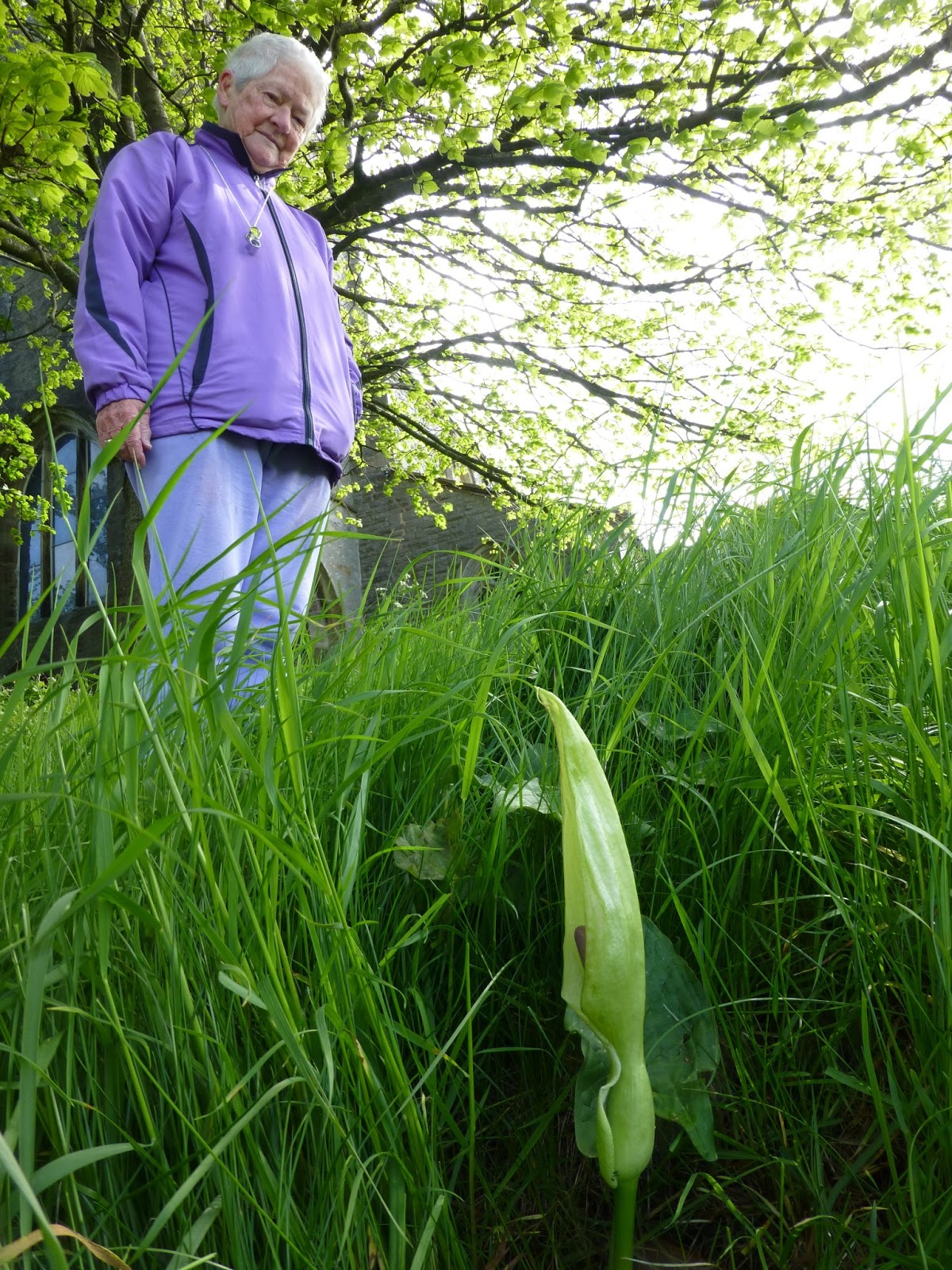
This visit on the late afternoon of Thursday 30 June 2011 with camera certainly was not grey!!.
|
|
Austwick churchyard/cemetery
|
I was delighted to find a number of "Hay Meadow Indicator Species" - i.e. grassland species that only occur in old unimproved grassland.
I had the privilege of meeting a family tending a grave..
and I had time to think a little about the ecology and management involved..
and time to play at taking pictures of beautiful textures in the vegetation and scenery.
The Yorkshire Dales National Park and English Nature used to use a system of Ranking of Hay Meadows and Old "Unimproved" grassland by using a list of "Hay Meadow Indicator" species.
0 species = Reseeded/heavily fertilized grassland
1-4 species = Some interest
5-9 species = Unimproved grassland - worth investigating further
> 10 species = High conservation value.
I have surveyed grassland both inside and outside the National Park, and used this system to compare the fields.
Fields with 10 or more species I would get excited about. And within the top category, I myself would make an extra division - did it have more than 15?
After finding two species of Lady's Mantle (Alchemilla) (apart from the garden one) and Self Heal and Quaking-grass in my first few steps of looking, I realised I should be able to make the "Ten species "target.
Here is what I found:
Bird’s-foot Trefoil Lotus corniculatus
Primrose Primula vulgaris
Downy Oatgrass Helictotrichon pubescens
Field Woodrush Luzula campestris
Glaucous Sedge Carex flacca
Greater Burnet Sanguisorba officinalis
Hairy hawkbit Leontodon hispidus
Ladies Mantle xan. Alchemilla xanthochlora
Lady’s Mantle glab Alchemilla glabra
Lesser Stitchwort Stellaria graminea
Meadow- sweet Filipendula ulmaria
Quaking Grass Briza media
Selfheal Prunella vulgaris
Yellow Meadow-vetchling Lathyrus pratensis
And growing on the road verge outside were:-
Bistort Persicaria bistorta
Meadow Crane's-bill Geranium pratense
That's 16 species - plus two more growing outside !!
Whoopeee!
|
|
Twayblade (This is a type of orchid)
|
|
|
Field Woodrush - the fruit are opening
and shedding their three seeds
|
Plus two extra on the road verge outside. (The Bistort and the Meadow Crane's-bill
It is an excellent cemetery.
Britain has lost over 98% of its species rich grassland, mostly in the last 60 years. .. This cemetery is an oasis for the flowers and for the insects that live on them.
Three species not on the above list but which were nice to find are:- Yellow Oat-grass, Knapweed and Foxglove and "Fox and Cubs" (Pilosella aurantiaca)
The people of Austwick are lucky to have such a diversity of wild flowers - which look good with the mixture of mown areas and mown borders and areas where the wild flowers are allowed to flower - And later in the year all most areas I imagine will be mown, otherwise False Oat-grass would take over.
|
|
Red Clover, Oxe-eye Daisy,
Rye-grass and Rough Hawkbit
beside gravestone
|
|
|
View from Austwick cemetery
|
|
|
View towards village from the cemetery
|
Why not visit the churchyard whilst the flowers are out? .. and take some photos too?