Showing posts with label algae. Show all posts

Tuesday, 26 February 2013

Mosses of Ingleton Churchyard - 1


Ingleton church tower looks down on many mosses: - the tower can't get bored!

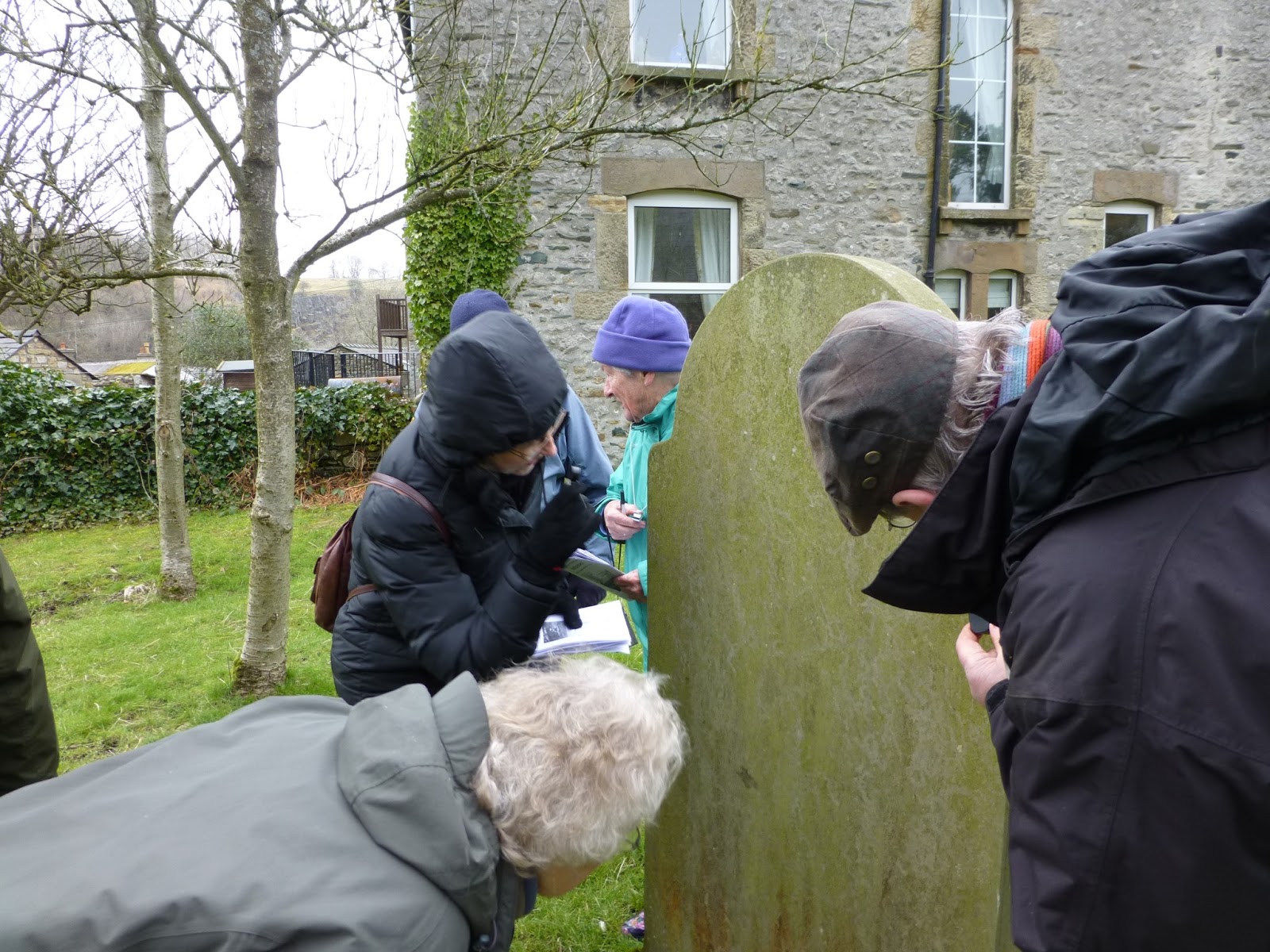
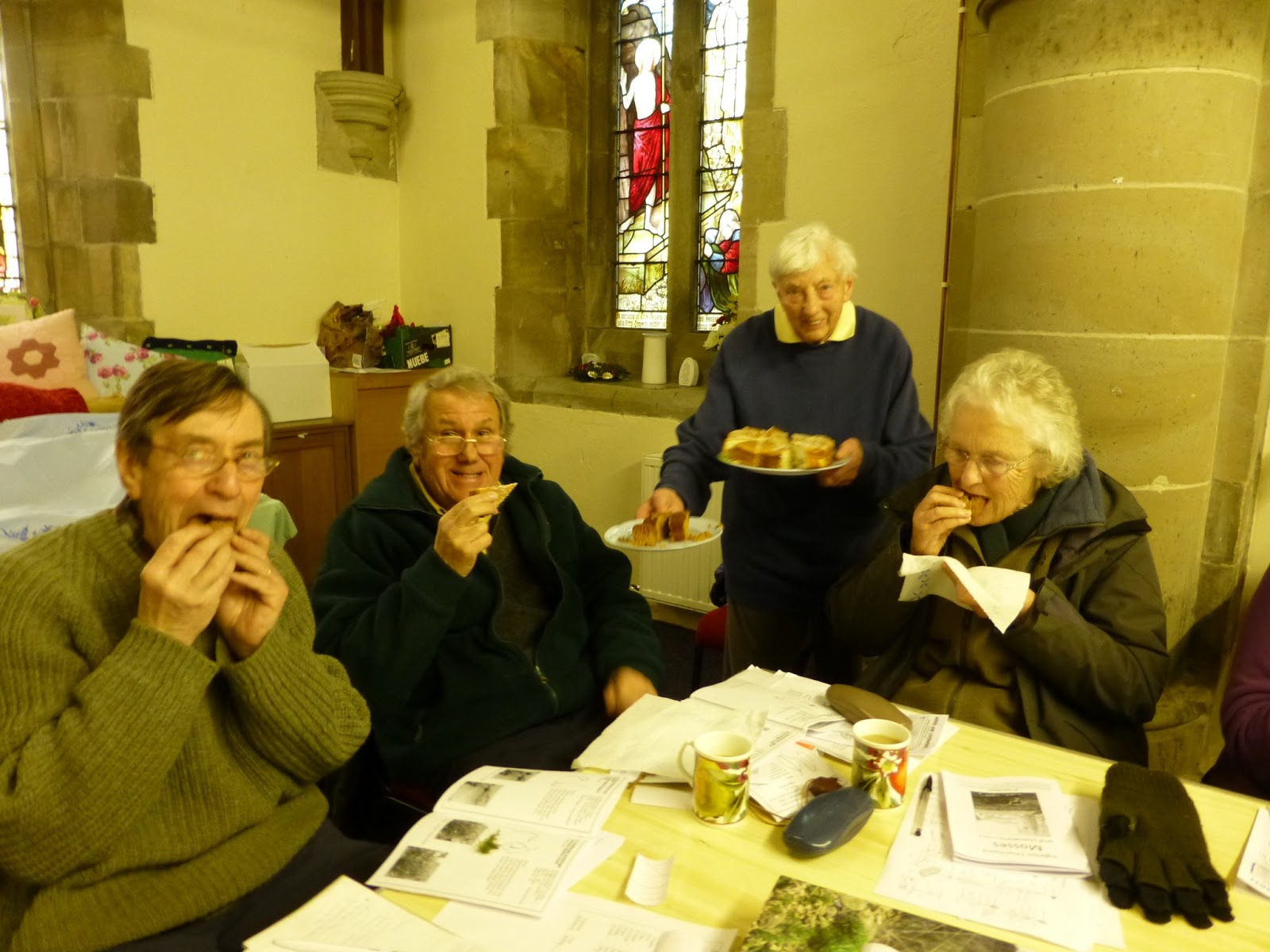
Here are  some of the mosses it sees .. and a few shots of the well-attended Beginners Workshop on 23 Feb

There will be a repeat workshop during the Ingleton OvergroundUnderground Festival on 29 May when it WILL be much warmer
(I made a moss booklet for the workshop. One day I will put a copy in the church. It had descriptions of 16 of the 32 bryophytes that I had found when I visited three weeks ago. .. At the workshop and in the exploration afterwards I discovered another 6)
(Click here for other posts on this blog about Mosses and Liverworts)

This is the view as you climb the steps to approach the church.
Bottom left, marked by the blue pen is some Syntrichia - I think - ruralis (Great Hairy Screw Moss)  but I still have to check that it is not Syntrichia intermedia (Intermediate Screw Moss)
I hope it is the former as I like that name best.


The Syntrichia above  after spraying it with water.
The leaves are about 4mm long, are tongue shaped and have hair points.


On the wall on the right of the gateway is a patch of The Smaller Lattice-moss
 Cinclidotus fontinaloides - the shoots trail down
This should be growing beside the river.
What is it doing up here? (Rhetorical question - I don't know the answer - except to say the other places we found it on the walls, apart from this one,  were in north facing low-down shady places on the walls, so would be very moist). Below is a diagram.
There is a border round the edge of the Cinclidotus leaves because the margin is several cells thick. The top diagram shows a section through the edge of a leaf.

The picture below is the view towards the church from ground level at the top of the steps.
 H
This is ground level as you enter the churchyard at the metal gates
- and looks like absolute grot.
It is one of the last mosses I looked at, as it is so tiny.
Compared to this,the other mosses in the churchyard are big and bold and beautiful.

Yet this moss always does look this dark olive green colour - and many of the
leaf tips ARE ALWAYS broken off: - it is a method if dispersal.
It is called Didymodon sinuosus - Wavy Beard-moss.
The Didymodons are all small cushion mosses,
with leaves mostly about 1-2 mm long.

Below is a picture of  
Didymodon sinuosus that I took whilst attending the BBS Acrocarps course at Preston Montford three weeks ago.
Didymodon sinuosus  Wavy beard-moss.  (tarmac track Preston Montford) the leaves are about 2 mm long. see the tips of the leaves are often missing.


As you walk 10metres up the path toward the church there is a flower bed on the left immediately next to the path. This has clumps of another little cusion moss- this time a  bright pale green moss. It is not shiny. - this moss can often occur in flower beds.. It was in the Giggleswick church flower bed, and in John Bearpark's garden at Settle.. 


It is Barbula unguiculata   the leaves are suddenly blunt at the tip but then have a point sticking out. the leaves have a mat surface. Under a microscope you would see that the cells have time little lumps called papillae on them that reflect the light in different directions - this is why it is mat no shiny)

Just below the Barbual in the picture above is another tinier moss that has smaller wider leaves - I am  going to check out what that is.


Barbula unguiculata  a  (Bird's-claw beard-moss)   an even closer view
- My camera won't get any closer. These leaves are about 3mm long.


Here is a group of us on the lawn in front of the tower.
Do you see the flat grave on the right and behind the group. Well the picture below shows the same (or maybe a grave nearby..)

In the front is Green Mountain Fringe-moss Racomitrium fasciculare

This is Racomitrium fasciculare (Fascicle means a little branch) It is a yellow green moss when wet though can look dark green when dry.  It is half way between being a carpet moss (Pleurocarp) and an cushion moss (Acrocarp). This Racomitrium does not have a hair point. Racomitriums grow on exposed acid rocks. This is a slate gravestone. 

Next we went round the back of the church and found some more Racomitrium on another gravestone

Here we are at the back of the churchyard. The base of this gravestone (sandstone) again has a piece of Racomitirium fasciculare

Actually here we are looking at the algae on the same gravestone - Lots of Clebsormidium crenulatum (This filamentous green alga that is growing well due to nitrogen oxide pollution - even in westerly rural villages such as Ingleton, with supposedly relatively pure air). and lower down on the gravestone some Trentepohlia (orange)

Here we are at the beginning of the workshop - in the warmth of the church room at the back of the church. Mike is holding a thallose liverwort he brought in to show us, as so far, we haven't found any thallose liverwort in the churchyard.


Welcome coffee and cake break


Examining specimens. See the book   - front left- the British Bryological Society  Field Guide


Just behind people on the left.. is the west wall of the tower -see below
Look at the zonation of mosses on the ground to the left of the tower.

To the far left, and in the soil below the trees is Oxyrrhynchium hians (Swartz's feather-moss) (I may study that later - it is a more non-descript-than-usual pleurocarp  growing amongst the vegetation under the trees.

The bright green in the middle is  (Still to be checked) Clustered-Feather-moss Rhynchostegium confertum
I met the caretaker who told me he removed moss from this path in summer. Perhaps Rhyncostegium is one that comes back when others have been removed.

The dark green right next to the wall and green door is Lophoclea bidentata - Bifid Crestwort - our only liverwort  (..so far) 

Bifid  Crestwort at ground level.. and below closer:.

Bifid Crestwort close-up. It is a leafy liverwort. See the leaves have no vein and two points. Liverworts do not have veins; and mosses never have two points.
..On the left is a model of Bifid Crestwort (Lophocolea bidentata) I made (100 times as big as the real thing) , and a quick sketch on the right.  From above (top) you can see their are two rows of leaves, inserted obliquely. the leaves are about 1.5mm long. The lower view of the model is from below - you can see it has underleaves.                                                                   


To get a sense of scale, whilst standing on the liverwort, turn round and look south, and refocus on the distance - .. to see..

the Ingleton viaduct..  and above and beyond the viaduct to...
the Forest of Bowland with a covering of snow..
 Thank you - aren't modern cameras marvellous!


But back to the liverworts at our feet....


And a bit of revision for those who came on the workshop - do you remember the pleurocarp(carpet moss) with branches arranged like hands or fans placed downwards near the base of the trunk of the ash tree?

Yes it is.

Mouse-tail Moss: Isothecium myosuroides

 I hope you'll join me again later this spring when I run another workshop at Ingleton Churchyard this time on:-
"Let's practise using the BBS Field Guide Key" .. .. We'll visit a few of the mosses we met last time and a few new ones. It will be one evening between 5.30pm and 8pm. date yet to be fixed.

BEGINNERS WELCOME!


(Click here for other posts on this blog about Mosses and Liverworts)


Sunday, 4 March 2012

Lichens of Malham Tarn House - 1


 "Malham Tarn House: Its building materials, their weathering - and colonisation by plants" is a paper written by Arthur Raistrick and Oliver Gilbert in 1963 in Field Studies, the Journal of the Field Studies Council.  You can read it online

1963 is 49 long years ago.

On 25 Feb 2012 Allan Pentecost led an introductory lichens day at Malham Tarn Field Centre, and we looked at the walls of the house. Will this blog post develop into a 50 year update?


Acarospora fuscata


Arthur Raistrick was a famous historian,  geologist, a Quaker and a conscientiousness objector. I was privileged to hear him give a talk in Littondale once when he was in his late eighties.  He had led excavations of archaelogical sites on Malham Moor, and wrote books on many topics. The room where students make their tea is now named in his honour.

When I lived at the Centre as Botany and Ecology Tutor, from 1979 to 1987  I used that paper many times to learn of the history of the house and I used to walk round the outside of the house peering up at the tall walls, working out which coloured blob was which lichen. I expect Mark Seaward who ran many lichens courses a the centre also showed it to people.

I met Oliver Gilbert when he came up to run a lichens course in the eighties.

Oliver Gilbert used to be a tutor at the Field Centre too. When I first met him, I regarded him in awe.. being tutor here, after Sinker, near the Beginning of Times. (The house may be old, but the FSC only started in 1947, and the Centre started in ....).  .

Oliver proudly showed me the boardwalk on the fen which he and his brother, Richard, had first built in the 1960s, with their bare hands. Before that access to the fen had been a black peaty squelchy path.The boards had been relayed several times since then - and now the National Trust  are putting plastic boards down which will last longer. Oliver told me me how very much he had enjoyed being tutor.

Now it was 25 February 2012  I  was at the Centre again, one of eight students attending a day course on lichens run by Allan Pentecost, sponsored by the British Lichen Society.

When we first went into the courtyard, I went to the coal house door, and chirped "Can I do this bit please?"

The wall to the (former) coal-house and other out-buildings is north facing and built of limestone but the wooden shutter of the coal-house opening is framed by sandstone building blocks. When I and Henry Disney had both taught here week after week, we always started our grand guided natural history walk of the estate with an examination of the lichens (and algae) on the building blocks round the coal-house door.


There is ecology under your nose, wherever you are.

Why did the powdery pale green lichen Lepraria incana grow where it grew.?

And why did the Orange Alga Trentepohlia (which looks like a lichen but isn't)  grow where it is growing?

Have a look if you visit the coal house door.

You might even see a slight depression in the sandstone block where I used to scratch away the sandstone and mix the grains produced with water - and add Universal Soil Indicator solution. A yellow orange colour was produced .. to show that water flowing over the sandstone had a pH of about 5.8 or 6.  The limestone rock is much harder and there is no tell-tale hole on the limestone block. - and the limestone powder added to distilled water and indicator produced a deep bluegreen colour - showing the water is pH 8.

New fact for me:
There are actually two species of Trentepohlia on that door. Both are filamentous algae, with ordinary green algae pigments, but they also have orange pigments.
 Allan showed us-
Trentepohlia aurea  link1-  a brighter, lighter more golden version of bright orange, a fluffier appearance
Trentepohlia umbrina a darker brick red colour (is umber a dark version of orange?), more adpressed to the rock.

I will take a photo of the coal-house door another day.

Meanwhile at the top of this blog post is a picture of Allan on the south side showing us Acarospora fuscata on the south side.


We actually started in detail on the East facing side which is sandstone.

Candelariella vitellina and Klebsormidium crenulatum (filamentous nuisance alga)

Candelariella vitellina.

The yellow-orange  lichen on sandstone is often Candelariella vitellina.

Well I've had enough writing now - and you've probably had enough reading.

In my next post I will write about the other twenty or so
 lichens (with pictures) that we found.
---------------------------------------------

Since starting this blog post, I have just  learned of the death of Audrey Disney  two days ago on 1st March  Audrey is/was the above mentioned Henry Disney's wife - Henry was Director when I was here, and then he moved to Cambridge. Audrey was Secretary at Malham Tarn Field Centre for a while. The funeral will be in Cambridge on 12th March.
She had a lovely smile and happy nature.
I don't think lichens were her major interest - but she was helpeful to people who came to the centre, and would have met Oliver Gilbert and Arthur Raistrick who lived in the area, and Allan Penteost. I have a picture of her skiing on the lawn, with the house in the background which I will add when I have opportunity.

Other Lichens posts (see also the Lichens link in the menu in the right hand column):-


    1. Lichens of Malham Tarn House - 2    29 February 2012
    2. Lichens of Malham Tarn House - 1    29 February 2012
    3. Lichens of Malham Tarn Fen - with Allan Pentecost 29 February 2012
    4. Lichens flourescent in bonfire light  5 Nov 2011
    5. Opal Lichens Settle    CCG walk led by myself -  2 April 2011
    6. Algae (and Lichens) for Beginners - Malham Walk with Allan Pentecost August 2009
    7. Lichens Day at Giggleswick Churchyard with Mark Seaward 14 June 2009

Wednesday, 29 February 2012

Lichens of Malham Tarn Fen

We're off to the woods today!
Allan Pentecost is leading the first of two introductory lichen days, as part of a series of introductory days run by the Lichen Society at FSC centres throughout the country - His second day will be 31 March

Today I am one of his eight students. We set off through the cutting . (N.B. this page has not yet been checked by Allan)
Past the snowdrops at the cottages
to the boardwalk on the fen, and the side bridge at the inflow stream.

Parmelia saxatilis  This foliose lichens has isidia on the older parts -( lots of tiny dark grey projections -)
and a coarse network of white lines on the younger parts
(click on the image to see a larger version)

Where we look at a willow tree in detail

Les takes a photo

In great detail.
Left: Parmelia sulcata This also has raised white lines, along which, on older parts, soralia  may develop
 It does not have isidia.
Right: Platismatia glauca -
This is only attached at one point, it is not flat on the bark,
so it is more like a shrubby lichen.
It is pollution tolerant.
The underside is dark and the thallus has frilly lobes.
Platismatia contains a lot of a chemical  called lichenin
-  a starch similar to that found in bread -

Pollution -

I remember 30 years ago (oh so long!!) being told by Mark Seaward whilst looking at the same trees (but 30 years younger..)  that the lichens we were finding could tolerate up to 60ppm sulphur dioxide pollution.  Sulphur dioxide pollution in the past limited lichen growth - from the Lancashire milltowns 25 miles away (south) and Yorkshire mill towns 30 miles -Plus to the east. Thirty years ago we found only one patch pollution sensative Usnea on a birch tree. This time we looked hard and someone did find a tiny piece of Usnea - but not near the board walk, and I haven't got a picture of it.


On a side branch of a willow tree we find an early coloniser - Fuscidia lightfootii
Fuscidia lightfootii This has colonies that are usually less than the size of a 50p piece.
It is light green with dark fruiting bodies.
It is found on twigs and you branches in wet and boggy places especially in the south and west.


On the same trunk as Les is photgraphing we have
Mycoblastus fucatus a grey crusotose lichen .
Now, is that the papery grey of patches 1a and 1b (note they have a few black apothecia)
or is it the more lumpy bluey grey of 2?

Next we follow the side stream about 20 yards and look at an area where the birch and willow scrub was removed about three years ago. We find not one but several species of Peltigera.

Peltigera
Peltigera are the only lichens that we find on the fen that have Cyanobacterai (Blue green algae) as the algal part of the lichen - all the other Lichens have green algae. Allan suggests this is because bluegreen algae tend to prefer less acid conditions - and the fen and peatbog are made of Peat - perhaps the parts where we find the Peltgera are lower down and growing on plants that receive more base rich groundwater.
There are two Peltigeras here. There one with a felty surface and one with a smooth surface.


Need to look at them with a hand lens or under a low power microscope to look at the rhizinae. 

We found P praetextata, P hymenina, P horizontalis, P membrancea,.. but I still need to sort them out.
I think we could have had a whole day on Peltigeras!!

We found lots of different species of Cladonia:- 
Cladonia fimbriata
That's the one in the centre of the picture,
on the left side of the trunk.
We had a brief visit to the peat bog proper - but by, was it cold! 
then returned for lunch.- Hot soup and fresh sandwiches. Delicious.


Welcome Hot homemade soup back in Malham Tarn House.

In the afternoon we looked at our specimens .. and then ..... a guided tour of the lichens on the wall of the house... but that is for another blog post..

introductory British lichen society - FSC days 

Other posts on this blog on lichens:-


  1. Lichens of Malham Tarn Fen - with Allan Pentecost 29 February 2012
  2. Lichens flourescent in bonfire light  5 Nov 2011
  3. Opal Lichens Settle    CCG walk led by myself -  2 April 2011
  4. Algae (and Lichens) for Beginners - Malham Walkwith Allan Pentecost Aug 2009
  5. Lichens Day at Giggleswick Churchyard with Mark Seaward 14 June 2009


Monday, 24 August 2009

Algae (and Lichens) for Beginners - Malham Walk

This was written in 2009.         Click for Other Posts about Lichens on this blog

Note added on 8 Sept 2012: Today On 8 Sept 2012 I am leading a walk along the same track - meeting at 10.30am in Malham Yorkshire Dales National Park Car Park. - - I have added some notes in red today to this blog post which was otherwise written in 2009. 

Today's walk is run for Plantlife members and for everyone else local or visitors who would like to come. Now back to my preparations in 2009..

We haven't got Rainforest in Yorkshire - so lets look at Nature at a small scale - algae, bluegreen bacteria and lichens.


On Wednesday 26 August 2009 I am helping Allan Pentecost in "An Algae and Lichens Walk" - Let's be honest - I have organised the walk and put the posters up .. and now hope to learn as much as I can from him!! - Thanks Allan. This Monday evening after it had stopped raining I went to Malhamdale to take some photos. The views just before I dropped down to Malham village were great! You are looking towards Gordale above.

Focusing on the wall top we see Verrucaria nigrescens and on top of the cap stone is a yellower lichen, seen closeup below.


On the other side of the road I looked across a stone along the road - You can see Malham Cove in the distance. On the stone there is a white lichen Aspicilia calcarea  and an orange one Caloplaca flavescens. Here below is the same rock and lichens but closer up.

Once in the village, I park in the National Park Car Park. the sun is shining on the trunks of the two small ash trees. Near the base of the trunk is Xanthoria parietina and next to it a species of Physcia. Let's go for Physcia tenella

The tape has mm on one side and 1/8 ths of an inch on the other. The pictures below have ended up sideways.


This is of Lecanora chlarotera.


This lichen has black fruiting bodies.


On a Mountain Ash trunk near by is some Usnea subfloridana  (Sadly by 2011 it had disappeared)


this tree has Ramalina farinosa

and Parmelia sulcata

The border of the door for both Ladies and Gents toilets is sandstone. This lichen grows on it.It is Lecanora campestris


Outside the chapel the wall tops are also sandstone and have large patches of a whitish lichen


and also one with black fruiting bodies


On the fence post over the road is this green. Is it alga or is it lichen?.. I think it will turn out to be the filamentous alga Klebsormidium crenulatum


I set off. at the footbridge on the back wall of the Blacksmith's is some Caloplaca flavescens.


by now the batteries in the camera and the spare batteries are flat. . I have only gone 100 yards. Time to go home!.


Click for Other Posts about Lichens on this blog