Friday, 8 November 2024

Waxcaps near Helwith Bridge

Waxcaps can be found in old grassland that has NOT had lots of fertilizer applied.  Today I went on a foray with Claire Bending from the Yorkshire Waxcaps project and three other friends in Ribblesdale near Helwith Bridge. In Settle it was grey and cloudy, but four miles up the valley here, there was was blue sky and sun.

holding a Scarlet Waxcap -
Hygrocybe coccinea)

The grass was fairly closely cropped by sheep which was excellent for the waxcaps.

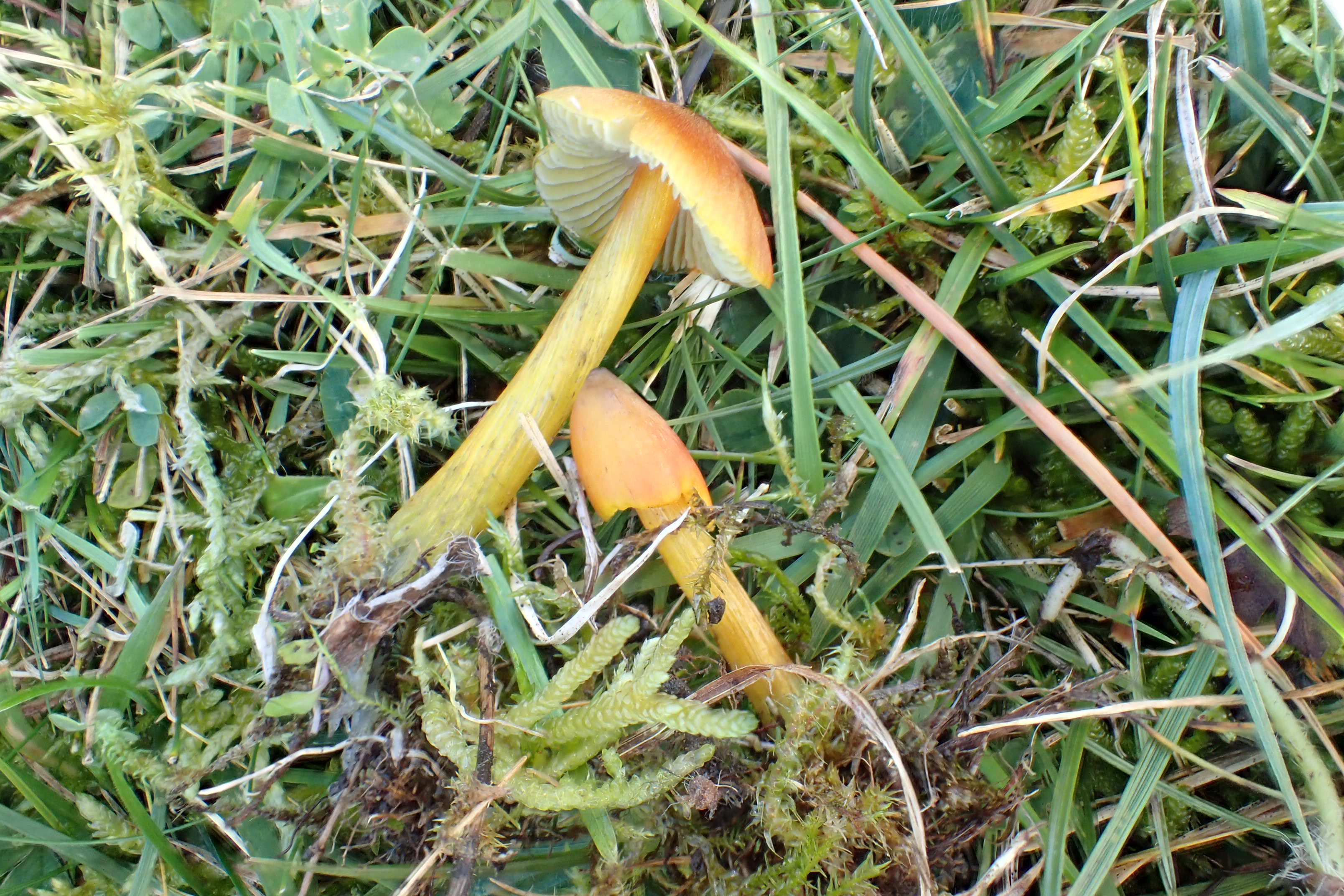
Here are several yellow and orange waxcaps that I have now learned to differentiate between. I might just have lumped them as one species last year !!. Plus a couple of Pink-Gills (Entoloma) - that I still cannot name. 

We also found (though not shown here)  - Cordyceps militaris, Meadow Coral, White spindle, Yellow Spindle (possibly two types) and Black Earth-tongue, Parrot Waxcap, Snowy Waxcap, Scarlet Waxcap, Crimson Waxcap and Meadow Waxcap. So altogether I saw 13 waxcaps, maybe four Entolomas (Pink- gills) one Earthtongue and at least three spindles/clubs. 

Pink Gill -1

Pink-Gill 1 from below

The Goblet Waxcap - if you look closely it has tiny hairs on its cap

The Goblet  (pretty tiny!)

Butter waxcap - If you look at the top  middle one you see its gills are adnate... which is different to the next one...


Whereas this one, the more common yellow waxcap around Settle Hygrocybe chlorophana  has sinuate gills.


This is the Persistent Waxcap, Hygrocybe autoconica (better known as Hygrocybe persistens - but it has been discovered that it was called H autoconica first so that is now its official name) It has a viscid (sticky) cap, that is usually a bit more conical than this, and a dry stipe.


We also found Oily Waxcap Hygrocybe quieta -  that smells of oil. Its cap and stipe are greasy. Its gills are yellow to salmon pink in colour. 


We found Honey Waxcap too - though I have not got a photo of that.


We haven't quite decided what these are.


We haven't quite decided what these are.


This has almost free gills and is supposed to smell of beetroot (though I couldn't smell it) - I have forgotten its name  (coming shortly..)- but it is not Snowy or Cedar Waxap


A different Pink Gill.


I hope you enjoyed your walk with us looking at these waxcaps.

Friday, 18 October 2024

Waxcaps and water walk at Winskill Stones

 Yesterday I had been on a training day on waxcaps with Clair and Steve Hindle and Sarah and Ann (Chair of Yoredale Nats) and  Alister  the manager of the land ..  It had rained very hard.

Today was a sunny afternoon so at 13.50 Doris and I parked at the Car park at Winskill Stones. We had intended to park at the opposite end of the nature reserve, but the road was flooded after yesterday's rain, so we stopped at the main car park.

Doris took the low road and I took the High Road (open field and bank searching for waxcaps). Doris is 93 and with her mobility walker shot off at a great rate of mph.


In the distance you can sea Smearsett Scar (left) and the foothills of Ingleborough and the quarry at Horton beyond.

All though this is a limestone area the ground is saturated with water after the heavy rain yesterday.

South of the road only revealed one - Cedarwood Waxcap


We approached the water - 


I marched through and took a photo of Doris waiting.
Doris waiting.


And Doris took a photo of me
- the water got up to about 6 inches deep.


We returned to the car  (there was not much waxcaps if any on the north side of the road, then decided to explore west, along the road towards Samson's toe.


THe grass in a tiny area next to the nature reserve is not grazed.
The grass is long and will be bad for waxcaps


Meadow Waxcap


Meadow Waxcap


Snowy Waxcap


Yellow Waxcap

Yellow Waxcap

Conical Waxcap=Blackening Waxcap


Mycena pura

Mycena pura


Back at the car park Doris was pretty cold - at least her hands were. 

We drove back towards Settle and I stopped about 200m before the corner at the top of Langcliffe Brow, and Doris stayed in the car. I expected to find plenty of waxcaps on the south (uphill) side here but roamed rapidly around and found none till I came back to the road again where I did find a Crimson Waxcap and a Yellow Waxcap.

I used these waxcaps that evening to make a small display at the Craven Conservation Group talk about Red Squirrels


Thursday, 3 October 2024

Settle Wildflowers 152: Ivy - Eco-explorers - Settle Parish churchyard


A white sheet was placed under the ivy (see foreground top left), we bashed the ivy with a stick and looked for insects which landed on the sheet.


October 2nd  - Eco-Explorers at 4pm.
Two  weeks ago we had spread out a white sheet under the holly tree , knocked the branches with a stick and looked at the creatures- insects that fell off it.

That was such a success that we tried it again this week.  We tried horse chestnut tree and holly tree which yield a spider and a fly. We tried a different species - Ivy in flower - and that had lots more under it.
Even a two year old can discover more using a hand lens. - I think this is a record in our group though.


The ivy bush - technically growing in the Settle Carlisle Line Railway land.


I have never noticed the curly ridges on the ivy before.


Fox and Cubs still out in the grassland


You might have noticed our young hero has a white badge with a big S on his arm.

They had been doing the letter S in phonics today at school. 

 At the Sticky bud tree (Horse Chestnut) beside the Church we all had fun discovering Spiders, and Snails and putting String into conkers.


Reflections:-

I had a quick look round but failed to find any FUNGI as we had done two years ago.

People say there are far fewer insects this year. I agree. The fact that we were interested in the wasp - well in earlier years we would have been pestered by wasps all late summer. Not this year with its excessive rain.

I am so grateful for the two families that came. and are keen.

It meant the meeting took place. It meant that I discovered creatures and there in the centre of Settle, below the Settle Carlisle Railway

We have over ten families on our list (maybe 15 or 20 including those who came to summer camp)  but there are so many other activities arranged for children nowadays (one of our regulars has now started gymnastics , others go swimming or to brownies/guides), or parents / grandparents have to work, that very few come. 

Some people say "Arrange another event in the half term holiday" -  but then we discover that nearly every family goes off somewhere else at half term.


--------------------------------------


Sunday, 22 September 2024

Settle Wildflowers 151: Juncus tenuis - Slender Rush Helwith Bridge


Fri 20 Sept: Juncus tenuis. Slender Rush. The Car Park at Helwith Bridge. Gravelly soil, puddles. This is a new record for Settle's hectad SD86 , The nearest other records being near Grassington, Thornton in Craven and beyond Low Bentham. https://database.bsbi.org/maps/?taxonid=2cd4p9h.8qq
It has blades like grass blades in that they are dorsiventrally flattened.
It is likely to have been imported with forage or timber from North America. I have found it on footpaths in Holland and on Headley Heath (Box Hill) on footpaths. for many years but the maps show it does really well in the west of Britain and SE of England. It is spreading.
I thought it might be Juncus compressus (The round fruited rush -when I first found it because I have found that in the area before, and because this had exceedingly round fruit.
-
But Juncus compressus has tepals that are obtuse to rounded at the apex, ad the tepals of this plant here are acute, and longer than the capsules.
Jucncus compressus (and gerardii for that matter) are rhizomatous and Juncus tenuis is tufted. This was definitely tufted.

And quite a lot of vigorous separate tufts n the car park.


Saturday, 14 September 2024

Settle Eco-Explorers Summer Day Camp 28-29 August 2024

 We had three families on the Wednesday and 16 families on the Thursday 29 September

(The Wednesday evening 4pm meetings on the first and third Wednesday of the month have now resumed - next meeting starting at St Johns Church Settle at 4 pm: Wed  18 September)