Sunday, 21 July 2013

Bog-Day 2013 display at Settle and Age UK

28th July 2013 is International Bog Day.

On Friday 19th July  Settle Age UK Lunch Club 
had booked me to give a talk on wild flowers...
So guess what the topic was!
.... The brilliance of bog plants -- leading to International Bog Day

In this post I recount some of my adventures in organising the talk.

and give them thanks for helping me make the display..

The display will be there for other groups who use the Hall.


I got up early and collected a few samples of some (not rare)  bog plants from two nearby bogs - Helwith Bridge and Ribblehead. It was SO hot.!
The Bog Asphodel was in perfect condition - the flowers just coming out.
 Then at Ribblehead some men were repairing the bridge


After the meal at St John's, Settle, I got the people to talk about the uses of bogs. then we stuck some of the plants onto sheets to put on the wall and onto cards to make greetings cards:


Read my post about International Bog Day and Malham Tarn Fen and Peat Bog

Read my post about the event which actually took place at Malham Tarn on 27-28 July 2013

Wednesday, 17 July 2013

International Bog Day -28 July - Malham Tarn Bog and Fen

28 July is International Bog Day (and there will be events below on 27th and 28th)
(also see press release)

(For a Picture Report of the event which eventually took place 28-29 July 2013 at Malham Tarn  click here)

Now you may think bogs are dangerous damp places with pools full of green bog-moss where you can trip up and fall in.

Well yes they can be..

But this time of year Malham bog is relatively dry - and the event described below  will be a (free) opportunity to find out the magic secrets of the Moss.

Find out the top ten secrets of Malham Tarn Bog: (I am going to write this section shortly when I have time...)
1.
2.
3.
4.
5.
6.
7.
8.
9.
10. Bog Mosses: Sphagna- There are 34 different types of Bog-Moss in the UK and Malham Tarn is home to half of them!  (This is quite amazing, as in the South Pennines there are only about 6 types of Bog-Moss as most species have disappeared due to air pollution during the Industrial Revolution)
The rare Cleft bog-moss Sphagnum riparium (yellow green) (click for distribution map)
and common Blunt-leaved bog-moss Sphagnum palustre (seen here with orange centre) (map)
grow on Malham Tarn Fen 
----I will make a display of some of these.

... or maybe you should come on the walk yourself to find out!!!

To celebrate International Bog Day, and the day before 27-28 July
  Judith Allinson of Craven Conservation Group
will be leading some walks at Malham Tarn Field Centre, BD24 9PU
to Malham Tarn Moss (The Bog)
and to Malham Tarn Fen (The adjacent wetlands - of international importance for their conservation value).

This is part of the Tarntastic Celebrations at Malham Tarn
which is celebrating 70 years of the "Field Studies Council". Malham Tarn is one of 17 centres run by the FSC. which runs environment education days and courses for people of all ages and abilities.

These two days at Malham Tarn are FREE. .. so make the most of them. (and include stalls, food, music, presentations, walks and more..)


Dr Judith Allinson has also run courses for the Field Studies Council, for CIEEM, for Natural England, for Plantlife and  other organisations.
  Her next long course at Malham Tarn open to all is "Grasses Sedges and Rushes" 2-9 August


If you would like to attend or want more details, send an email

Sharon and Peter Flint http://flintsentomologists.moonfruit.com/# of the Yorkshire Naturalists Union will be running some pond dipping sessions and will show some of their Insect Survey results that that have made using the Malaise Traps on the Fen.

Terry Whitaker of Butterfly Conservation will be setting up a moth trap on one of the evenings and we will be able to look at some of the moths which live on the Bog and Fen.

On Sunday 27th the National Trust will run a Family Day on the Fen -  Family Fun Day at Malham Tarn -  a day of fun up at Malham Tarn. We will be doing a variety of activities including pond dipping, minibeast hunts, guided cycle rides (bring your own bike & helmet), craft activities and making bird / bug houses. There will also displays and information in the newly renovated Orchid House. You have to book and pay for this. 11am-3pm Adult £5-00, child £2-50

-------------------------------------------------------------------------------------

Veronica catenata in inflow stream

Two insects doing their thing.

YNU Botany Group at Malham Tarn at YNU 150 year celebrations - July 2011


Hare's-tail Cotton-grass in May on Malham Tarn Bog


Grass-of-Parnassus- it would take rather of lot of luck to have it out by 27 July, - This photo was taken 10 Aug 2012

YNU Butterfly group photo an Emerald Moth - July 2011
-

Large Emerald

Large Emerald


On the Fen board-walk

Looking for sedges - One third of the British Cyperaceae (sedge family) grow within 3 miles of Malham Tarn

A Hover-fly on a devil's-bit scabious with the Bog in the right far background

A gentle walk on the Board-Walk
(For a Picture Report of the event which eventually took place 28-29 July 2013 at Malham Tarn  click here) 


Other places celebrating International Bog Day include:

Chicago:
http://www.chicagoparent.com/resources/going-places/finding-nature/volo-bog-state-natural-area/events/international-bog-day

Peatlands Park, N. Ireland -
International Bog Day and NI Bog Snorkelling Championshipshttp://www.discoverireland.com/us/ireland-things-to-see-and-do/whats-on/listings/?fid=NITB_28771

USA:
https://www.facebook.com/InternationalBogDayUSA

Canada
http://events.mec.ca/node/4288

Friday, 28 June 2013

Bishop Nick’s Walk on the longest day 2013


Bishop Nick’s Walk on the longest day 2013 - 21 June


Did you miss the 6:30 am walk with Bishop Nick of Bradford on 21 June 2013 - the longest day of the year? Well you can find out about it here..
(For the whole day see here: http://www.bradford.anglican.org/bishops-longest-day-tour-of.php )

Settling off from Austwick Church
Bishop Nick likes to get to know his diocese and is prepared to go to extreme corners and efforts to listen to his people. Thank you. Thank you. He deserves our thanks. He also writes a blog and tweets.

And me? (Judith Allinson) - I love the outdoors and learning about sharing wildlife knowledge with people. I edit the website for Christian Ecology Link and I live within 6 miles of the starting point of this walk. Last year I attended the first of these longest day walks starting off at 5 am to walk up Pen y Ghent in the pouring rain. This year a slightly lower level walk had been planned in the walk in the beautiful countryside round Austwick, to finish at the locally famous café at Feizor. (The bishop would then continue with his epic 16 hour day visiting other people and places).

We met at 6:30am, with the leader, leader Revd Ian Greenhalgh Austwick, in shorts and turquoise lined training shoes raring to go. He saw me. “We will not going on the long route,” he said “The weather is not good and we wouldn’t have views – so we are going on the short route you like through the bluebell and flower woods.” he said. “Also the Bishop has not arrived yet.”

With time to fill in, “Look at your church wall!” I announced. The gritstone wall capping had dark grey and reddish streaks on it and had the bases of metal posts where once railings would have stood before being taken down for the war effort 70 years ago. The rock just below the base of each metal post was sandy yellow colour - no organic growth here because of pollution from the lead from the base of the posts. “The reddish and blue black streaks in between is Gloeocapsa sanguinea - blue green algae/bacteria. For the first 2 billion years of life on our earth Blue-greens were the only organisms.”
A few yards further

The Bishop arrived. The weather was grey and slightly drizzly. We all set off chatting to each other at 6.45am oblivious that other villagers would still be sound asleep in bed. The drizzle soon stopped and it brightened up.


The first street we passed was called The Pant. “People in England 1500 years ago used to speak Welsh.” I said. ”It’s amazing that nearly all the Welsh words have disappeared from around here apart from Pen y Ghent which means “Hill of the Winds” and this word Pant which means “Valley”


Over the bridge from Austwick Beck I espied a tiny white crucifer with long narrow seed pods and simple oblong leaves at the base of the plant. “This is Thalecress. (Arabidopsis thaliana) – This is the first plant that scientists investigated to work out the genome for a plant, long before they looked at important plants such as wheat. It has simple chromosomes and a short life-cycle”

Further along the track we saw the much more impressive tall pink spikes of bistort. “We have that in the wildlife area of Settle churchyard” said Revd Hilary Young of Settle “You can eat the leaves.”


 Bistort

As we prepared to leave the track and pass through a field we met farmer David Booth and his wife Elizabeth in their landrover. I opened the gate for them. The bishop had a chat with David whilst Elizabeth came across to me, ready to close the gate after the landrover. The bishop had visited David’s farm last year on his 2012 21st June travels. “We come round and check all the sheep once a day, usually at this time.” said Elizabeth (Afterthought by JA: There we are at 7.20am on a jolly “early morning walk” whilst the farmers have been up doing a lot of work already. )


Meeting the Farmer

In a field just before the woods, Mike Southworth pointed out dips and hollows on the ground. I subconsciously would have taken them to be remains of quarrying. But we discussed the local archaeologists’ suggestions that these are the remains of an ancient settlement, maybe Celtic /Iron age.

We walked thought the hazel woods. We saw chimney-sweep moths flitting around the delicate plants of white pignut. “Chimney-sweep moths because they’re black!” deduced the Bishop.
Beside the depression (Picture by S Dawson)

We came to a huge depression in the ground. The vegetation here was grass, compared to the land completely surrounding it which had hazel, bracken and bits of limestone pavement. “It is a frost hollow – I said - the cold air at night is heavy and rolls down. – That is why there is no bracken in the bottom. But why is there a hole here at all?“

The flippant answer of “It’s a bomb crater” seemed less flippant when Ian pointed out that land had used been used for army training during the war. However the natural history suggestion is it that it is a huge (pre-glacial) solution hollow called a doline – water has drained in and dissolved the limestone. It would have been a much bigger hollow before the last ice age – but the ice sheet has removed some of the surface land..

We strung out and I caught up with Ian. “Stop here - isn’t it quiet!” he said. The track was in a hollow and surrounded by hazel and flowering hawthorn trees. It was indeed quiet.

A little further on I encouraged people to clamber up onto the pavement area. There was now a splendid view of where we would have walked if we gone on the long walk. I played my penny whistle - Dingle Regatta - just once through.

“Ask them to be quiet again” I requested of Ian. So we were silent – the sound was not silence this time as it was full of the bleating of sheep in the valley. But it was peaceful.

Onwards.

In the next woodland compartment we saw some rare Aquilegia flowers - Just one of many features making the area an SSSI.
Enjoying the flowers


There is a point on the walk called The Two Nicks – nick meaning a cleft in the landscape, where the track up from Feizor reaches the summit and then becomes the track down towards Wharf or vice versa. We decided that today is should be called the Three Nicks.


The Three Nicks


The walk offered people an opportunity chat on a whole variety of topics. Nick lamented the change (announced on the news the day before) of the Girl-guide promise from “to serve God and the Queen” to “to develop a faith”,

Others discussed the rise of the Internet, Facebook and Twitter., of the ability to communicate with people in different parts of the world. Bishop Nick pointed out that children and young people change from one preferred programme to another so quickly, that it is difficult to keep up with the “In” programme. .

At Feizor cafe - Elaine's Tearooms  coffee, tea and bacon sandwiches were waiting.


Figure 9: Bacon Sandwich

I gave Bishop Nick copy of Doris Cairn’s book on “Wildflowers of the churchyards”

Later that day Bishop Nick would be visiting Austwick Primary School, Clapham Cave Rescue Centre, then Threshfield Court Care Home and a Grassington Festival event and a host of other places.

I left at 8:45 am to return home to my job for the day -the day teaching two people how to recognise plants the quadrats in the grassland they would be surveying on the side of Ingleborough.

Good luck Bishop Nick and the rest of your 16 hour day! – It did come out sunny for them later.

Judith Allinson
23 June 2013


Participants: Stephen Dawson (High Bentham), Ian Greenhalgh (Austiwck (? –), Alison Bogle (Bradford Diocese Press Officer) , Michael Southworth (Austwick), Stuart Stobart (Long Preston), Hilary Young (Settle), Pip (Burton in Lonsdale), Wendy (Ingleton- worked for Millennium Trust and now works for a firm selling Fair-Trade Cotton goods), Canon and Mrs… or Thornton in.. and one other man.


Looking at the Book "Wildflowers of the churchyards"


Wednesday, 19 June 2013

Wild flowers of the Churchyards

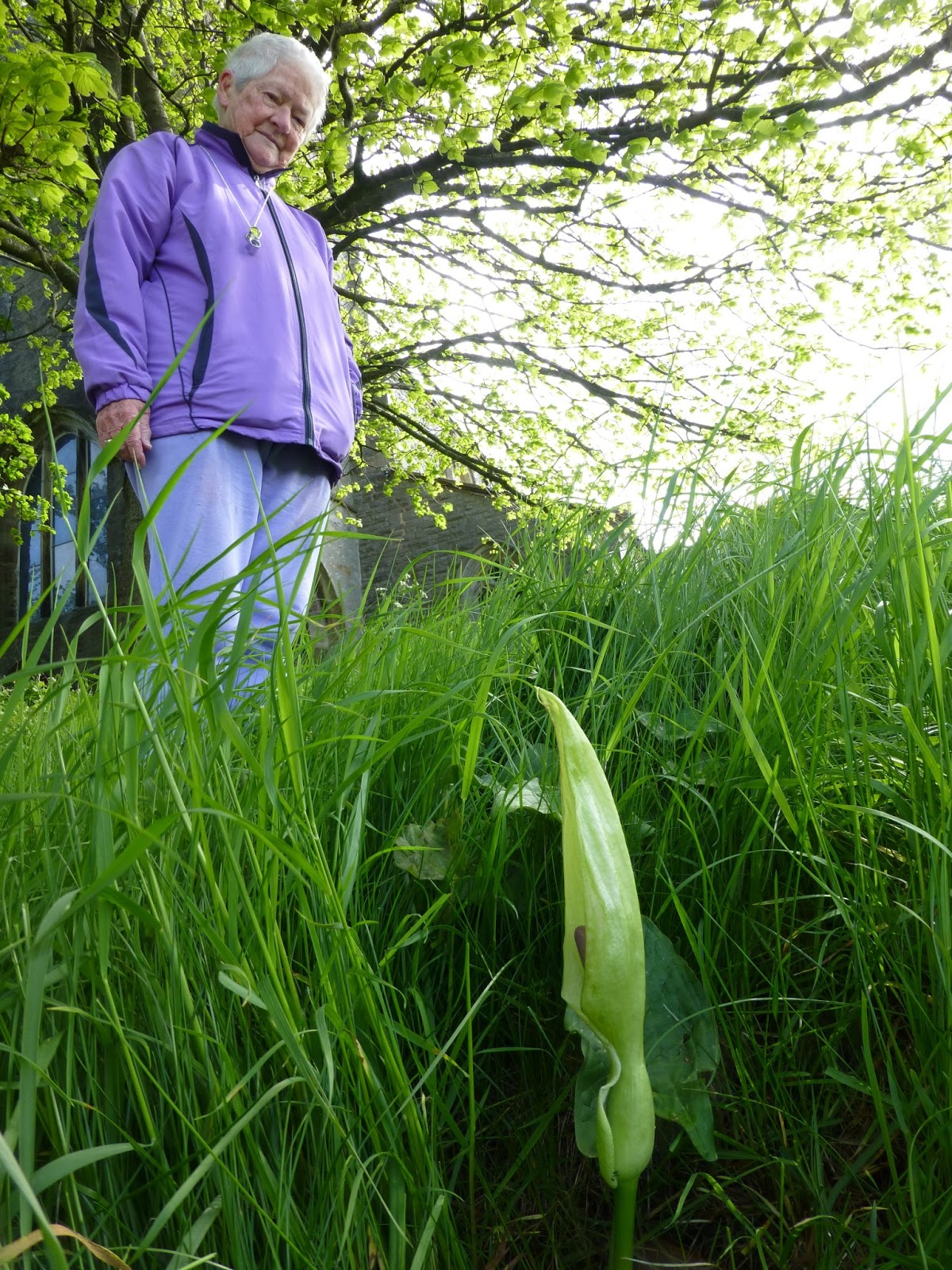
At the Ingleton Overground Underground Festival in May 2013 we launched Doris Cairns' book of paintings of the wildflowers of the churchyards at Ingleton and Chapel le Dale.
Doris attends Ingleton Church


The book is written in a lively style. There are stories and explanations as to how many of the flowers got their names, and about Latin meanings.
The book costs £15-00.

Here are pictures of the Launch.
Angela my friend said "I like the book and enjoyed the walk to see the flowers and your talk about flowers .. but I would like to have heard Why and How Doris came to write the book.."  I asked Doris.. but her answer is for another blog post.

Just enjoy the pictures of the launch here.

Revd Charles Ellis (right) introduces Doris (far left) and her book at the launch

Looking at the book

In a walk round the churchyard we look at the young Sand-leek.
The blue rope has been positioned to protect it from mowing.

Young Sand-leek

Doris looks at "Cuckoo Pint" from above

Now we are looking at the Cuckoo Pint  from above -
see the Ingleton Viaduct in the background.


Which buttercup is this?
Sepals pointing down - yes it's Bulbous Buttercup.
Copies of the book are available in the church and in Curlew Crafts, Inleton