Sunday, 13 March 2022

SD86 - Three year review - 36-SD8366 12 March 2022

 12 March 2022

This post has two main aims: 

1. A three year marker in my lichen survey of SD86

2. Showing some lichen pictures that I need answers for. 


It is three years since I started to survey hectad SD86 !! 

That was Feb/March 2019 after returning home after the Workshop at Cober Hill, Cloughton, near Scarborough, with the British Lichen Society - and armed with a dot map from Janet Simkins the BLS Data Manager  showing the number of lichen records for each monad in my ViceCounty - VC 64.

A hectad has 100 1km squares - a lot. "I will record 10 squares per year" I said.


On 3 April 2019 I wrote my first lichen blogpost:-

SD86 - 00 - SD8060 - Rathmell - Lichens Rule!


I attended Cober Hill again in 2020 - just a week or so before Covid Lockdown.

In February this year 2022 I had hoped to attend Cober Hill, but caught Covid at just the wrong time, so was unable to go. It also stopped me attending a two day lichen course in Cumbria with the Cumbria group.  

(.. If you ask.. . Fortunately Covid came to me as a cold.  I tested negative the first two days of the cold - only on the third day did it register positive. Then it took 13 more days to be negative again.)

Three years on, I have achieved recording 30 monads each with 19 or more species in each. 
There is an average score of 31 species per monad, with the  highest scores being 62 (Swaw Beck),  58 (How Beck), 47 (Winskill Stones), 44 (Scaleber/Black Gill).  The first two had six or more visits, Winskill Stones had had three, and Scaleber had had at least four visits...

Yesterday (9 March 2022) I went out with J Wulf's Settle Nordic Walkers and recorded some Ramalina fraxinea - fallen off a solitary sycamore above  Catrigg Foss..in a new monad for my survey. - Which encourages me to stop now and take stock.

I also made the Resolution to WRITE UP any new records that I had found. 
THAT DAY
(And wrote up all three) 

Today 12th March.

It was sunny ish and I set off at 3.30pm intending to continue above Catrigg Foss. 

I made the mistake of driving, 
and parking next to the road in the parking space at the far end of Winskill Stones.

And what do lichenologists do in Car Parks? 

Yes,
They rarely get beyond the boundary of the car park.. 
And so it was.

I parked, and set of at 180degrees to my intended destination and stopped
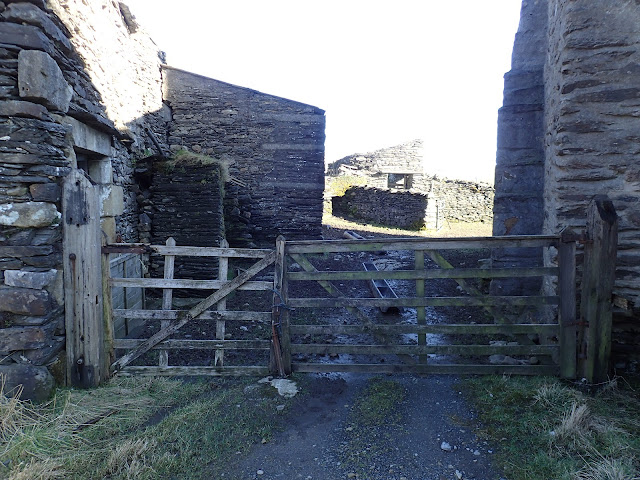
-at the rickety wooden gate by the road just opposite my car - with Fuscidea lightfootii 


And two more unnamed - Note for scale:
 The majority of close ups were taken with my Olympus tough camera and the capture a field of view about/ or a little bigger thn29mm wide and 15 mm tall. 


Query No 1.

Query No 2


-at a limestone outcrop just beyond (possibly quarried a little in the past) with lots of fascinating fossils rather like the labelled fossils at the cattle-grid at the road down to Lower Winskill from the other carpark- There was - some potential Farnoldia, on the limestone:  and a brown areolate crustose species with black fruiting bodies

Does anyone know what this pale brown crustose areolate or at least rimose (=cracked) lichen with black fruiting bodies is? On top of limestone and possibly influenced by nutrients and water from soil / droppings
Query No 3

Query No 3

The thallus did not seem to change colour when I added bleach (centre) and KOH (just above my finger)


Same closer up - Query No 3

And here nearby in a vertical position in a dry stone wall. Query No 3
-It is Fuscidea cyathoides colour but this is growing on limestone and does not have a black edge to the thallus. Whereas Fc grows on acid rock.

-----------------------------------------------

Also intriguing on this rock were "Little white eggs" laid in the depressions left or made by a lichen fruiting body.
See the "eggs" near the top

Query 4 and Query 5
On the left is Placynthium nigrum with its navy blue prothallus.
Top centre you can see the  possible white eggs?
And I am not sure what the black fruiting bodies are - All suggestions welcome

-------------------------------------------

-

I walked over the cattle grid and north west down the road 15m 
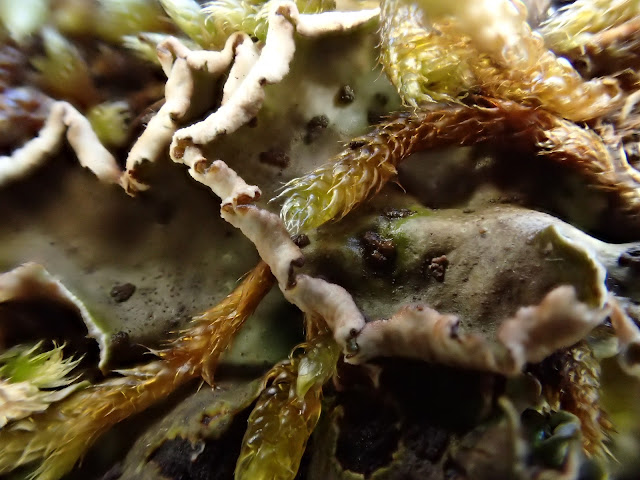
There was a thick white lichen growing over moss.. It was very thick and lumpy almost papillate. I searched for fruiting bodies but could not find any, but put possible contenders in a plastic bag.

I racked my brains remembering there was a parasitic lichen that grew on moss..


I looked over the wall to the horizon to the valley separating  Penyghent on the left and Fountains Fell on the right
Then I noticed patches of moss were always at certain points on the wall - always next to a wooden  (bird perch) post.


So I photographed the moss 
and then and noticed a white patch in the moss.. It was Diploschistes muscorum - in fruit.


Indeed on the top of the wall there was a big patch of Cladonia pocillum - The host on which the Diploschistes initially grows. (See top right of picture belwo)


 -------------------------------------------

By now now the sky was grey and I was getting freezing cold. 
I came home. 
-------------------------------------------
Back at home:

Now I must
1. Enter the species I know.. 

-------------------------------
End of day:-


Well I've increased the list for SD8366 by 5 to give a total of 52. I only need another four species to move it from the orange band up to the red band at 56 species. 

Five new species for my list for SD8366 - And all within 50 metres of the car park!

-------------------------------
Any help with queries would be really welcome.

 -----------------------------------------------------

and just checking ..I see I did not enter the Peltigera leucophlebia I found on that beautiful Lockdown day on 9 May 2020- When I walked on Plantlife Reserve photographing wildflowers such as Early Purple Orchids and Horseshoe Vetch for my Wildflower Dairy
So I add that now.

Only two months away. Early Summer is nearly here!. Must get planning. .. and so much to do before then.


Saturday, 12 March 2022

Nordic Walking, Ramalina fraxinea, Shield Ferns, Eoin Keith, Plantlife, Blue Moorgrass, Spring Flowers near Settle

This post is lamenatably unspecialised. Enjoy leaping from topic to topic, in the same way as I leap from clint to clint on limestone pavement.

And just as I find different worlds down different grykes, so you will find different worlds in this walk at different stages of this blog, of this walk to Catrigg Foss. We have so much to be thankful for around Settle.


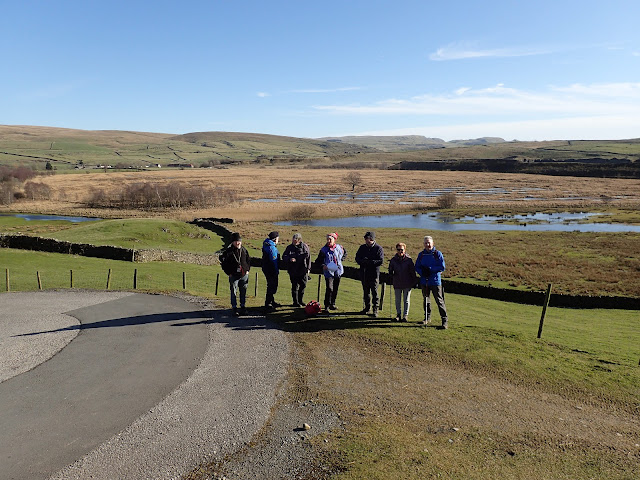
To day I attend a Nordic Walking session led by Jo Wulf. She has 8 walkers in the group plus a baby strapped to one very fit walker's chest. So she has a flock of nine altogether. She lends us poles, apart from M who has his own. 

We meet at the car park of Plantlife's Reserve Winskill Stones. I am pleased to see the new(ish) notice board (after 20plus years) in the car park showing only plants that can be found here. I remember surveying the reserve in 1998.  The year that Plantlife bought it... 24 years ago.. just seems like yesterday.

I show the group - or at least those who will look - the Blue Moorgrass - Sesleria caerulea on the rocks in the Car Park. This plant is listed as Nationally Scarce. - So if you visit Winskill Stones do look out for it. People come up all the way from London to here to see it. It is only just coming into flower today 11 March -- but it is easy to recognise because it is the only grass in flower at this time of year (apart from Annual Meadow-Grass). It is very special because the flowers actually start to from inside the shoots in late autumn and sit there over winter, ready to shoot in early spring.

And it is blue.


(These pictures were taken on a different occasion later in March in a different year)


From NBN 2019


We set off

Jo reminds the newer people of techniques. The poles should be pointing backwards, so "Trail the pole tips along the road and then use the poles at that angle."


The cattle grid at Winskill Stones


----------------------------------

After a kilometre, at the top of Goat Scar Lane there is a tree and under it I find a lump of lichen that has blown off - Ramalina fraxinea. This used to be a rare lichen in the area but I have now found in several times - including in the copse of trees planted on Winskill Stones half a km away. It seems to like growing on trees in in exposed places.

Fortunately this tree is in a brand new monad (1km square) SD8367 in my recording system at SD 83176700 - by about 7 meters - so the lichen is a worthwhile record in my recording scheme. 

Angela and I also look at the big white patches on top of the limestone walls - Aspicilia calcarea.


Ramalina fraxinea

--------------------------------------------


We walk down the steps to Catrigg Foss - A favourite haunt of composer Edward Elgar .

We look at the stream at the top.


We walk up to the path ready to descend.


Several trees blown down in the recent gales have been sawn through to give us access


Half time sustainance


Jo gives us some Gluten free chocolate nut flapjack.

I photograph the flowers: Opposite-leaved Golden-saxifrage and Dog's Mercury.


Opposite-leaved Golden Saxifrage

Dog's Mercury


Then I take photos of Ferns: Hart's-Tongue Fern and Hard Shield Fern. I wan to write about local ferns on Facebook, ready for the Talk on 17 March by Alison Evans.


Hart's-tongue Fern


Hard Shield Fern

Hard Shield Fern

Hard Shield Fern


Time to return.  I look at the geology to work out why the deep valley valley has formed here. On the far side of the valley to the north is Silurian Acid rock - 423 to 428 million years. On our side, the south it is limestone- 326 to 359 million years ago in the Carboniferous Period.


The Nordic Walking group climbs back up the limestone 


As we walk past the copse in in Plantlife's reserve where I had seen Ramalina fraxinea nearly three years ago I remember taking a "Slow Video of Curlews" that evening on 2 July 2019. Last week I had attended a talk by the Curlew Recovery Program who told me "If you hear curlews calling late in the year it is a good sign that they have stayed around to raise their young, and that the young have thus probably survived. (otherwise the parents would have left)


We hear no curlews today but I do hear a skylark.


We hear no curlews today but I do hear a skylark.


I looked up towards the skyline - to a valley made with  Penyghent on the left and on the right is the steep slope of Fountains Fell. I remember the Spine Race earlier this year: the early morning of 10th January of this year 2022. 

I had gotten up before dawn to go and watch the fore runners of the Spine Race. (The Pennine Way in January) The leaders who had set off at 8 am the previous day from Edale were now 90 to 100 miles north, 25 hours later. By 9am one determined walker was running with poles, 

Yea - Nordic walking like us!???

and he had little time for my videoing and probably inane comments - His name?  - Eoin Keith. 


At this stage he was lying about 4th - I had videoed Eugeni an hour earlier at 8am. The two leaders had passed at least an hour - maybe two hours before I had arrived - Indeed had passed Horton before I had left my house.. otherwise I would have gone to Horton to see them.. Eoin was lying fourth - and with James and Sabrina on his heels a few minutes. But bit by bit over the next 3 and a half days the people ahead of him had over extended themselves and were forced to retire. And Eoin and his walking poles won the 268 mile race in just over 92 hours  40min and 30 seconds.


So Jo - I'll keep persevering with the poles.

----------------------------------------

Back at the Car park: Jackie reminds us of the cake stall and teas at Giggleswick Church in Aid of Ukrainian Refugees that afternoon. I remember that I have to go to IPrint to collect the prints to put on our display at the ACE Climate event at Victoria Hall.

We say "Thank you to Jo"

If you would like to go Nordic walking at or near Settle contact
Jo Wulf at 07966 981985 or email jowulf@wolftracks.co.uk

Nordic walking Nordic walking fitness walks.
.Mon 9am and Friday 10.30am from Settle.
Wednesdays 2.30pm from Long Preston. £5. Poles provided.


Thursday, 3 March 2022

Helwith Bridge - 1 March - Walk for the Climate


We met at 1pm at the CarPark opposite the Helwith Bridge Hotel on 1 March 2022


Today’s IPCC report is … a damning indictment of failed climate leadership…This abdication of leadership is criminal…now is the time to turn rage into action.’ Antonio Guterras, UN Sec General, whose speech starts at 12 mins into the launch video.

Climate change isn’t lurking around the corner waiting to pounce, it is already upon us, raining down blows on billions of people,’ Inger Andersen, Executive Director, UNEP.


to be continued


Half way round, and below Foredale Cottages we look out over the Moss


Learn your Settle Ferns: - Three ferns at the entrance to St John's Church Settle

Wall Rue; Hart’s-tongue Fern; Maidenhair Spleenwort 

Have you noticed the the tiny ferns growing on the red brick garden-wall next to the telegraph pole with the signpost for St John’s church, on Church Street at the entrance to St John’s?


Ferns do not have flowers  are an ancient lineage of plants, much older than flowering plants.

 The leaves, called fronds, are divided into pinnae (leaflets). If you look at the back of mature fronds you will see brown blobs where the spores are produced.

 Our ferns  here are rather wind scorched - but they are a good introduction to the ferns that grow on cliffs and down grykes in limestone pavement.

 Maidenhair Spleenwort has a black stem and opposite round leaflets - called pinnae


Maidenhair Spleenwort


Wall rue has very irregularly lobed leaflets and is the tiniest of the three


Harts tongue fern has a frond that is not divided into pinnae - it is a simple strap shape.  Our specimen is very stunted - most fronds are only a few cm where as in woods and shady gardens they can grow to 30 cm long.


Have you got any ferns in your garden or on your walls?


Craven Conservation Group uses our church for its talks on the third Thursday of the month. This month - 17th March 2022 at 7.30pm - the group is pleased to have THE PRESIDENT of the British Pteridological Society giving a talk on ferns. (Dr Alison Evans is also a member of Craven Conservation group and lives near Earby)  all members of St Johns - indeed everyone from Settle area - are welcome to these talks. We hope we will also learn more about some of the rare species which grow in our area.

Saturday, 26 February 2022

Silver Eco-church award for St Johns - What else to do to work towards gold award? Visiting Speaker Pam Martin to come on 6 March

Green Speaker  as  Settle Methodist Church gains silver Eco Church Award


On Sunday 6 March St John's Methodist Church, Settle will be welcoming Pam Martin as their guest speaker for the morning service at 10.30am

This month (March 2022) St Johns  achieved their silver Eco Church Award for carrying out environmentally friendly activities. They gained their bronze two years ago

Pam Martin is an assessor for A Rocha for Gold Awards. She has a wealth of experience from assessing other churches, so we hope she will be able to give us some ideas of what we can do at St John's.

Pam now lives in Edinburgh, but still does work with Levens Church in the Lake District, and will be combining her visit to Settle with a visit to the Calisle Diocese Synod at Penrith.

St John's church extend a welcome to anyone in Craven concerned about green matters, and to other churches in the area that are working towards an Eco Church award.

"The tick box system for Eco Church - looking at church life, buildings, church life etc - has been very helpful in encouraging us to be proactive in doing things,"  says Judith Allinson, a member of St John's Church,  "from carrying out a transport survey of church and hall users to setting up our pledges bottle. Our eco-group will be organising more trips through the year - the first one this month is to visit Allerton Waste Recovery Park near Knaresborough on the A1."

Pam Martin is a former teacher. When she taught in Germany last century she was very impressed how far ahead of us the German churches were in expressing concern for, and  Caring for, the beautiful world that God has made. She has since taken part in horticultural courses and written and spoken on behalf of A Rocha 

 A Rocha UK   https://arocha.org.uk/about-us

A Rocha UK (ARUK) is a Christian charity working for the protection and restoration of the natural world and committed to equipping Christians and churches in the UK to care for the environment