Monday, 5 May 2025

Climate Walk 1 May 2-25 Brockhole Lane , Settle to Cleatop Park Wood

People from Craven Conservation Group (CCG), Churches Together in Settle and the public came on this walk - 15 in total. We planned to set off at 10am and a Wildflower Exercise Walk 

this counts as a "Climate Walk"; A CCG walk - A "31 Days Wild" walk,  a Lichen Walk and  a Wildflower Exercise Walk 

Brockhole Lane: 3/4 mile long, a stonewall bordered bridleway with baserich soils,, with delightful wayside / woodland  flowers.  These plants can flower unlike the grazed sheep pastures on either side.

We are so lucky to have this resource in Settle.

1/2 mile upward through a grazed pasture (avoiding a cow and very young calf)

3/4 mile uphill through woodland on millstone grit with a flora that likes acid soil.

A view/ rest on big limestone boulders and outrops in acid grassland at the top ( a slight detour) and a spelndid view of Settle

Return through pastures higher up the slope and down to the start of Brockhole Lane.

Detour 1: The Age-UK Allotment - At Dog Meadow Allotment

In the foregound centre left is a hole- steps go down to running water whichis a culvert - so gardeners come here to get water.
Age UK have a splendid allotment. You can come here on Fridays and help I think of just have a chat - but check up with AgeUK first 01729 823066 or e-mail info@ageuknorthcraven.org It says Wed and Fri on their website but they don' do Wednesdays any more.


We set off


i was pleased to see there is still some water in Watery Lane (in spite of the fact the River Level at the Lochs Measuring gauge was down to 2mm. (NB 5 days later it is recording -1cm), We wil be coming here with Settle Eco Explorers tomorrow.

The special Town Hall Clock - Adoxa moschatellina


By 11.45 (1/2 mile walk) we had recorded over 20 plants. Three people had to return to Settle for meetings.

By c. 12 30 WE had walked 3/4 mile and recorded almost 40 species of plant in flower (I am waiting for the list from Geoff).
Four more people had to return home. That left about 7 of us.
 

 We walked across two pastures and uphill towards Cleatop Park Wood. We had Lunch in the Woodland Trust area below Cleatop Park Wood.

This area is all on grit rock 


We looked at all the Trees the Woodland Trust had planted.  

The trees do seem very densely planted. I do hope they will thin some of them out.


The bench had gone.

(I enjoyed having a break at this bench during my Coid year visit.


I was pleased to refind the Tree with the lichen Lecanactis abietina grwoing on it, about 50m up from the start of the wood.


We met a bird watcher and he showed us a pond area  in the wood that he said had been good for frogs ten years ago, but that had silted up now.


We saw the Climbing Corydalis growing by the path a bit uphill from this. It is too early for it to be in full flower. Here is a bit in bud.


That meant we had seen a total of five species of plant in flower in the wood: Bluebell (loads), Wood Sorrel (a few), Climbing Corydalis near the top end, Oak, Common Sedge. And that's it.

Four people now walked ahead to get back to Settle.

That left Geoff and Richard and I who enjoyed sitting down at the summit 


I took a photo of this fly sunning itself on a rock beside us, and the picture came out well, so I am showing it. It looks like Sarcophaga carnaria. Michael chinery;'s "Collins Guide to #Insects" says:-One of several very similar species with large feet and red eyes. Size is very variable. Common around houses but not often inside. Breeds in carrion, female bringing forth young larvae instead of eggs.


I was delighted to find a new lichen for my tetrad - a species of Cetraria.
Probably Cetraria aculeata but it could be C muricata.


THe view behind is us very good: - looking towards Ingleborough on the left and Pen y Ghent on the right.


After this it was a two mile return walk to Settle.


Saturday, 26 April 2025

Climate Walk 1 April 2025: Pen y Ghent - Purple saxifrage and Solorina saccata

 Our initial plans had been to go to Leighton Moss by Public transport (train) but as the key member for this was unable to come and the weather forecast was so good (a big yellow sun) we decided to go up Pen y Ghent. As we knew who was coming and we were relatively fit we climbed up the short steep path from Dale Head.  Phil, Phil and I.  (In 2022 a larger group of us had walked up the long slow way..)

I took my copy of Mike Berners-Lee's "A Climate of Truth" with me to show the others.


It was very, very, very windy so I did not explore off the path.  I took my red Christmas Pudding woolly hat off and put it in my pocket to prevent it blowing away. I just hoped the wind would not blow my glasses off and away high into the sky and over to Ingleborough.

At the summit we chatted with a group of students one of whom took our photos from all directions


The path at the top down the main route that had once been a very wide stretch of pebbles, almost scree, has now been replaced by steps, and the exposed pebbles and soil have grassed over.


Over the other side as we started to drop down to the limestone ridge along the main public footpath, we were suddenly in the shelter and it was sunny and warm.

We looked at plants - found the Purple Saxifrage and lots of  Mossy Saxifrage leaves. I took a photo of the lichen Solorina saccata growing next to the Purple Saxifrage.  


In the distance I saw a group of people. "I wonder if they are botanists?" I thought. But I was too lazy to go across and ask. I wish I had done now because it turns out I think they were a group of people I actually know.

Moral: Be curious, don't be lazy.

Then we walked down.  down. down. I was very grateful to Phil for lending me her stick to add to my own stick... so that I had 2 sticks for Nordic walking. I was still the slowest walker.  Oh my knees..

We called in at Hunt Pot where there were primroses on the slope.


Phil encouraged us to keep up our walking pace... If the bus at Horton to Settle was a few minutes late there would be a chance we could catch it..  "Keep walking" he said.

And we did catch it!!  "Thank you Mr Bus driver."

It took us back to Langcliffe (home) where we got into my car and drove back up to Dalehead to collect Phil's car.

So we used public transport after all.

-----------------------------------

Phil and Phil are keen to get an itinerary for the months ahead.  Do you have any suggestions where we should go for future 1st of the month's walks?- They can be long ones like this or short gentle ones.

1st  May is to be along Watery Lane (Brockhole Lane) to Cleatop Park Wood which will have lots of Bluebells.

And later in the year we may make it to Silverdale/Leighton Moss.


See other Climate Walks 


Thursday, 24 April 2025

Lichens of Ingleborough

Paper by Allan Pentecost and Mark Seaward in April's edition of the YNU "The Naturalist" - Journal of Natural History for the north of England 

on

 "Lichens and lichenicolous fungi of Ingleborough Hill and its immediate surroundings." 25 pages long.

I was delighted to receive this the day before I attended the  British Lichen Society's week long spring meeting in Wales (at Plas Caerdeon, between Dolgellau and Barmouth) and was able to show everyone at the meeting the journal and article I had just received.


Both Allan and Mark are former presidents of the British Lichen Society.

Allan has been visiting Ingleborough a lot over the past few years and I went on two walks with him in the lower slopes of Ingleborough - one in the west, one on the east.
Andrea his wife supplied the photo of Ingleborough for the front cover - taken from an unusual view.

Mark has done a lot of research into finding early records of lichens. It is impressive how some "Rainforest Species" have been found here in the past - including Lobaria and Nephroma. and Pannaria rubiginosa. Alpine species were seen near the summit. It is very useful to see what species were recorded in the past.

The rainforest species are not there now. The mill towns around Bradford and Lancashire, and maybe sulphur dioxide from chimneys from power stations in the last century have had their effect.


I ran a walk for the Yorkshire Wildlife Trust / Wild Ingleborough project in 2023 introducing people to Lichens. .. potentially billed as Yorkshire's Lost Rainforest  . Colt Park Wood does get enough rain (just) to classify as an Atlantic Rainforest area.  The rainforest species don't grow here now due to pollution in the last couple of centuries - but it is good to see in this paper reports of records showing that a few species did once grow here.


 I visited Ingleborough twice with Allan when he was carrying out surveys for this project. Once when I was pleased to find Peltigera leucophlebia on the hillside above Bleak Bank Farm (famous locally from the channel 4 TV series with the Dawson family). The second time we walked from Horton via Sulber and above Thieves Moss when Allan showed me Placynthium garovaglii

-------------------------------------

They say
"377 taxa have been recorded of which 34 taxa have not been seen since the 19th century and a further 18 taxa are doubtful in the absence of herbarium material" So I suppose that means 325 species have been recorded.

-----------------------------

The picture on the back cover of the magazine show the people at the YNU conference at York this March with over 100 people. I took the photo!  It was a good conference.


A lichen I was shown on a trip up Ingleborough below Sulber is
Placynthium garovaglii  


There are two upcoming BLS Week long Field Meetings in the north of England:   In Autumn 2025  at Hebden Bridge;
in 2026 maybe in the Eden Valley (in Cumbria, but bordering Yorkshire.)


Find out more about the Yorkshire Naturalists' Union here.
Find out more about the British Lichen Society here.

Eventually I might write one or two posts about the BLS trip to North Wales. The previous post to this describes P horrescens

See more posts on this website about lichens


Wednesday, 16 April 2025

Hypotrachyna-horrescens in Woods at Tan-y-Bwlch

The BLS Spring meeting this 2025 is based at Plas Caerdeon outdoor adventure centre near Barmouth. 

On Monday - Day 2 the group visited  Coed Hafod y Llyn (Tan y Bwlch Centre buildings are here) (Tan-y-Bwlch railway station is the principal intermediate passenger station on the narrow gauge Ffestiniog Railway, which was built in 1836 to carry dressed slate from Blaenau Ffestiniog to Porthmadog for export by sea,)

Hypotrachyna horrescens (used to be called Parmelinopsis horrescens ) could be confused with Parmotrema crinitum - They both have Parmelia-like pale grey thalli. and some black cilia on the upper srface (like Desperate Dan's bristle. But H horrescens is smaller - lobes 1- and P crinitum has lobes to 15mm wide,3mm wide  P. horrescens medulla is k- and the cortex is k yellow. P crinitum medulla is K orange.


See more posts on this website about lichens

Tuesday, 1 April 2025

Rhizocarpon geographicum (Map Lichen) at Linton Churchyard

I am running a two  hours "Lichens for Beginners Walk" at Linton Church on Saturday 7 June 2025  starting at 9.15am. -   Details here

--------------------------------------------------------------------------------------------

I associate the fluorescent yellow green of this crustose lichen with slates of the Lake District and North Wales. It is said to be a lichen which which grows on rocks in mountainous areas of low air pollution However it does grow on acid rocks in this part of Yorkshire too, and its colour makes it stand out.

There is a patch on this buttress near the church porch. 

Rhizocarpon has been put outside a space station in outer space, suffering no atmosphere and intense radiation - and on return to earth was able to continue growing. This is an example of an extremophile

The lichens were subjected to the vacuum of space and to temperatures ranging from -20°C on the night side of the Earth, to 20°C on the sunlit side. They were also exposed to glaring ultraviolet radiation of the Sun.

The green parts of the thallus (like little islands - called areoles- contain the mixture of algae and fungi. The black lines between them, and thick at the edge are just fungus - called prothallus.


This is a picture of the thallus (lichen body) enlarged . I showed this to the Lichen Chat and Improvement Group and they said that the black splodges are a fungal infection.  


Judith at Helwith Bridge/Foredale pointing
to the Rhizocarpon geographicum
on the Ordovician / Silurian rocks near the Quarry

Here is a link to a post  including Rhizocarpon geographicum on this blog

Monday, 31 March 2025

Blastenia (Caloplaca) crenularia - Lichens of Linton Churchyard 2.

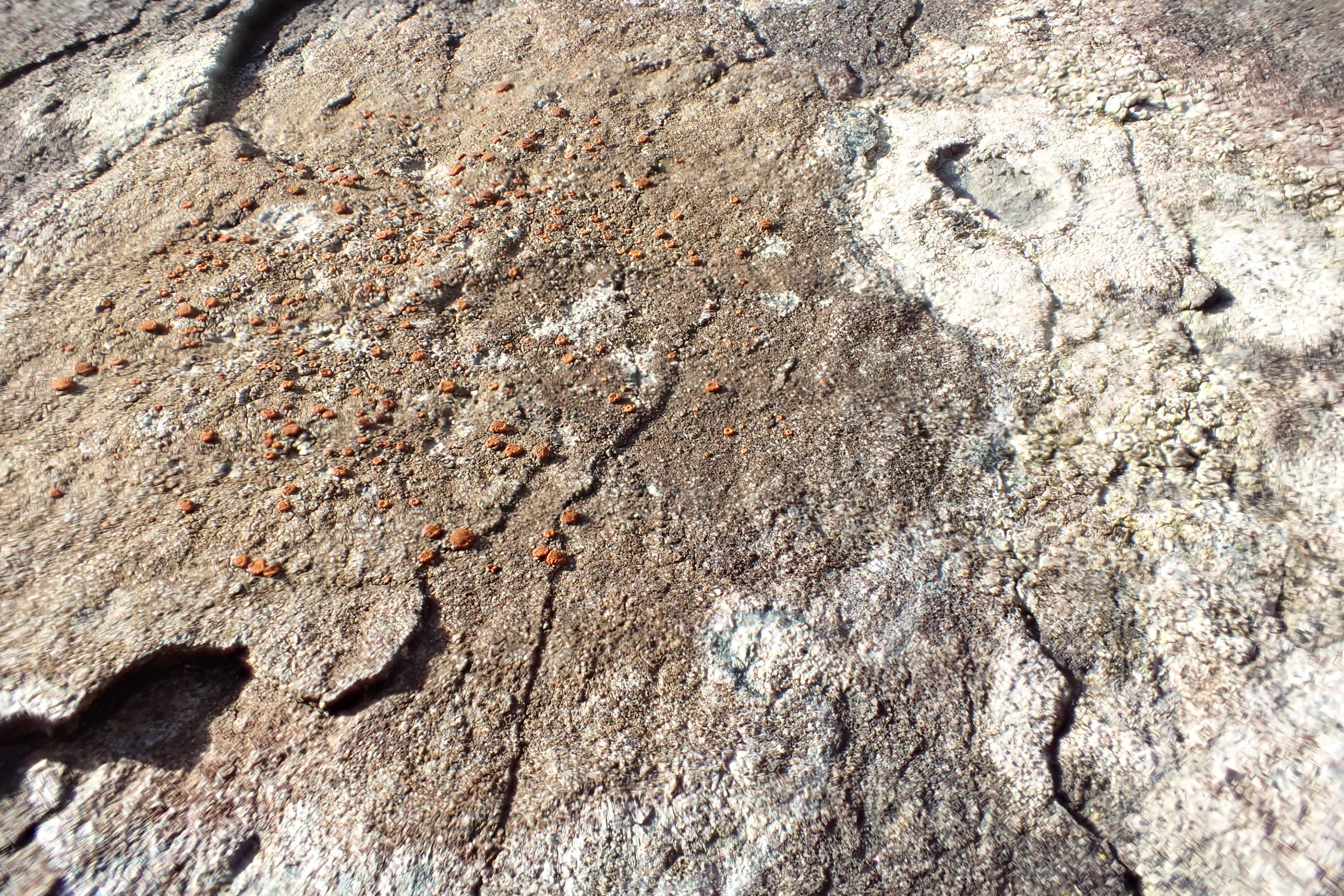
 This crustose lichen with its many brick red apothecia is distinctive. It grows on acid rock, here on top of a table-tomb.   It is a new record for this churchyard not spotted in 1993 when the last reported survey of the churchyard was made.


Friday, 28 March 2025

Lichens and mosses on limestone at Dalehead after Johnny Campbell and Amy-Jane Beer passed by up Penyghent

 Tue 25 March 13:47pm -Johnny Campbell (Second from left) and Amy-Jane Beer  passed by on their way up Penyghent and on up the Pennine way

Fountains Fell Behind them -- turn right...

and set off up Pen y ghent


I crossed over the road (behind me from where I took this photo) and into the field and studied the mosses and lichens on a few rocks of exposed pavement -the rest of the pavement was under soil and mosses.  15 species of moss in no time.  But I struggled to get more than seven lichens on the first few rocks SD843489 713589

Squamarina cartilaginea

The rock I was recording. By the time I took this they had reached the summit.

There was lots of Placynthium nigrum  on the limestone- some fruiting

I moved to some more rocks 20m away SD8435771393
The Placynthium nigrum had a little bit of the parasitic lichen - Toniniopsis verrucarioides


Toniniopsis verrucarioides on Placynthium nigrum

Acarospora glaucocarpa (This is quite close up)
Well that's my guess... but seems pretty similar to A cervina.


Acarospora glaucocarpa on the Placynthium nigrum


A big blob of Rhizocarpon umbilicatum - not many features on it in this photo but a thick thallus and it is turning a little yellow with K . 


So my lichen total was 13.

Thursday, 27 March 2025

Myriolecis antiqua (Lecanora antiqua) - Lichens of Linton Church

On Sat 5 April I am planning to lead a two hour "Introduction to Lichens for beginners" churchyard walk.  at Linton Churchyard, Grassington, starting at 9.15 am. This is free but it is necessary to book (because if no-one-books I won't turn up )

Here is a new lichen for me for my area: 

----------------------------------------

On the right hand side of the arch at the church entrance is a large whitish patch made up of lots of densely packed apothecia (fruiting bodies) with a "jam tart rim". - A species from the genus Lecanora.  If not on mortar, it will be influenced by the mortar between the stone

 blocks.

I have not seen this species in my home hectad of SD86 yet. (Though it has been recorded before 1999 in the Malham Tarn House monad)  I tested it left with a drop of C (bleach)  and right with a drop of K (alkali)


The apothecia discs  (Leftish)  go orange with bleach, and slightly yellow green with KOH (rightish) 


When Maxine saw the picture at our LCIG (Lichen Chat and Improvement Group) she immediately saw the colours of the spot tests (orange on apothecia)  and said "antiqua".

I was pleased. I had been introduced to this species at Preston Montford by David Hill in 2023 - see pictures

and found it I think on an old wall at Cober Hill, Cloughton (though there is no record within the correct monad for Cober Hill, only the one next to it.).


It has already been recorded in this Linton/Grassington Monad - pre 1999  SE0066  to be precise: SE 0049663224


See more Lichens Posts

Tuesday, 25 March 2025

Pennine Way - Johnny Campbell tour - Malham - Horton section - Rob Cowan Great North Road - Amy Jane Beer Nature Writer -and more

Johnny Campbell and friend Freddy Hodkin are walking the Pennine way and arranging performances en route.

Johnny Campbell Singing at Malham Methodist Chapel


He wrote: "Myself and @freddiehodkincomposer  of @righttoroam_kernow will be walking the 268 mile journey in 19 days, 17 shows en route to champion and celebrate the 60th anniversary of Britain's first long distance trail!)

I was given a poster about the event at Horton in Ribblesdale on 25 March -by Horton Church - but then saw there was an event at Malham on 24th also featuring the writer of a book due out in April of "The Great North Road" - 

Which became the A1. 

Having grown up in Ripon, 5 miles from the great North Road and with memories of being concerned (and possibly confused) at the tender age of say 8 or 9 that this Roman road was now being covered by tarmac dual carriageway  I was keen to hear this speaker, so went to Malham Chapel.


Rob Cowan


It was a lovely occasion - We heard the fascinating talk by Rob Cowan with readings from his book, including a picture of a skeleton recently being excavated at Catterick.    The light walls and modern projection equipment worked well.

Johnny Cambell's voice resonated in the well-lit chapel. This was done up about 15 years ago - pews removed and a special floor with illustrations of Malham Cove, Janet's Foss etc illustrated so that you can go on a mini-pilgrimage round the village within the Chapel building.


Sally from Malham Chapel was there providing hot drinks and squash and cake and crisps for both before and in the interval of the event.. (and an opportunity to visit the spacious disabled access loo.)

I used to attend Malham Chapel when I worked at Malham Tarn Field Centre.. So it was memory lane.. except that it looks completely different now with the pews removed.  One memory I have of the chapel was the Sunday school anniversary with about nine   8-11 year olds (At that age, how long will they keep coming I thought).  This evening three of them had actually come for the performance.


 I looked at Rob's book and will buy it next month.

I bought a DVD of Johnny's music and a tea -towel

And I met Amy Jane Beer - nature writer and in 1921 president of Friends of the Dales. 


She told me she was walking with Johnny to Horton on Tue 25th and would be speaking at the event at St Oswald's church that night.  So as I write this they are on that walk....


Past Malham Tarn Past the Field Centre and SSSI/ Ramsar site, SAC, National Nature Reserve,

Past the barn used for the scene in Monty Python's "The Meaning of Life" 

Over Fountains Fell

Over Pen y Ghent

and down to Horton

--------------------------

I remember many other people I have met on that route - 

From Peter Bayes and his wife at the Pen y Ghent Cafe who I met when as a  teenager I was walking the first half of the Pennine way. (maybe 55 years ago)

To the many adults on courses like "Exploring the Yorkshire Dales" from the Field Centre when we walked the 12 miles from the Tarn to Horton

To people from Lichens and Mosses expeditions  .. (We have REAALLY good Mosses and Lichens in some of the limestone cliffs and gills and pastures in this area. )

To The Bishop of Bradford (Now Leeds - Revd Nick Baines) on his first day as Bishop of Bradford, when we walked up PenyGhent in the rain

To Jasmine Paris, and other Spine walk racers. (I will add some links later)

---------------------------------------------------

The next day I drove up to Dale Head at 2pm, in Silverdale valley between Fountains Fell and Pen y Ghent...to look out for Johnny and his group - I was only just in time - they were making such good progress. 


Here they are just before leaving the tarmac road to start the ascent of Pen y Ghent.

Amy-Jane Beer was with them and showed me a photo of the lichen Rhizocarpon reductum up Fountains Fell, with its apothecia in concentric circles. 

I waved them on and then crossed to the grassy mossy lumpy pasture opposite with a very few exposed rocks of limestone pavement - where I enjoyed the warm afternoon. Inspired by the British Bryological society Meeting last week I recorded 15 Bryophytes. I tried to find 10 lichens on the same rocks. It was hard work - I managed seven - and then had to move 20 m where I found rocks which included an extra 3 species.