Thursday, 8 May 2025

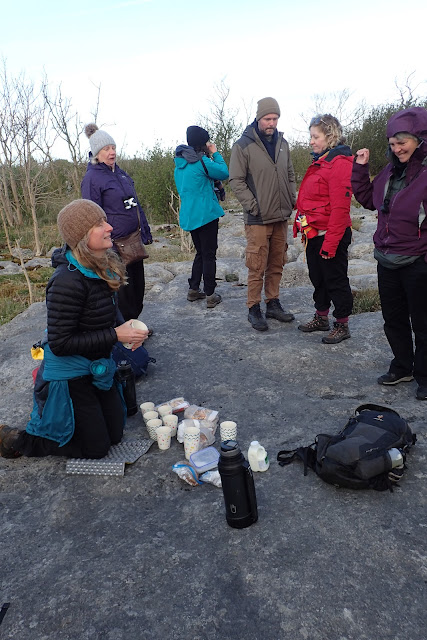
5 May -Day 5 of 31 Days Wild - Early morning walk with John Osborne as part of Ground Nest Fest

Wild Ingleborough and The Folly have again organised various events for the week - Ground  Nest Fest.

We met at 6am at the Chapel le Dale Car Park 


Then we walked up past Southercales Farm settlement, Past this Ash tree with a ? Mountain ash? growing on it.


Well Done Ellie. .. Not on the programme - she had carried up a thermus flask and coffee and redbush tea.
Very welcome


4 May 2025 4b of 31 Days Wild - Lambing Service at Horton


Audrey reads "Little Lamb, who made thee?"


John Dawson explains the work involved in lambing.


Explaining the uses of wool


4 May: Mike Berners-Lee's books in the church garden: A Climate of Truth, and How Bad are Bananas? - talk 10 May

Next Saturday 10 May, Mike Berners-Lee will be coming to the Action on Climate Emergency, Settle  (ACE) meeting held in our St John's Methodist church hall, BD24 9JH to lead a discussion on his latest book - "A Climate of Truth" 

Meet at 10 for coffee ready for the talk and discussion at 10.30am 

I took some photos of two of his books in our church garden.

A Climate of Truth and How Bad are Bananas?


It is a good weather forecast for Saturday so why not have your cup of tea/coffee in the garden? 


Photos taken on 4 May


Lichens near Foredale Farm - mid north side of SD8069 - 3 May 2025


The route of the old road to Foredale Farm, bounded by two drystone walls, was left when the newer tarmac road to the quarry was built many years ago.

Penyghent seen in the distance. 

This made a nice place to sample lichens as the old route is now grass covered.  The walls, whilst constructed mostly of siliceous rocks, had a few limestone stones in them, and the sun shone.

Here are some lichens I found. I really wish I had taken a photo of the farmer on the quadbike with the sheep and lambs too.


This is Xanthoria calcicola (also in the top picture) which has a very warty thallus and is bright orange with a slightly more yellow bright margin. It does not usually fruit, but this one has apothecia.


I am calling this Diploschistes muscorum. It has urn-shaped apothecia - They seem very small in this specimen but maybe they are young.  
Close up


The very small apothecia  in the small thalli on this rounded sandstone rock in the wall turned purple with K. I call this species Caloplaca holocarpa sensu stricta.  It is a distinctive species 


Another jolly patch of Xanthoria calcicola. Xanthoria calcicola is rare around here
 in this Settle hectad. 

But I think I have seen in the Mersey embankment, on the Thames Embankment, on the Wall beside the Seine and in the botanic garden at Barcelona..( I  just need to double check.)


Dermatocarpon miniatum - Although it is growing on a sliceous rock there are odd limestone rocks in the wal, and also this wall is a hundred me or so from the old long since discues limestone quarry processing plant when there would have been lots of limestone dust.  I had put a bit of water on this very dry lichen.


Collema fuscovirens


The bedrock showing in the track is an anticline. 
It has some Lecanora muralis growing on it 


Another jolly patch of Xanthoria calcicola. Xanthoria calcicola is rare around here
 in this Settle hectad. 

But I think I have seen in the Mersey embankment, on the Thames Embankment, on the Wall beside the Seine and in the botanic garden at Barcelona..( I  just need to double check.)


Monday, 5 May 2025

2 May 2025: Lichens in SD8069

I would like to send in my Lichen results to the British Lichen Society for the first ten monads of my hectad SD86 (from Rathmell to here- Helwith Bridge)  but somehow I did not write up my results for this monad to locations to a precision better than SD8069.

So this is a good excuse to resurvey parts of SD8069 the Helwith Bridge aquare.

So I set off on the evening of the 2nd May 2025.

The geology here is well studied and very interesting - with folded 450 MYR old siliceous rocks at the bottom (Silurian and Ordovician) and an  unconformity with  a 100 MYR gap and  then Carboniferous Limestone on top (actually the limestone is just into the next monad and hectad to the west).

The rocks at the bottom have been quarried for many years at Helwith Bridge Quarry

The names of these rocks seem to change EVEN FASTER than Lichen names. I would, at  O level 50 years ago, have called these "Silurian slates" - I like the alliteration.   Then I was told they were "Greywackes" which is sandstone formed when sandy deltas slipped down into the sea and the pressure metamorphosed the sandstone. Then last week I was told it was part metamorphosed siltstone.  The British Geol Survey this week calls it "Horton Formation - Siltstone. Sedimentary bedrock formed between 427.4 and 425.6 million years ago during the Silurian period.".. And Says the old name "Horton Flags"  is now obsolete. And the rock next to it is  Austwick Formation Sandstone (Silurian Period) Map 

Anyway it is siliceous rock. 

I took this to be Porpidia macrocarpa


View from site towards Penyghent


Some sort of Cladonia. there was a lot of C subcervicornis around.


Normandina pulchella on moss (Hypnum maybe cupressiforme) on sloping rock outcrop at ground level


Ptilidium ciliare and Peltigera membranceaea


See other lichens posts


Climate Walk 1 May 2-25 Brockhole Lane , Settle to Cleatop Park Wood

People from Craven Conservation Group (CCG), Churches Together in Settle and the public came on this walk - 15 in total. We planned to set off at 10am and a Wildflower Exercise Walk 

this counts as a "Climate Walk"; A CCG walk - A "31 Days Wild" walk,  a Lichen Walk and  a Wildflower Exercise Walk 

Brockhole Lane: 3/4 mile long, a stonewall bordered bridleway with baserich soils,, with delightful wayside / woodland  flowers.  These plants can flower unlike the grazed sheep pastures on either side.

We are so lucky to have this resource in Settle.

1/2 mile upward through a grazed pasture (avoiding a cow and very young calf)

3/4 mile uphill through woodland on millstone grit with a flora that likes acid soil.

A view/ rest on big limestone boulders and outrops in acid grassland at the top ( a slight detour) and a spelndid view of Settle

Return through pastures higher up the slope and down to the start of Brockhole Lane.

Detour 1: The Age-UK Allotment - At Dog Meadow Allotment

In the foregound centre left is a hole- steps go down to running water whichis a culvert - so gardeners come here to get water.
Age UK have a splendid allotment. You can come here on Fridays and help I think of just have a chat - but check up with AgeUK first 01729 823066 or e-mail info@ageuknorthcraven.org It says Wed and Fri on their website but they don' do Wednesdays any more.


We set off


i was pleased to see there is still some water in Watery Lane (in spite of the fact the River Level at the Lochs Measuring gauge was down to 2mm. (NB 5 days later it is recording -1cm), We wil be coming here with Settle Eco Explorers tomorrow.

The special Town Hall Clock - Adoxa moschatellina


By 11.45 (1/2 mile walk) we had recorded over 20 plants. Three people had to return to Settle for meetings.

By c. 12 30 WE had walked 3/4 mile and recorded almost 40 species of plant in flower (I am waiting for the list from Geoff).
Four more people had to return home. That left about 7 of us.
 

 We walked across two pastures and uphill towards Cleatop Park Wood. We had Lunch in the Woodland Trust area below Cleatop Park Wood.

This area is all on grit rock 


We looked at all the Trees the Woodland Trust had planted.  

The trees do seem very densely planted. I do hope they will thin some of them out.


The bench had gone.

(I enjoyed having a break at this bench during my Coid year visit.


I was pleased to refind the Tree with the lichen Lecanactis abietina grwoing on it, about 50m up from the start of the wood.


We met a bird watcher and he showed us a pond area  in the wood that he said had been good for frogs ten years ago, but that had silted up now.


We saw the Climbing Corydalis growing by the path a bit uphill from this. It is too early for it to be in full flower. Here is a bit in bud.


That meant we had seen a total of five species of plant in flower in the wood: Bluebell (loads), Wood Sorrel (a few), Climbing Corydalis near the top end, Oak, Common Sedge. And that's it.

Four people now walked ahead to get back to Settle.

That left Geoff and Richard and I who enjoyed sitting down at the summit 


I took a photo of this fly sunning itself on a rock beside us, and the picture came out well, so I am showing it. It looks like Sarcophaga carnaria. Michael chinery;'s "Collins Guide to #Insects" says:-One of several very similar species with large feet and red eyes. Size is very variable. Common around houses but not often inside. Breeds in carrion, female bringing forth young larvae instead of eggs.


I was delighted to find a new lichen for my tetrad - a species of Cetraria.
Probably Cetraria aculeata but it could be C muricata.


THe view behind is us very good: - looking towards Ingleborough on the left and Pen y Ghent on the right.


After this it was a two mile return walk to Settle.