Saturday, 22 October 2022

Sphagnum - Peat Exhibition at the Folly, Settle - and a bite to eat at their café


Give Peat a chance and other Exhibitions at the The Folly  now till 23 Dec. Tue-Sats  11-4pm

Please all you people who go for a wonderful meal at the Folly Café
- and please all of you who visit  Settle Tues-Sat when the museum is open -
Go to the top floor of the Folly and look at the exhibition on "Give Peat a chance" - on  Peat and Sphagnum.- just opened, with a square meter Sphagnum garden. " at The Folly  If you go, note: there are magnifying glasses and a chart of species on the wall.  And whilst you are there on the stairs see the "All our Land" project and on the 1st floor the ACE Settle display on The Climate Emergency. The Folly


This photo was taken in 2017 the week the café opened

Another visit to the café


Saturday, 1 October 2022

Climate Walk 1 Oct 2022 : Fungi, wildlife, trees and prayers for the Amazon - at Scaleber Foss, Old Settle and Settle Parish Church

How are local wildlife (around Settle), climate change and the survival of the human species linked?

This may see a very "local" post - but I am amazed as I put up these posts how quickly the world is changing - and at an accelerating rate.
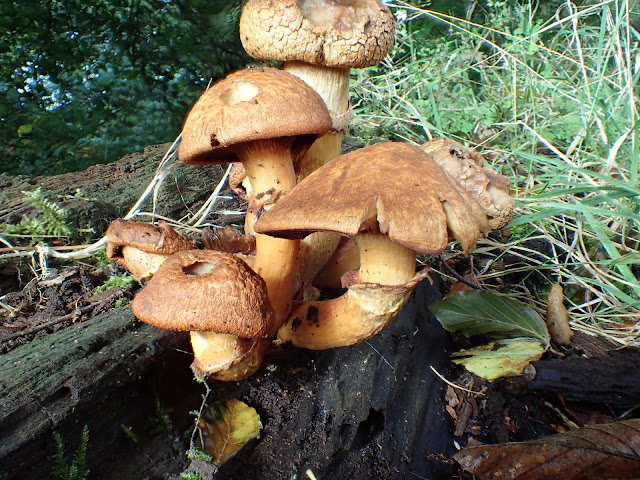


Pholiota: Scaly-cap (or maybe Gymnopilus)


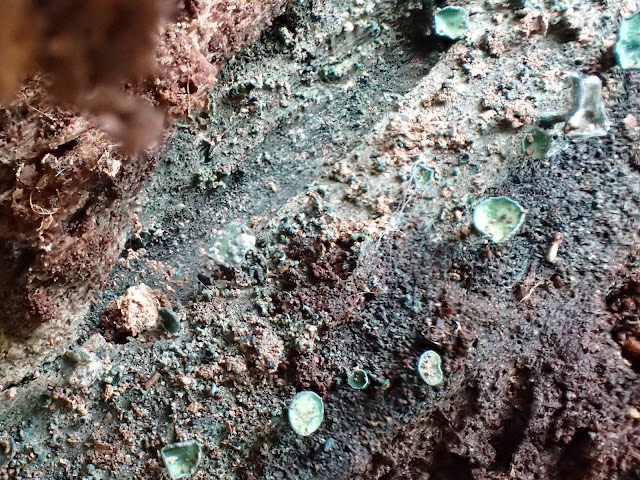
Green Wood-cup - Chlorosplenium aeruginascens  (young cups c 5mm)


On the first of the month at Settle a walk is held and the sheets from the "Pray and Fast for the Climate site (a UK website)" are used. Last night (30 Sept) I emailed the producer of the prayer/info sheet and asked to be sent it a day early so that I could print it out. The draft sheet was emailed to me and can be read here.  (The final sheet will be put up on their website sometime soon, but it often misses the first day of the month so I am very grateful it was sent to me early)

The prayer for today included a section about the election in Brazil taking place tomorrow 2 October. In  the few years that the current president has been in power vast amounts of the Amazon forest have been destroyed, as he encouraged people to remove the forest. (Crazy. And O so sad)  

Brazil’s election
On Sunday, October 2nd, Brazilians will elect their president. The election, which is being contested by the incumbent Jair Bolsonaro and his predecessor, Luiz Inácio Lula da Silva, has been described as one of the most significant elections in the world for the climate. During his time in office, Bolsonaro has presided over a sharp increase in deforestation, and analysis done for Carbon Brief and based on the two candidates’ stated policies and actions, suggests that a win for Lula could reduce Amazon rainforest loss by over 75,000 km2.  Please pray for wisdom for all who are voting – and that whoever wins, the Brazilian government will take action to preserve its forests. 


Losing this forest (I was informed over 30 years ago, at a Right Livelyhood Award Ceremony in Bradford - when JOSÉ  LUTZENBERGER  - 1988 received the award  ) can upset the currents in the Atlantic Ocean - and if we lose the Gulf Stream,  Britain will become a much, much colder place. 

(Whilst the rest of the world will get hotter) - 

Also, Climate change from increased CO2 and methane and other greenhouse gases will give increased heat  which  will mean that crops cannot be grown so by 2050 lots of people will be starving and coming into northern countries as climate refugees.

It is only now (2022) as Pakistan floods and storms with 150mph winds in Florida that the BBC and newspapers are beginning to talk seriously about climate change. I am heartened to hear lots of good programs now on the radio .. But why could we not have had them 10 years ago?

--------------------------------------------------

I write these blog posts - mostly about nature - but it is amazing look back - at the rate of change of opinion. So that is heartening.

Back to our walk.

I went to the meeting point in Settle but no-on turned up.  

Two people are on holiday, one person is going on the "Visit different faiths walk" at Bradford (excellent - I recommend it) , two more couples looked at the weather (wind and showers and slippery on the ground) and said they would give it a miss, and also said 9.30 was rather an early time to start.

In some ways I was relieved - I had actually printed out a risk assessment for this walk - broken branches dues to the strong wind, slippery ground and a big drop at Scalebar Foss, and wet grass underfoot elsewhere

So I just went by myself (and arranged to meet three others later).

I had visited Scalebar a week earlier to check and knew there would be two fungi there. In fact I went to the same fallen tree at the top (did not go to the dangerous slope)  and found 5 fungi. It is worth recording this - just so that next year I can say how many extra fungi appeared in the week leading up to 1 Oct.

Shaggy cap - Pholiota

Green wood Chlorosplenium

Pleurotus

White Cap )need to look it up

White mycelium in log.

Orange jelly fungus


I also photographed a few mosses and lichens:


---------------------------------------------------

I went to my friends in Upper Settle. I was shown White Spindles in their garden. 

We sat on the seat in the adjacent play area and looked at the Climate Prayer sheets.

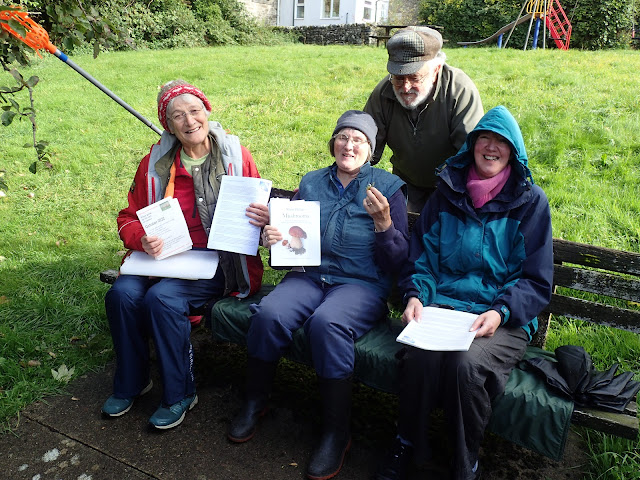
Two people walking up the steps past us agreed to take our photos  
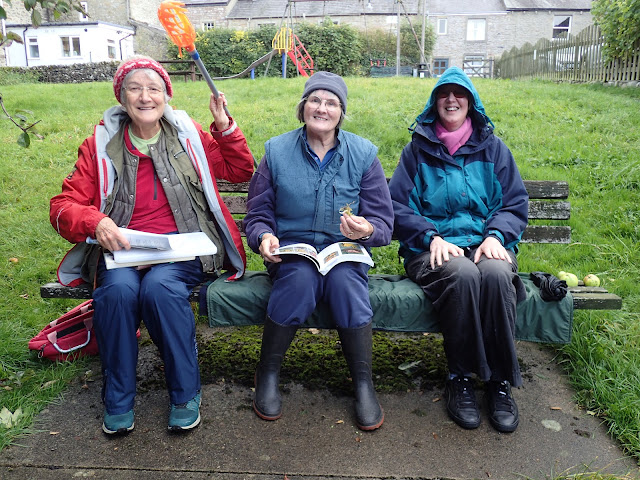
With Fungi books and Sally's apple picker.


Sitting with Climate Prayer sheets, Fungi book and White Spindles.


-------------------------------------------------------

We discussed the difficulty of getting younger people to join and hep run organisations - from Craven Conservation Group to Churches Together in Settle, from U3a to the Yorkshire Naturalists Union.

Maybe It is because young people spend so much time online that there is no time to do anything else.


(Digression - for my own education:
of Generation z spend so much time online that there are not any hours left in the day to do anything else. Generation Z is those born between 1997 and 2012 - i.e. 10 - 25 year olds.

Generation Y is those born between 1981 to 1996 - also known as Millennials, i.e. now aged 26 -41.

Generation x - 1961 to 1981

Baby boomers - born 1943 to 1960

Silent Generation – people born before and during the Second World War (1925 and 1942). They valued stability, sought after corporate jobs, and married early.
-----------------------------------------------------

 Sally and Keith told me they were going to support Settle Parish church's monthly fundraising lunch (Best: acronym for -Bacon, Sausage, Egg and Tomato butties) . sounded good.  I followed them down - but first

I made survey of trees in the churchyard and found the following starting from the lych gate and walking to the left. (counting.. 20 altogether including a few shrubs.

Elderberry (1), Bramble (2), Ash (3),  Yew(4),  Two unknown garden shrubs, Holly(5). Sycamore(6), Raspberry (7)

Corner near viaduct.

Privet (8), Ivy (9), Elm (10), Ash, Horse Chestnut (11), Elm, Goat Willow (?Hybrid?) (12), Laburnum (13), Lilac(14), Long leaved Cherry (15), Ash, Sycamore, Apple/pear (16), 

Corner (now at "step" between two parts of  the churchyard)  

Currant (17), Yew, Hawthorn (18), Silver Birch (19), 

Corner  

Two ornamental Cherry and Cypress(20) in centre  

Box (21), Holly (now next to Church)

 Horse chestnut,  Palm (22), 

Corner 

Holly, Cherry, Yew 

Lych gate. Path to Church:

Yews, Holly, Conifer.


I met a lady carrying some flowers to put on the grave of her mother and father. She had lived at Settle Junction till she was 8 and missed the railway. (The house had been pulled down since then).

I went in and had lunch - giving up my bacon in my hot sandwich as they were running short - and still felt guilty because of the sausage but thoroughly enjoyed it.

I met a couple of young, well youngish, people who were on the way up to Penrith as one of them was entering at Whinlatter  with their dog the race:-

https://www.timeoutdoors.com/events/lakeland-paws 

https://lakelandpaws.com/events/

--------------------------------------------

Back home and sorting my pictures. Well, I must stop doing this now and print out some posters for the coffee morning we are holding at Church for the Rainforest Fund on Wednesday 5 October, so that they can display them at the Giggleswick and Settle Brass Band Concert Tonight.


Thursday, 22 September 2022

Loreleia postii - A little orange toadstool that grows on a Liverwort - Marchantia polymorpha - at Giggleswick - plus lichens and fungi.

 Loreleia postii A fungus growing in association with a liverwort.

In 2017 on 28 October Craven Conservation Group went on a walk led by Archie McAdam (See the post written then) . As Doris and I (last) walked down the steep footpath beside the road from Giggleswick Chapel down to the Giggleswick Carpark we discovered a very few tiny orange fungi which Archie (after consultation with Roy Watkins) eventually told us were Loreleia postii - A fungus that gets its food from liverworts.

It is similar to another one called Loreleia marchantiae (The Liverwort Navel) 

I had been back a couple of years and not found them.

However on 21 Sept (my it's the equinox!) I fancied a walk and some fresh air - and drove to Giggleswick and was pleased to find about 10 tiny orange caps scattered up beside the path. More than last time. SD 8089764002 and SD8092264008

There is much less Marchantia now than there used to be. In 2017 it was more obvious that bare soil had been left when the gravel path had been laid and wooden fence had been erected, and the Marchantia polymorpha had spread over much of this bare soil. By 2022 grass is beginning to creep in. And moss (Didymodon sp?? still to be checked) is more abundant than Marchantia. However the Marchantia is still there, thinly scattered all the way along.


One large (3mm cap) 1/5 of the way up - near centre,
plus three more diagonally above and to the right


Down as this path enters the car park (and with no fungi) the Marchantia was fruiting and some was divided up like this:-


More notes: After this I walked to the good tree next to Mill Hill Lane  SD80936419 where I had found fungi in previous years but did not find any. It is too early.

Notes mostly to myself on lichens (SD84)

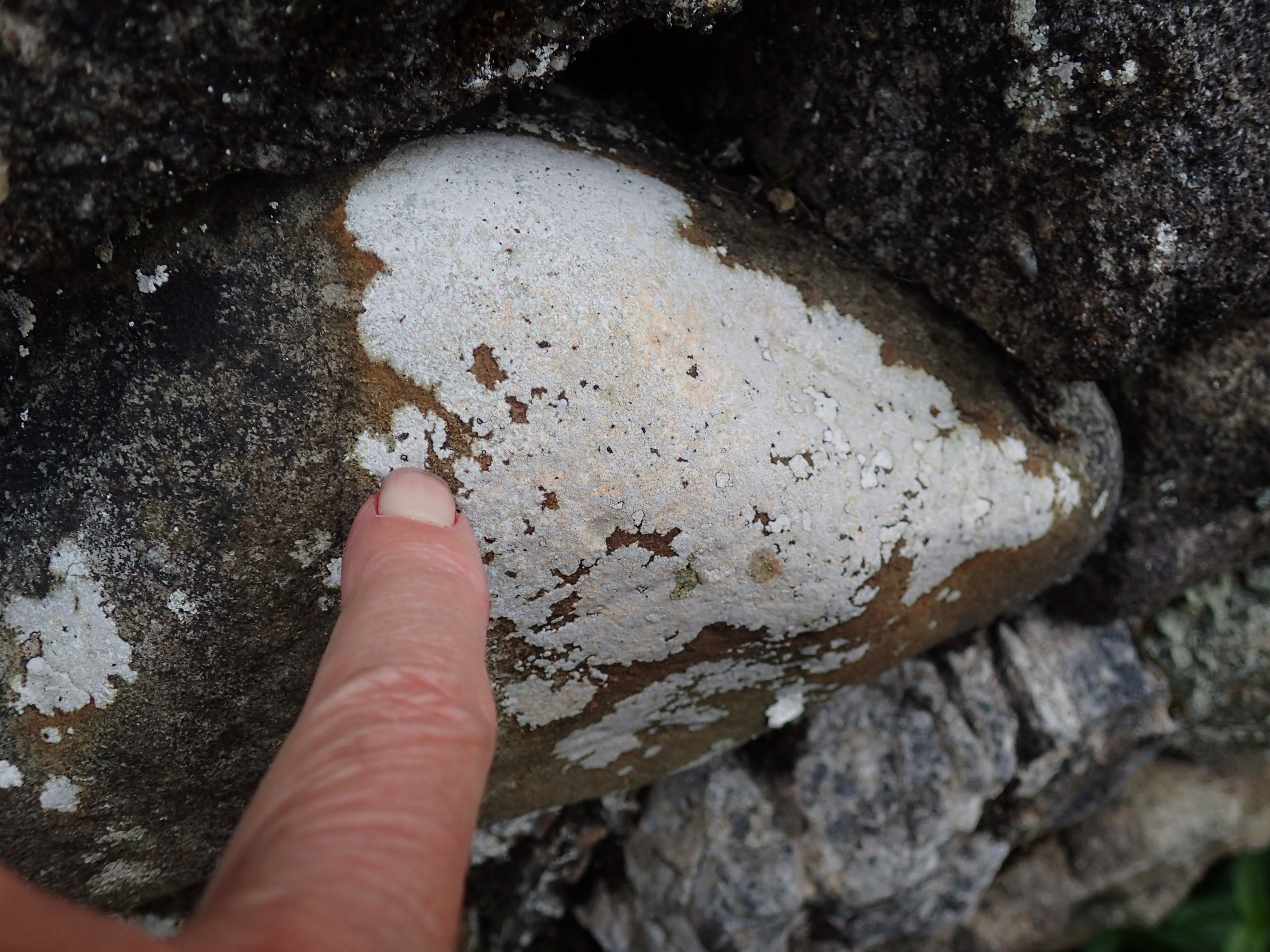
Then I walked across to Giggleswick Church - At the point where the path is enclosed by two old walls, 15 m from the churchyard perimeter I found this pale pinkish crustose lichen: It was growing on a smooth roundish Sandstone stone in the wall in several places. It was K- and C red. It has soredia


I wonder if it is Trapelia placodioides. I think so. 

Oh - I see I saw it with our "lichens for all Group" last month with Allan and Sue and Les on the Gritstone rocks near Craven Bank Lane on 6 Aug

Then I saw it at Harden Gill at Humberstone YNU Day on 14th August. -

Like London Buses - three in a row. 

I have entered it on my "List of species in SD 86" - I am up to 170 species


The wall has a "right mixture of stones" - It is lying exactly the fault line anyway!!

This I think is Porpida macrocarpa -  well the big black apothecia


This is Cladonia pyxidata


Cladonia pyxidata

Once in the churchyard I looked for fungi.  Although wildlife conservationists  ask for parts of the churchyard to be left unmown for the sake of insects and small mammals etc, I am really pleased that parts of it with the old grassland are still kept mown - not because it looks neat and tidy, but because some fungi do better here.  I only found three species - but they were all in the mown area. I might put them up later.


Although this one looks bright and cheerful here,
it is actually the Conical wax cap or Blackening wax cap and is one of the very few waxcaps that are inedible.  Hygrocybe conica

Hygrocybe conica - at NE corner of church

Hygrocybe conica


Two more species at lawn south of the church building that I am thinking about.


Wednesday, 14 September 2022

Settle Wildflowers Day 120: Prickly Lettuce - Lactuca serriola - in Langcliffe Quarry Enterprise Centre

I found this plant in August - a new one for our area (Langcliffe, Settle, Yorks Dales) - and was not sure if it was Prickly Lettuce Lactuca serriola or Great Lettuce Lactuca virosa. Both have spines on the midrib of the leaves.

Having put it on Twitter #wildflowerhour and elsewhere on social media (and having plumped for L virosa) I have now been informed

It is in fact L serriola - because "Virosa has obvious purple flushing in all parts but especially along stem and leaves. Serriola usually has whitish appearance."

I have now updated the rest of this post accordingly

----------

The old council yard and buildings at the Hoffman Kiln, Langcliffe gave me many new flowers in my 2020 list of  "Wildlfowers found on Lockdown walks." Sadly most are now gone -

Since then the buildings (except one) have been pulled down and new buildings , tarmac and paving stones erected on the "waste land". These buildings are now called Langcliffe Quarry enterprise Site.  The old footpath path amazingly close to the railway has been replaced by a new one a few meters back and a large grill now separates walkers from the old path and railway. New topsoil has been placed in the parts to be left as garden.

One new plant has arrived on these beds: (lots of old ones too, such as Broadleaved Dock, Spear and Creeping Thistle, various Oraches..)
The new plant has spines on the midrib of the leaves, has white latex and is..

Spiny Lettuce. Lactuca serriola

I struggled to work out whether it was Great Lettuce Lactuca virosa or Prickly Lettuce Lactuca serriola. Indeed I struggled to find it with the flowers out at all - it always seemed closed in in bud and closed in fruit.

Then I realised it must be like many others in that tribe of Lactuceae /Cichoreae - Such as "Jack Go-to-bed-at-noon" - Tragopogon pratensis. - that it must go to bed at noon.

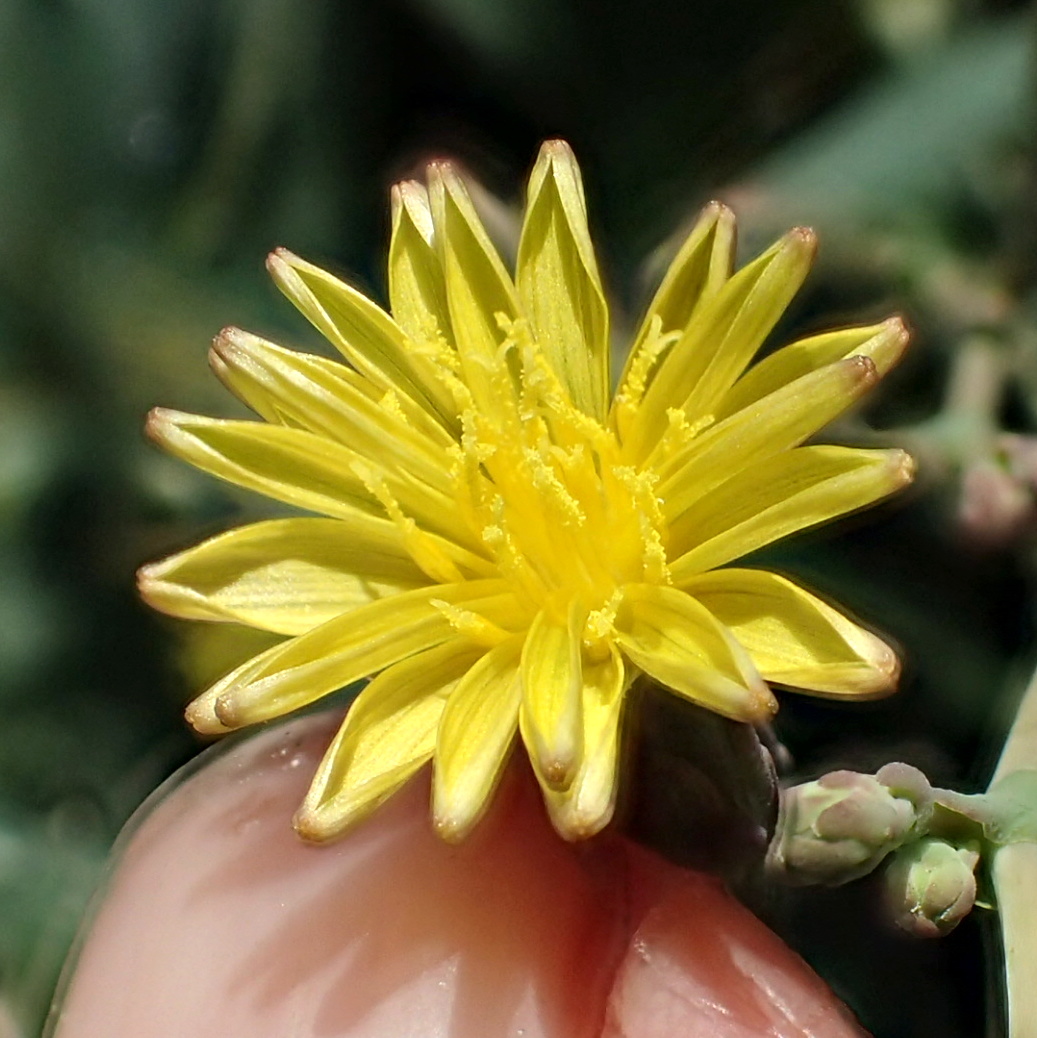
So on Tuesday morning 13 Sept I trotted out again - at 7.30am it was in shade - then back at 10.30am, and the blue sky and intense sun the tiny yellow inflorescences were open and just two heads were in seed.


I took one seed head home and measured the achenes 


The white beaks on the achenes are the same length as the achenes.


They were 4mm to 4.3mm long and very dark brown almost black. So I  first made it L virosa. Some of the leaf stems had a hint of marron in them.

L serriola on the other hand is supposed to have achenes that are 3-4 mm long and are olive grey, and to have no hint of dark red in the leaves.

Well my advisors elsewhere who know the plants said the purple colour in the stems and leaves are important.

So L serriola it is


I took lots and lots of pictures.

There are at least four separate plants.. So I hope they will seed well and last at least till new people come to the buildings and do the flower beds.
The involucral bracts open out in a quite spectacular fashion. 


(I did actually pick this head so that I could hold it up to the light
... and very close to the camera)


There are pictures on the internet of  L serriola with much more lobed leaves and more clasping base of the leaf blades to that at a distance the plant looks more like Soft Sow thistle.. I shall have to investigate plants more carefully.

In an earlier Settle Wildflowers post -Day 68 I said that I had found 11 members of the (sub) tribe Cichoreae or Lactuceae around Settle plus 1 extra (Bristly Oxtongue) near Ripon. This now brings my total to 12 members around Settle (Plus 1 bear Ripon)


Below: some L virosa info:


Lactuca virosa
By Franz Eugen Köhler, Köhler's Medizinal-Pflanzen - <a rel="nofollow" class="external text" href="http://pharm1.pharmazie.uni-greifswald.de/allgemei/koehler/koeh-eng.htm">List of Koehler Images</a>, Public Domain, Link


See more "Wildflower Walks around Settle"