Tuesday, 6 January 2015

2015- BSBI New Year Plant Hunt - Settle -


Below is the account of my walk on 4 Jan 2015
Wild flowers in flower within site of St John's Methodist Church Spire... and just beyond
Posted on 6 Jan 2015.
 (See also accounts for 2016 Plant Hunt on 1st Jan and 2017 Plant Hunt at Settle on 1st and 2nd Jan)

1. Ivy-leaved Toadflax
The BSBI New Year Pant Hunt challenged people to record as many plants in flower as possible in a 3 hour walk between 1 Jan and 4 Jan.

In the countryside few wild plants are in flower,  I knew weeds were most likely to have flowers, so the best place to search in our area would be inside Settle itself.

2. Groundsel
So on Sunday 4th Jan 2015 after church, I toddled along in my best boots, and Christmas Tree Coat searching for wild flowers. Toddled- my legs would hardly bend after yesterday's exertions.  (Later I exchanged these for more serviceable trainers, purple ski jacket and white woolly hat).


3. Annual Meadow-grass
In fact you could call this first section "Wild flowers in flower within site of St John's Church Spire."

In a year's time this spire will not longer be here - as we are planning to build a new church next to the church hall on the other side of the road. And this church will be replaced by houses. So  hey ho, enjoy the view of the spire whilst it lasts.


1. Ivy-leaved Toadflax on a wall.


2. Groundsel.
You can see St John's Church Spire in the background


Some garden plants -
 I asked permission to go in the garden opposite
3. Annual Meadow Grass


4. False Oat-grass


4. False Oat-grass

5. Lady's-Mantle- Alchemilla mollis


5. Lady's-Mantle- Alchemilla mollis


5.a. Wood Aven- Oh that's only in fruit and does not count.


6. French Crane's-bill again-
with our church spire in the background
6. French Crane's-bill -
This is a garden escape and
may not count (Geranium endressi)


6a - Red Valerian - but it is a garden escape so I won't count it.
5. Lady's-Mantle- Alchemilla mollis
6. French crane's-bill

I walked to the river and a Dipper flew under the bridge.
But no extra wildflowers there. 
I walked along Craven Terrace, now out of sight of the spire


8. Dandelion


7. Common chickweed


9. Petty Spurge


10. Flexuous Bitter-cress


11. Procumbent Pearlwort

Somewhere I passed Welsh Poppy in a garden-- that is a sort of weed.

12. Welsh Poppy.


I called in at Booths briefly and warmed up.

One year a while back I had found seven weeds in flower in the soil of the flower bed in front of the Social Club in January. but the next year they covered it with wood chip. Baah.  I visited it but found nothing new for my walk.

I visited the flower bed beside the road at the entrance to Greenfoot Car park where one month earlier I had seen Geranium sanguinium - Bloody Crane's-bill - in flower - but it was definitely finished now.

However on the way back in some cobbles I found a Speedwell at last. It was Veronica agrestis - Green Speedwell.

13. Green speedwell


13. Green Speedwell


14.Sticky Mouse-ear-chickweed


15. Petty Spurge


15. Petty Spurge near the Coop


16. Shepherd's purse -
I saw quite a few shoots
 but this was the only one in flower 


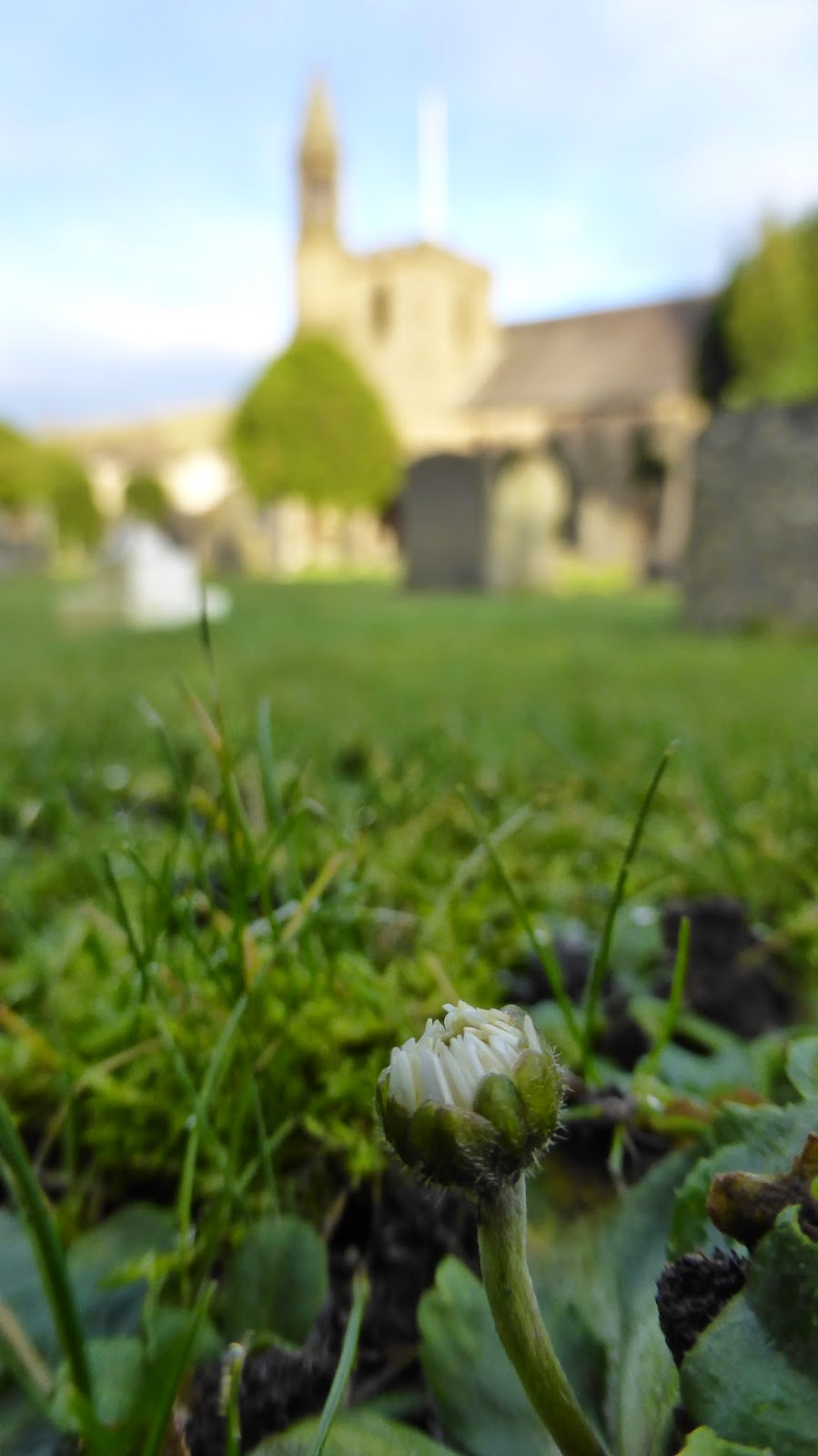
17. Daisy -  in the Anglican churchyard


18. Ivy

I had seen lots of ivy, but this was the
first still in flower - you can see the anthers.
And framing a good view of the church


17. Daisy. Now a daisy in the lawn of st John's Church


18. Wallflower (The orange flower at the top of the picture)
in St John's churchyard. See I have the spire towering above.
Yes it's a garden plant - but it is only just in flower, and deserves recording. And it is in the BSBI atlas, presumably as naturalised


So with six flowers in the beginning section and three at the end that comes to nine. And nine more just a little further away. Not bad for 4th January.

2017 post script - having seen how Red Valerian is spreading in much of Upper Settle, andit is good for Humming bird Hawkmoths.. I am now counting that as "wild". So the total is 19.


Monday, 5 January 2015

BSBI New Year Plant Hunt - Part 1 Clapham- 3 Jan - Settle Harriers Winter Handicap


The North West Yorkshire Botany Group had told me they were going on a walk beside the Tees on 2nd Jan as part of the BSBI New Year Plant Hunt. (1-4 Jan)- Aim" to see how many plants in flower can be seen in three hours."

So when I took part in the Settle Harriers Winter Handicap from Clapham on 3 Jan  (c. 7 miles) I decided to use that as my recording trip.

I saw no plant in full flower at all - The hazel catkins were still in bud. It was wild countryside we ran through, not a place for garden weeds.

I did see a bedraggled Crimson Waxcap (Hygrocybe punicea) (a fungus) at Norber Erratics, and the filamentous alga Klebsormidium crenulatum on the stone wall above the Clapper Bridge, and patches of Map Lichen (Rhizocarpon geographicum) But nothing with anthers and stigmas.

Back in the village after lunch, and the prize giving, I went to collect my car which I had parked in my friend Elga's drive.

There was lots of Poa annua (Annual Meadow-grass) in flower on the roadside. There was Petty Spurge (Euphorbia peplus) in flower in her garden. and her first three snowdrops were just coming out. We failed to find the daisy which she said was growing in her lawn.

The Settle Harriers are a very friendly group. They gave me a large handicap.. and I still came last!!. (And I hadn't run slower to look for flowers, honest)

Half a mile from home.


There were 42 people in the race this year - a record. The handicap winner was 12 years old! (the youngest ever - another record- accompanied by his Dad). And the fastest runner on this day was the son of the record holder for the race- who also took part, his record still not beaten.

But back to plants.. Perhaps more searching in Clapham village would have revealed a few more weeds. But it started raining and I decided to save my efforts for the bigger town of Settle the following day.

Friday, 26 December 2014

Settle Community Christmas Day meal 2014 - Pictures and videos

See poster and details for of Christmas Meal 2015 


First a "Big Thank you" to all the participants who came and the helpers - and the three people too ill to come on the day - We all contributed - It would not have happened if we had not come or planned to come.

Settle Community Christmas Day meal is what it says:  A community meal.

And a thank you to the builders and the caretaker for getting the hall ready in time - Building changes are being made to the church hall.

I'll start the story on the previous evening:  At 5.30pm at St John's Methodist Church we always have "Stories round the tree"  This Christmas eve we learned how to make snowflakes from six squares of paper. I later took mine across to the church  hall.
Our teacher
Judith - proud to finish hers in the 15 min available


Christmas morning:-
For over 100 years Langcliffe people have been singing carols round the (sycamore) tree on Christmas morning. Starting at 9.30am, we sing our last carol just as the sun rise over the hill

Straight after this at 10 am (well 10.10am)  I attend St John's Methodist Church in Settle. The minister has invited us to bring a present to open and show people - so I take the newly published Atlas of British and Irish Bryophytes- 2 volumes.

After the service I carry the Posada (knitted crib scene,,  that travels to different houses in the church family up to Christmas, representing Joseph and Mary's search for somewhere to stay in Bethlehem) across to the Church Hall


 ... where Christine is cooking. (Eight of us had help peel potatoes, wrap presents and set tables the previous morning).


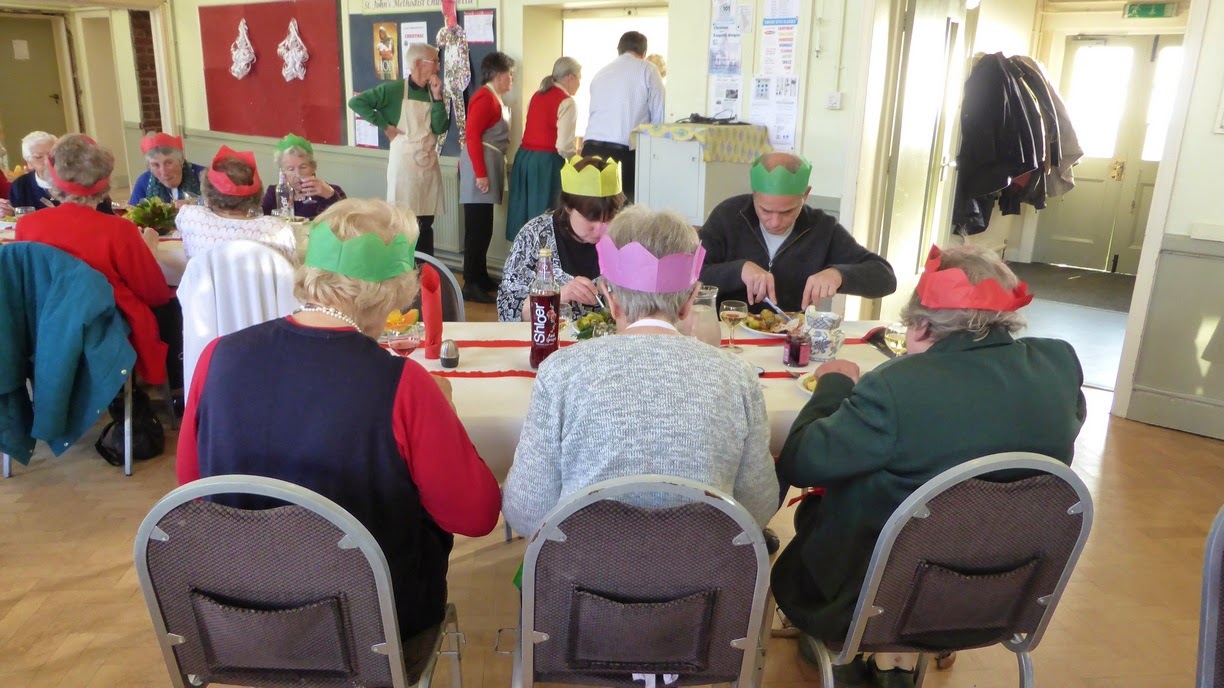
I go home to collect more stuff and came back at 11.30 to find our visitors arriving. Including helpers there would be 48 people altogether.

Jane and Tony were serving coffee. Will we squeeze 40 people into the large meeting room to sing carols before lunch?


Of course..


There is even space for Baby Jesus -
Stephen Dawson has brought the very life-like Baby Jesus
 from Langcliffe church - Dorothy Atkinson is holding him


Barbara Denne plays the piano again ( by ear - no music) 


Listen to See amid the winter's snow


One lady in the Hellifield group  is 97 (purple jacket, front right when the video plays)
Revd Dawson says grace. Then we prepare to go into the dining home.


Here are the tables as left the previous day - but we rearrange them herring bone for the meal. See the delightful table decorations by Elga.
I nip back home to collect the Aunt Bessie's Yorkshire Puddings I have left in my fridge. Hey Ho. But must have Yorkshire Puddings.


I remember to buy the correct amount of cranberry sauce this year.


 --------------------------------------------
Then there's a choice of Christmas Pudding and home-made trifle and trifle donated by the Coop.


Wendy says on behalf of everyone "Thank you"
 to the Servers and helpers  (some are still hiding in the kitchen)


After lunch comes pass the parcel.

We sit round in a circle .. I play the piano accordion. The audience help me keep in time by clapping the time.  We have three soft toys that get passed round and when the music stops people chose their wrapped presents from the bags.


Then I invite people to say party pieces: We have slightly fewer this year - I should have made more effort to ask people

Pauline reads a funny poem about someone retiring from skiing.. Downhill skier by Pam Ayers


And then. Oh it's time to eat again. Tea time.
Here's the cake I bought from the Naked Man Cafe..
it is very popular - people ask to take pieces home

Serving tea

There's spare turkey to take home too.


As the light outside dims, people take their leave, and by 4.30pm many people have left so the helpers can start to clear away.


By 5.15 There's just me and Althea and the Posada left.


All quiet!

Ian comes to collect Althea.

I lock up and leave the Posada in the empty room.


Wednesday, 17 December 2014

Happy Christmas and Best Wishes for 2015 - to All

Here are Settle Voices singing a favourite carol (on 13 Dec 2014)  to wish you well on your journey onwards.
.. both  up the line, and onwards through life.
(Do set both videos off- even if you don't watch them right through)


New Year's Resolution for the week:
https://blog.bufferapp.com/improve-posture-good-posture-science-happiness
(to remind myself)


Remember, If you live near Settle -  there is still space on Christmas Day at Settle Community Christmas Meal..


Happy 2015!


Monday, 24 November 2014

Sannet Hall Klebsormidium

This shows the way I had come
I was returning from Malham Tarn on Tuesday morning the scenic way - along Henside, to Sannet Hall, when the sun came out. (Next I would descend to Stainforth.)  This picture is looking back from Sannet Hall towards Henside

The grass was vivid lime green - making for dramatic picutres 

and so was the Klebsormidium (filamentous alga) splurging all over the wall. 


You can see it can't you? On the right, and on the wooden post.

Klebsormidium grows on acid rocks and wood.
The stones in the wall just here are mostly made of Greywacke  a 450 million year old Silurian rock (that I would call slate if I hadn't been told better) - that lies below the 350 Million year old carboniferous limestone.
(Digressing: (Greywacke is a grey sandstone (hence the name grey)  with particles of sand of various sizes and also of clay in it. It is generally characterized by its hardness, dark color, and poorly sorted angular grains of quartzfeldspar, and small rock fragments or lithic fragmentsset in a compact, clay-fine matrix.  The sea where it formed may have had turbidity currents and been moving to have such a mixture of particle sizes.  I like this description here even if it was 1833)
Anyway,  it is acid, and with the high rainfall we get round here, and it being a north facing side of the wall, the alga is doing really well. I suspect the mild October and November has allowed it to continue growing.
This alga has spread relatively recently in Britain - but I have never seen quite so much as on this wall.

It is increasing because of the background nitrogen oxides (and maybe ammonia) in the air, from intensive farming, cow muck, car exhaust etc.

The adjacent  farm may have had a slight effect - but the alga extended a third of a mile or so to the south towards Stainforth (as far as the greywacke stones extended) so I think it is mainly here due to the exposed position of the wall.  (Or it could also be as far as the much spreader was able to drive...) I just don't know.


The pollarded trees look dramatic too.


This was a bright yellow green lichen - but I don't think it was Rhizocarpon geographicum - more like a white lichen turned yellow green by an alga .. I must try and find out about this.

Here is a link to a website about a prototype algal farm on a flyover over a motorway in Switzerland 
-See other pages on this blog about Klebsormidium alga

Wednesday, 19 November 2014

Leaflet part 6: how to write a biodiversity leaflet - A better template - more space

Back to Part 1  (Intro).
Back to Part 2 : - A leaflet that people will pick up
Back to Part 3: - A leaflet that people will READ
Back to Part 4: A leaflet so that people will ACT
Back to Part 5: It's now divided into TWO leaflets

Two leaflets, in print size big enough to read. I felt quite proud.

At the end of last week I said I would:

1) Ask "How could the leaflet be used?"
-~ask a few local religious leaders/
and people in charge of notice boards

2) Find out how much it would cost to get it printed locally..

3) Consider, what would the 14 year olds make of these leaflets?
Or the 13 year olds I taught in Sierra Leone? -

 perhaps I really do need a picture of a bee and some bee statistics...  Or can I supplement my leaflet on the display board with biodiversity pictures made by other organisations?
    ------------------------------------------------------------------------------
1) Ask "How could the leaflet be used?"

Our local C of E priest was quite supportive.
He suggested putting about three pairs of leaflets in each of the local churches.
And with an extra 20 I might use at a house group, that would soon come to 100 copies..

2) Find out how much it would cost to get it printed locally..

I obtained quotes for printing from the local print shop. (250, 500 and 1000 ).. I could see that it was definitely much cheaper to have larger quantities made.
One quote was:
Costs for printing on 100gsm recycled 4/4
6pp Rollfold to DL

250 - £109.21
500 - £121.03
750 - £125.21
1000 - £130.74

12pp Parallel fold & Rollfold to DL  (assuming I made an A3 leaflet folded into 6)

250 - £178.52
500 - £194.11
750 - £215.21
1000 - £221.74

prices subject to sight of the artwork.

Now I would need to persuade the national organisation Green Christian / CEL that they would like to pay to have them printed - (rather than me just running off a few copies on my expensive printer, and putting the file online to make it available for other people to print themselves.)

I emailed the CEL Secretary.

"Bring some copies to the next planning meeting" said the secretary

"But they must be in the CEL House style - At the moment that is A4 folded rather than tryptych.
And a tryptych would still need to conform to margins, spacing, headings, fonts and size of print etc.. "

HOUSE style?

I then remembered that when CEL got its new logo 6 years ago we were sent templates for leaflets.
Ahh - I should have used those all along -

But maybe not.

 I have had chance to learn and be creative, and I have used the correct font already, and the red stripes at the top and bottom of the page.

I have now made leaflets
1. Using the CEL housestyle (but now in colour) - A5 (A4 folded)
2. Triptych leaflets - similar to what I have already done - but with similar layout to the CEL Housestyle - tthe only main difference trying font size 10 and font size 11 instead of the house style font  size 8.5
I still want the leaflets to be accessible to visually challenged people and to older children used to large print.


 So the front of the 2 triptych leaflets still look something like this, and the A5 leaflets are similar but a bit wider.


You will be able to download all the versions here:
Meanwhile here is a link to
Leaflet 1 - A5 word doc
Leaflet 1 - A5  pdf

Leaflet 1 triptych font size 10   word doc
Leaflet 1 triptych font size 11   word doc


The extra white space and extra spacing does make them look a lot better - as does the the much more restricted number of font sizes.
                                                     ---------------------------------------

Meanwhile - I read a blog post and was reminded about the  problems caused by cattle- Nitrogen oxides , green house gases, and deforestation to grow soya to feed our cattle -
I added "Go more vegan" to point 10 on Leaflet 1's list of of ten top practical steps.)
10: Buy food that is "Wildlife friendly" and go more vegan.
SINCE Wednesday I stopped being an omnivore and started being "partly more vegan." (Though not totally)

I still need to
1) consider further how the leaflet can be used
2) try it out on some 14 year olds
3) Take it to the Green Christian Planning meeting


Come back next week to see what I do next -
 Part 7: Attempting to use the leaflet to make a wall poster: 


Friday, 7 November 2014

Leaflet part 5: how to write a biodiversity leaflet - It's now divided into TWO leaflets

Back to Part 1  (Intro).
Back to Part 2 : - A leaflet that people will pick up
Back to Part 3: - A leaflet that people will READ
Back to Part 4: A leaflet so that people will ACT

  Leaflet part 5: - It gets divided into TWO leaflets


In Part 4 I decided to make the print bigger so that people can easily read it. 
A very successful decision.
I'm so glad I made that decision - I mean, how can I go about with our "Disability and Needs Awareness project at church".. and then produce leaflets with writing that is too small for people to read?

But it meant that the bible quotes and quotes by religious leaders had been squeezed off the main leaflet and would have to go inside on a separate double sided single column insert.

However like Topsy, the leaflet continued growing.
as a result of:
  1. making the quotes in bigger text,
  2.  including an extra column specifically promoting the Rainforest Fund, 
  3. and half a column explaining the benefits of CEL
I soon found I had a whole triptych insert,  (or the option of putting both triptychs together and making an A3 sheet). It looked rather boring,

Having spent parts 1 to 4 learning how to make the first leaflet look so nice 

(.. by make people aware they love it- wildife -  so they then want to act, and then showing them how to act), I decided to rearranged the second leaflet so it would look similar.

"Put a red squirrel on it" said Althea.

And since I had a nice photo through the window at Kindrogan Field Centre of a red squirrel on the bird feeder, on the red squirrel went.

Here is the front of the two leaflets:

 Whoops.. we seem to have slunk back to the word "Biodiversity" again. perhaps I should retitle leaflet 2 "Why does saving nature  matter to Christians"..
(The word Biodiversity was only coined in 1986 by E.O. Wilson)

--------------------
Inside leaflet 1 I made my own doughnut chart (using Excel) showing the different causes of wildlife population losses (from the Living Planet Report).


Well that was an achievement in itself .. quite proud of myself.

-----------------------------

Leaflet 2 will probably only appeal to Christians.. but that is fine. No need to print as many.

All the quotes on the leaflet were from men, all except except one by Ruth. This especially applied to religious leaders..  What to do about that?

In the absence of any modern "high up" women religious leaders, I found a page of quotes by Kenyan activist and conservationist Wangari Maathai, and put in a quote by her - It may not have been the best, but it was one of the shortest.  And found a nice photo of her on Wiki-Commons.

---------------------------
I went Scottish Dancing in the Church Hall this evening and stuck up the two leaflets. One co-dancer looked at them and said "That's sad" - meaning the wildlife loss was sad .

But I didn't want him to go away feeling sad. Not unless it brings results.

The next stage?

1) Ask a few local religious leaders/people in charge of notice boards how they feel they could use the leaflet

2) Find out how much it would cost to get it printed locally..

3) Go over the leaflets again and consider, what would the 14 year old children I used to teach in Bradford make of these leaflets? Or the 13 year olds I taught in Sierra Leone? - perhaps I really do need a picture of a bee and some bee statistics...  Or can I supplement my leaflet on the display board with biodiversity pictures made by other organisations?

Here is the back of leaflet 2.


Come back next week to see what I do next -  Onwards to Part 6: The CEL template and more white space

Sunday, 2 November 2014

Wonderful Waxcaps at Anley Hall - CCG Foray 2014

Jane Rushworth led us to Anley Hall, near Settle for our CCG 2014 Fungus Foray and with thirty people it was one of our best attended field events of the year.. The lawns of our local Nursing home, it turned out, are home for at least eleven species of Waxcaps- meaning they are of important conservation value.


On the front lawn was a fairy ring of Entelomas, and here you see us standing round the outside of this ring:


Crimson Waxcap - Hygrocybe punicea

We went back to St John's Church Hall and met after lunch and spread out our specimens


Jane got us to sort out the fungi in to groups


One member even found time for a quick water colour painting


Waxcaps. Only the Balckening Waxcap (Hygrocybe conica) is poisonous/non edible


A big thank you to:
Jane for leading the event
Archie MacAdam who was scheduled to co lead it, but was unavailable due to illness - but he checked several of our specimens
To several of the people in Archie's U3A class at Skipton who came and supported the event
To the Flowers of the Dales Booklet which publicised the event and brought in several extra people
To Anley Hall for allowing us to use their grounds.