Friday, 13 March 2020

SD86 - 10b - SD8160b - Lichens at Mearbeck

Settle Junction
Two weeks ago I visited SD8160 - the wall and wood just into the north of the Mearbeck square - and scored 18 species - producing a yellow square for the SD86 hectad. 

If I revisit this square, with another 11 species (total 29) I will be able to make the square turn light orange. (29-40 is light orange)

The A65 is a very busy narrow dangerous road, so best not surveyed. I park next to the railway bridge below Mearbeck House. 

I study the lichens on the flat metal top surface of the parapet of the railway bridge.  I wave to two trains going past. A police van stops on the main road but before I can walk up and cross the busy road to explain what I am doing the van leaves.


Physcia adscendens
Candelariella vitellina  on bridge parapet


I record Physcia adscendens, Phiscia dubia and a brown Melanahalea. Hypotrachyna revoluta (?) and take photos of Candelariella vitellina, and an unknown with black dots. (There is some Parmelia saxatilis but I have already recorded that before).


Looking south. See the two dark coloured lumps to the far left and right on the bridge top. they have a dark lichen with dark dots. In the foreground is Hypotrachyna revoluta


Hypotrachyna revoluta


With black dots


The pillar at the end of the bridge has a fine limestone capstone with fossils. Its surface is covered with Caloplaca flavescens, with a lemon yellow more powdery Caloplaca citrina on the sides

The old wooden post next to it has Trapeleoplsis flexuousa.


Trapeleoplsis flexuousa.


Trapeleopsis flexuosa.
and Candellariella vitellina


Not sure
The same, just closer


Well that gets us five new named lichens, and two no idea.

   ------------------------
Back over the noisy A65, the private drive up to Mearbeck is lined with parkland oak trees. It is a very windswept area.(receiving wind from industrial Lancashire and West Yorkshire in the past). The trees near the A65 will receive their quota of car fume pollution.

I discover five new lichens.
But as far as my list goes I am not totally sure of any of their names. So not much use as far as changing my yellow square ot pale orange.


I look at the first tree trunk: A lichen with a thick grey thallus and with black dots;


Phaeophyscia orbicularis 


Phaeophyscia orbicularis -camouflaged

Below: A lichen in a big white patch on the trunk: either a Pertusaria or Phlyctis


K turned yellow then red - so maybe Phlyctis argena. But there was only one patch of it.  with Phaeophyscia orbicularis above

K turned yellow then red - so maybe Phlyctis argena. But there was only one patch of it.


On the north side of the trunk is a yellowish greenish powdery lichen on the ridges. and with a pastel greenish granular lichen in the cracks. If only they could be Chrysothrix candelaris and Calicium viride.. but I see no pin heads. Much more likely to be an alga and some form of Lepraria


Ah well, may be I will have time to look at the specimens I brought back in envelopes  later, and work out names.


Wednesday, 4 March 2020

Skipton Woods: Mid Yorkshire Fungus Group visit March 2020


Setting off for Skipton Woods on 4 March, with Pup.  


Peniophora ?limitata

Peniophora ?limitata


Peniophora quercina on oak


Peniophora quercina on oak


Hypoxylon fuscum (hazel woodwart)

Hypoxylon fuscum (hazel woodwart)


Tubaria


err... 

Exidia  albida


This looks as if it has a smooth white mat surface.. but with a hand lens you see tiny pores..


It looks like this (awaiting name)


Awaiting name


Awaiting name close up


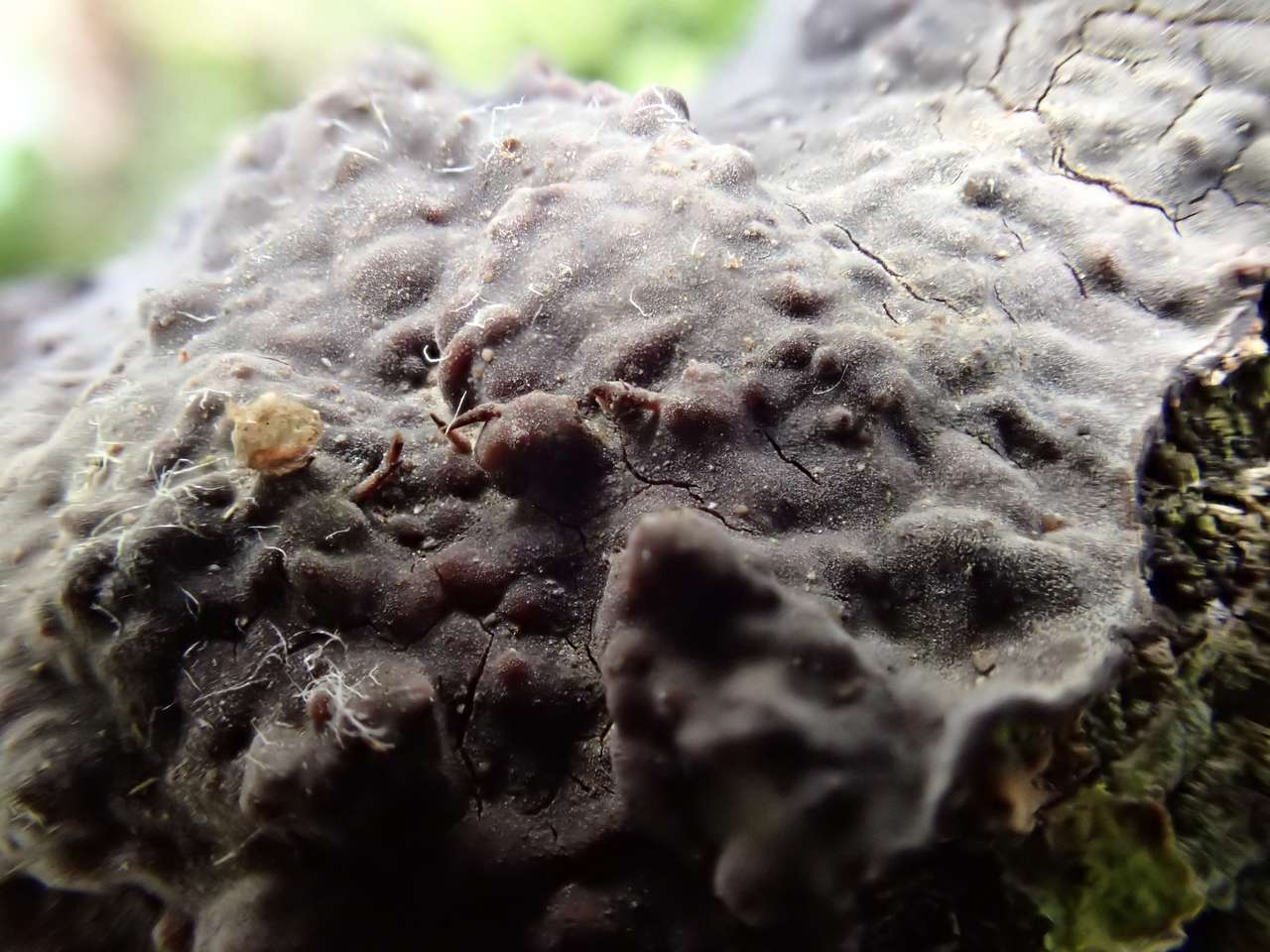
Schizopora paradoxa


Insect and millepede on Stereum sp .


Sulphur tuft - Hypholoma fasciculare --Sulphur Tuft - early in year so gills not yet very dark.
Lachnum virgineum - Stalked hairy fairy cup


Looking at Lachnum virgineum - Stalked hairy fairy cup
Mycena purpurofusca - the Purple Edge Bonnet
Mycena purpurofusca


Moth larva in bramble leaf
Xylaria carpophyla - Beech-mast Candle-snuff


Elf Cup


This beech nut shell was stuck to the twig with a fungus


The group goes some where in or near Craven (Ingleton to Otley!) on the first Wednesday morning of every month. Interested in coming?


Sunday, 1 March 2020

SD86 - 10 - SD8160 - Lichens at Mearbeck


A steam train whistles past. Little do the passengers know what lichens they are missing. Whelpstone Crag in the background. The stile where I started recording lichens in the foreground.


The more observant of you, my assiduous followers, (are there any?) may have noticed that I have leapt from SD86 - 04 (in May last year) to SD 86 - 10 today - 29 Feb 2020 - (Yep, it's a Leap Year)  


This is the 11th post in a series about lichens in all the 1km squares in Hectad SD86, centred on Settle and Malham. (Rathmell - Helwith Bridge - almost Darnbrook, Malham)

What happened to monads 05 to 09 in the first row of my hectad? From Huntworth Common and Giggleswick Scar to Helwith Bridge?

I did survey them (parts) and found nice lichens and brilliant scenery. Writing up their blog posts must follow later.

But now it is 2020 -


For those new to my series, do visit SD - 00 - Rathmell to see a full explanation of this project.

I am going to record all the 100 monads (1km squares) in my home hectad (10 by 10km square)- or at least make a small sample visit to each of them.

Last year I visited the first ten in a row, south to north. (plus a few scattered elsewhere in the square).

Now a whole year later, I am starting again, recording a parallel row.

If I can find 18 or more species then this monad can be coloured yellow on Janet Simkins's map (The British Lichen societies map of the distribution of lichens in Britain).

And today I found 18!! 18 I can put names to.

Somewhere in the eye of storm Jorge there was a quiet period this afternoon. Jorge (which has come from Spain) is pronounced "horkhay". It is the fourth rainstorm we have had in 4 weeks . You can see the flooding left by the previous three in the picture.

So off I set.

First stop was near the stile pictured in the foreground in the gritstone wall at the top of this blog.


Candelariella vitellina 


Candelariella vitellina 

Here there was some Candelariella vitellina on the top of the capstone next to the stile. Even though the thallus is thick, the granules are not rounded and compacted enough to be C coralliza
See Mark Powell's Twitter post

Further along the wall (south of the above, and south facing)


Pertusaria corallina 


Pertusaria corallina 


When alkali was added it turned yellow, and did not turn red after 2 minutes, so I'll stick with P corallina, not P pseudocorallina


If you watch this not very brilliant video of the steam train, in the wind, you'll see I pan round and zoom in on a fallen oak branch, before finishing with a view up the south north line of the edge of my hectad looking towards snow capped Ingleborough. 


The fallen branch from the oak tree:


I used this tree to send records to Janet's Epiphytic survey of northern trees. 

Looking at a fallen branch is much easier than peering through binoculars at waving branches in the wind.

I found Ramalina farinacea and Evernia prunastri but nothing special

On one branch was this interesting black jelly fungus:, 2cm across, and cup shaped below.  It is Exidia glandulosa or known as Witches' Butter since at least 1741. It is said to be based on a folk belief that witches milk cows at night and scatter the butter around.


Another one.


On a stone in the ground, almost as a was leaving the monad, I saw some big black apothecia 3mm across - must be Porpidia macrocarpa


Porpidia macrocarpa 


Finally another view of the train


Researching from from the "Winter Cumbrian Mountain Express" description: An electric train came from Euston to Preston to Carnforth. then people transferred to the "British India Line" "We then enjoy a circular steam tour outwards via Shap to Carlisle and back via the Settle and Carlisle line, hauled by 35018 British India Line.