Wednesday, 28 July 2010

Phleum pratense - Timothy-grass

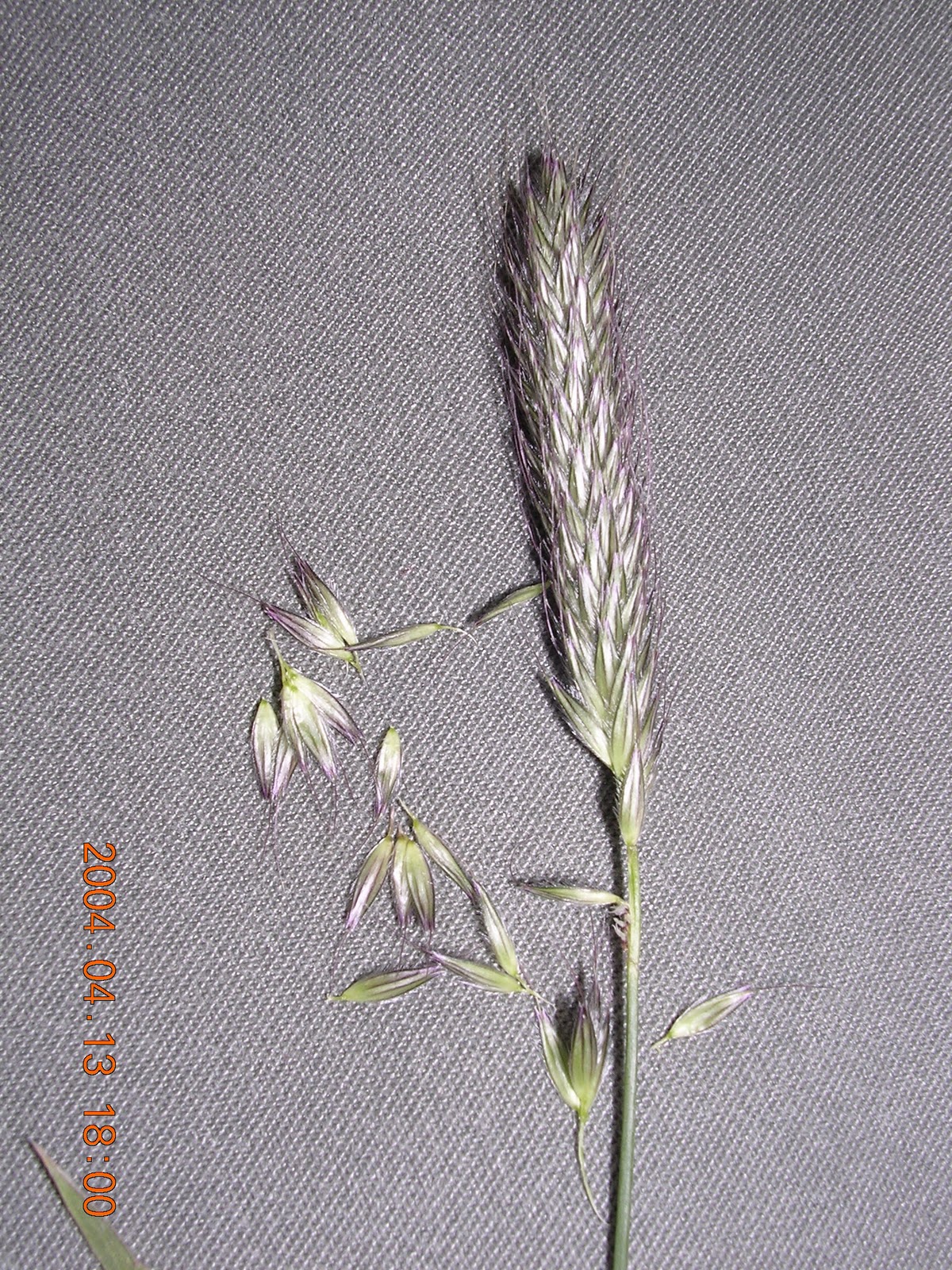
Timothy grass  Phleum pratense

Grass of the Month - July 2010


Recent (2026) Extra notes on Phleum pratense added at the end:


Phleum pratense growing in the thicker soil in the hollow below the limestone slope near the gate at Lower Winskill.

A grass with a spike-like panicle - is it Timothy or is it Meadow Foxtail?


Look at a spikelet.
Foxtail has one fine awn (long hair) per spikelet. Timothy has symmetrical spikelets with two "horns" - The glumes have points and look like "horns" of a devil. 
Phleum does not flower until July, so before July a plant with a spikelike panicle is likely to be Meadow Foxtail

By August nearly all the Meadow Foxtail flowers have fallen off their stem,  or at least are looking very dead.

But how do you separate the shoots vegetatively? - First you can look at May's grass- Meadow foxtail for a good chart comparison

The easiest way is that Timothy is famous for its swollen shoot base, looking something slightly-like an onion.


The picture on the right of a young plant formerly growing by a trampled bridle track shows a not very good onion shoot-base. 

It also shows how the blades can spiral on their own axes, and that the blades are shortish, can stick out at right angles (but later in the year they actually grow upright). 

It shows the blades can be a bluish whitish version of green. It shows that the old basal shoots are a pale fawnish colour (i.e. not dark red or dark brown as sometimes the case in Alopecurus, and not bright yellowy chestnut brown as can occur in Briza)  

But what if you don't want to uproot the plant? In June this year I was surveying some permanent plots in an experiment  in a hay meadow at Colt Park. - One cannot go round digging up plants! I could distinguish both Alopecurus and Phleum  from the other flowerless grasses as they are  larger than other grasses there in the "newest leaf rolled and leaves hairless" category.

This is what I found:-


Look at the back of the base of the blades, at the collar area ( the white line at the base of the blade which has the meristematic (growing) tissue.  Timothy had a wider collar than Meadow Foxtail. Timothy also has a long ligule that is about as long as it is wide. Meadow foxtail has a very short ligule.
Imagine the grass was the other way up so that from the back, the collar area looks like a man's shoulders.
Meadow Foxtail looks like hunched, rounded shoulders.
Timothy's shoulders are held back, as if the person is very proud and confident, or has a coat hanger across his shoulders inside his jacket.


Now if you see me slouching and then suddenly sit up straight, it is not because I am pretending to have a coat hanger across my shoulders - it is because I am pretending to be like Timothy grass.


.


With a good handlens you can see the tiny teeth or  bristles on the edge of the blade of Timothy


If you hold a blade of Timothy to the light it has an  interesting pattern 


There is more I could add - but Hey, that is for another day.
--------------------------------------------------------------------------------------------


Timothyttt


  Timothy-name

History of Phleum pratense as "Timothy"


Added in Summer 2026;
A neighbour in June in nearby Stainforth asked on Facebook asked "Why is it called "Timothy" grass?
I researched

NOTE (June 2026- Historical fact - AI - ChatGpt and other systems have just become rapidly available - )
(Though it makes it difficult or laborious to credit sources)
 And AI can still often be wrong. (As I know from suggestions AI has made to me about identification of species  of lichens and plants. )
Anyway,
I researched.
and discovered it is not because a man called Timothy Hanson in America bred it, or because he introduced it in the USA .. He simply promoted it in America in about 1720. It is first recorded as being called "Herd's grass" in New England in about 1711.. 
In the 1600s in Europe people encouraged a variety of plants to grow in their meadows. I presume the combination of meadow plants had just arisen naturally derived from wood pasture.  Phleum pratense  was not prized as an agricultural grass then and probably didn't have a name.  

The plants in European manage pastures and meadows did not grow in America.  As Europeans began to colonise America, they brought their animals horses, cattle, sheep etc with them. Seeds from the hay they brought for the cattle would escape and start to grow.
Phleum pratense is first known to have been recorded as "Hard's Grass around 1711 in New England. That tells us it must have been growing there for some years beforehand.  
  • Timothy Hanson promoted it as an outstanding hay crop around 1720.  It was already established by then.  So it became known as Timothy Grass.
  • Seed was widely distributed throughout the American colonies. from 1755-1850 Seed was deliberately imported for hay and pasture (e.g. Cock's-foot) - but 
  • British farmers later imported seed from America, helping to popularise a grass that was already native to Britain but whose agricultural value had been demonstrated across the Atlantic.

  • Linnaeus on the other side of the Atlantic published the name Phleum pratense in 1753,
    Scientists in Europe before Linnaeus had given species extremely long names made up of a description of their features. 
    Caspar Bauhin (1560–1624) was a Swiss physician and botanist . He distinguished between  genus and species, he laid essential groundwork for the naming system later refined by Carl Linnaeus.
    He called it Phleum pratense majus which literally means: "The larger meadow Phleum."

    e.g. John Ray referred to it in his works.

    Early herbalists made pictures of something like it, sometimes referring to it as Phleos (from a Greek word for grass), 


    European settlement of America
  • 1400–1492: No permanent European population on the North American mainland.
  • 1492–1600: Explorers, fishermen and a few short-lived colonies; only tiny permanent populations.
  • 1607 onward: Permanent English settlement begins at Jamestown, followed by rapid growth.
  • From 1600-1700 most of the seed introductions were accidental:-
  • Mixed with hay, straw, grain, and ship ballast.
  • Included timothy, perennial ryegrass, sweet vernal grass and probably Kentucky bluegrass.


  • More grasses at:
    http://rainforest-save.blogspot.co.uk/p/grasses.html


    Tuesday, 27 July 2010

    Coffee Morning 3rd August 10am

    Hurray! We have a Coffee Morning organised for the Rainforest Fund - It is this coming Tuesday on Augsut 3rd at 10 am in the church foyer.
    All welcome
    Come and enjoy the scones and cake.

    Buy beautiful Greetings cards.

    Buy the new 2011 calendars, ready to post as presents.

    Invite your friends.

    See you!!!


    .

    Wednesday, 30 June 2010

    Briza media - Quaking Grass

    Quaking grass - Briza media

    Grass of the Month - June


    Is Quaking grass your favourite grass?

    The beautiful hanging spikelets come out in mid June and dangle and wave in the wind. Their heart shaped lemmas become dark glossy brown and sparkle in the sun. It grows in a variety of habitats but often with other very special flowers:
    • On limestone grassland with Rockrose and Ladies-mantle
    • On chalk grassland with Orchids
    • In calcareous flushes with Birds-eye Primrose
    • In slightly acid flushes with Common Spotted-orchid
    • In traditional species rich hay meadows with Wood Cranesbill or Meadow Cranesbill.

      It doesn't grow on your average lawn or ryegrass pasture/silage field
    I took the picture above on 27 June 2010 at Winskill Stones Nature Reserve - see how brown and burned the grass is in the background on the shallow limestone soils with the drought. In the background are Ingleborough (left) and Pen y Ghent (right)


    Here is a close-up from the picture.
    It kept shaking in the wind so I put a piece next to a rock.  And now you see the rock is covered with lichen


    It has many different local English names.


    But how do you recognise it when it is not in flower?

    With a group of a dozen students I give each student a different feature to remember:
    1. They are small plants.
    2. Small flat leaves.
    3. Hairless
    4. No auricles
    5. Blades make an almost right angles with their sheaths. The shoot is erect.
    6. Emerging leaf rolled

      The above features mean it looks like, and could be confused with other pasture grasses:-
      Common Bent, Sweet Vernal-grass, Crested Dog's-tail or even Small Cat's-tail

      So what is special? - Learn these tips to become an expert:-
    7. It has slightly wider, whiter, fleshier leaves than most of the above (apart from Small Cat's-tail)
    8. The blades spiral on their own axis (as does only Small Cat's-tail)
    9. The blades often have crimson blotches or purple polo shaped marks.
    10. They have yellow brown dead lower sheaths (as can Crested Dog's-tail)
    11. They have rhizomes 1 cm long. Hence if you have one Briza shoot, look one cm away and you should find another. Dig one up (with landowner's permission of course) and look for the rhizome.
    12. And the clinching fact? - the feature you could look for and ignore all the above?
      Hold a blade up to the light and look with a handlens:-

      You will see a striking regular pattern: (Say this:-)
      "Green, medium green;   green, dark green;  green, medium green;  green,white.    Green, medium green,  green, dark green,   green, medium green,  green,white.
      Green, medium green;   green, dark green;  green, medium green;  green,white.    Green, medium green,  green, dark green,   green, medium green,  green,white."
      etc.
      Common Bent, Crested Dog's-tail and Sweet Vernal-grass have just a simple pattern: dark, light, dark, light, dark, light, dark, light.

      Small Cat's-tail - and small versions of Timothy - (which have wide white fleshy leaves which spiral on their own axes) also have a fancy pattern with some much whiter veins. But they do not have the extremely regular pattern that Briza does. (And they have swollen bases to their shoots and no rhizomes and no yellow brown old sheaths)
    I hope you found this useful - Why not come on a Grass Identification course? And have fun learning about grasses with other people. J.A

    Tuesday, 15 June 2010

    Environment Sunday 2010 -Settle Churches Together Walk to Winskill

    Here is a slightly more detailed report of our trip:-

    Environment Sunday 6 June 2010


    Churches Together in Settle celebrated Environment Sunday by making a field trip to see local wildflowers.

    But the group learned much more than wildflowers –

    Botanist Dr Judith Allinson of St John’s Methodist Church, Settle took the group of 12 (from 5 different churches) to Lower Winskill Farm and met the farmer Mr Tom Lord, then they visited nearby places.

    Access for the disabled - They discovered and tried out  Mr Tom Lord’s newly built  brand new flat path to his haymeadow, wood, flower rich limestone pastures and viewpoint of the valley below, so that people with wheelchairs and restricted mobility could have access

    Beauty - They looked at a host of yellow flowers including: Yellow Rattle, three species of Buttercups, Silverweed, Bird’s-foot Trefoil, Lady’s-mantle, Rockrose, Cowslips,

    Fields Manged for Conservation interest – The group learned how the wealth of flowers in the pastures was due to the geology, past management and the way Mr Lord had be managing the land sympathetically over the past 20 years.

     Ethical food -They ate British strawberries, British cream and Fairtrade chocolate shortbread biscuits and Fair Trade tea in an effort to eat “ethically”

     Stupendous views - They had views of the Ribble valley, 100m below, up to Ingleborough 10 miles to the north and to beyond Settle in the south.
    .
     Stimulating discussion- Mr Lord answered questions about farming. He pointed out that Upland farming was not “sustainable."  - At all.. Stunned silence. (This is an important point to people trying to be “green”.) The grants farmers get do not encourage them to save energy. – (Judith’s comment – “and there is me thinking ‘Isn’t it good that the grants that farmers get nowadays are often tied to some sort of conservation activity’ ”)

     Rainforest Destruction - Indeed the grants enable farmers to keep more livestock indoors in winter, and this usually means greater reliance on imported animal foodstuffs which contains GM materials and palm oils (causing rainforest destruction).

    Change in energy usage -  In 1957 this farm did not have electricity. And the farmer would work from a horse and cart. – How things have changed with respect to energy consumption!

      Change in pressure on farmers – where will this lead? - The Dales landscape is one of farms built as dairy farms in the Industrial Revolution and later, supplying cities such as Leeds. But now there are no dairy farms in the 10 miles of our valley to the north, and very few to the south. The farms have changed to beef cattle and sheep. “Most large dairies will not collect from small farms any more,” he said. “The dairy at Hawes making Wensleydale cheese being an exception”. We are losing a skills base. Farming is labour intensive – it is getting more difficult to find people with the necessary skills to do farming work. People who work building stone walls have to build an awful lot of stone walls before they can afford the expensive property around here.
    He gave us food for thought.

    “The policy makers need to do more thinking” he said. “But it is up to all of us to try and live more sustainable lives.”

    Settle Church’s contribution – to a new European book and to Nature Conservation - Whilst on the walk Judith showed the group a book that the European Christian Environment Network have just produced this June called “God‘s rich variety-Churches in Europe helping biodiversity”. She had downloaded from the internet that morning.

    “Look at page 11” she said:

    From North Yorkshire to Ghana / A look on food supply and climate change

    Even North Yorkshire (GB) is affected by loss of species diversity. The biologist Judith Allinson has documented the loss of species and noted that one species has disappeared every two years for at least a hundred and fifty years. (…...)  The Methodist Church in Settle has started a species protection fund: with the money from this conservation groups can buy land and support a variety of projects to protect habitats worldwide under particular threat. For example some of this some of the money from Settle is invested in Ghana.
    Protecting the diversity in our own back yard is important, but we need to remember the wider world.
    Further information:
    http://rainforest-save.blogspot.com
    http://www.christian-ecology.org.uk

    She thanked those members from her church at Settle who were supporting the project. “The European Christian Environment Network is meeting this week in Prague”. She said –“We must think of them. I have attended their conferences in the past as a representative of Christian Ecology Link”

    After the visit to Lower Winskill the group continued to Yorkshire Wildlife Trust Reserve “Globe-flower Wood” where they saw a little wood packed with the golden orbs of the rare Globeflower, once more common. The fields to the left were yellow with buttercups and the fields on the right golden with Kingcup. “What is it about May and the beginning of June that produces so many yellow flowers?”  and “Isn’t it great that this little reserve has been protected”

    Back in Settle Judith collected donations from people who came on the trip amounting to £20-00 to go to the Ghana project.  “Hmm – the Widow’s mite.. But every little each of us an each church can do helps.  Keep going!”

    Sunday, 6 June 2010

    God's Rich Variety - European Churches booklet

    An RSS feed from ECEN - European Christian Environment Network - told me about the 24 page A4 booklet about biodiversity work of individual churches in Europe.  It mentions our Rainforest-fund project and this blog . The booklet is at http://bit.ly/dbijPi - see page 11.

    Here is a picture of us looking at the booklet on our Environment Sunday walk at Settle today. Several of these people help in fundraising for the Rainforest Fund Project.
    After the walk people's donations contributed another £20-00 to our fund. Thank you!!

    The text on page 11 says:-

    From North Yorkshire to Ghana
    Even North Yorkshire (GB) is affected by loss of species diversity.
    The biologist Judith Allinson has documented the loss of species and noted that one species has disappeared every two years for at least a hundred and fifty years. In response to this the Methodist Church in Settle has started a  species protection fund: with the money from this conservation groups can buy land and support a variety of projects to protect habitats worldwide under particular threat. For example some of this some of the money from Settle is invested in Ghana.
    Protecting the diversity in our own back yard is important,
    but we need to remember the wider world.
    Further information:
    http://rainforest-save.blogspot.com
    http://www.christian-ecology.org.uk

    And if anyone from ECEN is reading this "Hi! - I am thinking of you meet this week in Prague"

    Environment Sunday 2010 - 6 June Settle

    The Sunday nearest to World Environment Day (5 June) is Environment Sunday - which is today 6 June. A group of 12 of us from Churches together in Settle (five different churches represented) made a visit to Lower Winskill Farm.

    We examined the beautiful flowers of the limestone pastures. Then we had an interesting talk and discussion with the farmer, Mr Tom Lord

    Monday, 31 May 2010

    Alopecurus pratensis - Meadow Foxtail

    Meadow Foxtail - Alopecurus pratensis

    Grass of the Month


    "Is it Meadow Foxtail or is it Timothy?" - 

    Have you ever puzzled over this question when seeing grasses with cylindrical flower heads, in meadows and hedgerows.

    Answer: "If the month is May - it is Meadow Foxtail." Easy.

    Meadow Foxtail comes into flower at the beginning of May.
    It can sometimes beat Sweet Vernal-grass into being the first grass to flower, at the end of April.
    If it is late June or July you have to look a bit harder.
    By then Timothy (also known as Cat's-tail) has also come into flower.
    Foxtail's head is more rounded.
    Timothy has a head that is abruptly cut off at the top and bottom so the silhouette is more rectangular,
    Foxtail's head appears furry.
    Timothy's head is stiffer.
    Scrape off an individual spikelet from the head and the difference is clear.
    Foxtail has one hair (2mm long) per spikelet.
    Timothy has two "horns".
    Foxtail's spikelets can easily be "unzipped from " or peeled off  flowerhead , leaving the spikelet stalks behind.


           If you try to do this with Timothy the cylindrical flowerhead just snaps.


    But how do you recognise them if they are not in flower?
    - Both are medium big hedgerow plants, with the emerging leaf rolled as it comes out of the top sheath.
    - Both do not have auricles and are hairless, and do not have rhizomes..
    First,  eliminate all the other medium big hedgerow possibilities that also have the emerging leaf rolled -
    • Reed Canary-grass is huge and has rhizomes so would occur in patches.
    • Couch-grass has auricles (little earlike projections at the base of the blade) and is hairy
    • The big Festucas are shiny bright green and have auricles
    • False Oat-grass is usually hairy and the blade bases are uneven. And if you pull it up it has knobbly shoot bases with flecks of rusty orange where the roots emerge.
    • The Bents are much smaller grasses.
    That leaves Foxtail and Timothy.
    • Timothy has leaves that are slightly wider,
    • whiter and
    • more succulent than the other hedgerow grasses,
    • and its blades spiral on their own axes.
    • When held to the light the veins make a fancy pattern with some much whiter than others.
    And Foxtail? - Well its leaves are just boring. When held to the light the blades have a simple light dark light dark repeated pattern, as do most grasses
    foxtail does have some interesting features when almost in flower: the  top sheath is inflated and has a whitish waxy bloom, which is quite striking - but at that stage you can recognise it by flower anyway. How do you recognise younger shoots?.


    You can get more information if you pull up the shoot to get the very base of the shoot, where the roots emerge.
    • Timothy's shoot bases are swollen like an onion,
    • and are white/pale fawn colour.
    Foxtail's shoot bases are not swollen.
    -Dark brown dead sheath bases cover the very base of the Foxtail shoots, where the roots emerge.or dark purple brown.
    -Purple red colour sometimes is the colour of the live sheaths two cm up from the base.

    I took the photo on the right on 15th May in the Meadow beside the river Mole below Box Hill

    Habitat: Meadow Foxtail is found in species Rich Water Meadows and so gives its name to the National Vegetation Classification Type MG4: Alopecurus pratensis - Sanguisorba officinalis grassland- Meadow foxtail- Greater Burnet grassland. However it grows in upland haymeadows too, and in Hedgerows.

    Thursday, 29 April 2010

    Learn to Speak like Clegg Cameron and Brown - ASC national conference

    27-29 April 2018 is the 2018 national Association of Speakers Clubs Conference. in York.
    it is eight years since it was last held in York.. and here are pictures from 2010


    Left: The Park Inn Hotel;
    Right rowing boats on the Ouse.

    The national Speakers Club (ASC) Weekend Conference and Competitions

    York 2010

    impressions of a “Newbie”


    Have you been watching the media analyse the speaking abilities of Clegg, Cameron and Brown?

    Could you make a speech yourself?

    Do you know in the UK there is an organisation with over 100 clubs where people meet fortnightly to learn how to make a better job of giving speeches? – whether as beginners, learning how to get over their nerves and just say a few sentences – or as ace speakers.. entering competitions .. such as the ones I attended this weekend.

    It is the first time I have been to an ASC (Association of Speakers Clubs) Finals and Weekend Conference - Would you like to hear about my trip there, to York? - You may if -

    1. If you are a person who attended the conference - so you can enjoy reminiscing

    2. If you are a Speakers-club person who missed the conference – so you can see what you missed

    3. Most important – if you are a person who doesn't know anything about speakers clubs but who might become more interested and take the plunge in a local club – I recommend it!

    Five years ago I joined Craven Speakers Club in Skipton, Yorkshire, and became “hooked”. (Craven is the name of our area – our group of 15 people are not at all craven – indeed, after a attending a few meetings, however shy initially, our members all become very brave. Well braver.)

    What happens at a Speakers Club? Members of speakers clubs practise giving mini-prepared speeches and three minute unprepared “on the spot” speeches, like the radio programme “just a minute”. Then the more experienced members evaluate the speeches. They give really helpful tips showing how presentation can be improved, such as:

    “More pauses - ”

    “Look at the audience -”,

    “Gestures- Don't clutch the lectern – don't wave your arms around all the time – but do use gestures to illustrate points.”

    “Use more word pictures- similes, more adventurous vocabulary” etc”.


    We learn from seeing other speeches analysed and by preparing speeches ourselves with the aid of a helpful manual. Skipton is a small friendly club and each fortnight there is opportunity for nearly everyone to perform or carry out some job if they wish, from operating the lights to manning the raffle, from delivering a speech to evaluating a session.


    There are Speakers Clubs throughout the country linked within The Association of Speakers Clubs:- 115 clubs in England, Scotland and Wales..


    We all have annual competitions in our club and the winners then go onto competitions at Area level and District level and then the finalists from the eight Districts compete at the National Conference. This year the conference was being hosted by our District – the Eastern District - which has nine clubs and stretches from us in Skipton, via Bradford and Leeds and York all the way up to Newcastle.


    Now I just love going to our local meetings, but have not had much interest in the area and district meetings –due to time constraints and distance. However when the National Conference was to be held in our district, and when I could see how much it meant to the more experienced members of our club, who had been looking forward to it over a year in advance, I changed my work arrangements specially so that I would be free to go this weekend, the 23rd April 2010.


    So, after a hard morning sorting my calendar and other last minute jobs,: .. Friday afternoon found me driving the two hours from Settle to York, wondering if I would find somewhere to park close to the hotel without having to pay more than £10, and hoping I could be helpful to my club and region by carrying out my allotted job of helping steward the tombola.


    The traffic built up.. and up..and the roads became more and more urbanised as I progressed east, away from quiet Settle and Skipton. More and more stressful - Would I get caught by speed-cameras as a struggled to remember whether I was in a 20, 30, 40, or 50 miles an hour zone? I kept braking every time I drove over those wretched white lines with a yellow box nearby. I had chosen to go via Ilkley, Otley and Tadcaster. (Should I have gone by train? – but no – then I would have been stuck with no transport at night.)


    Two years previously I had travelled with ASC friends to the same Park Inn Hotel. It is on the bank of the River Ouse in the centre of York. It was to an ASC meeting to hear Archbishop John Sentamu who was then the “ASC Speaker of the Year”. I approached York along the A64. Would I would miss the turnoff as had one of our members who had overshot and almost reached Scarborough? (I have to include this - it is part of the folklore of our club). I turned off, one turning too early, but no matter, it brought me safely to the same NCP Carpark just before the station that we had used on that occasion – and arriving at 4.05 pm meant that I would only have to pay £2-40 the night rate. The car parking man was helpful and friendly


    The tombola stand
    Relief!

    I was here.

    I slipped into the hotel, registered, and found the Tombola Stand.

    Yes, I was needed on the stand, and would just have time to go and find a bite to eat in York before starting at 6pm. It was nice to have a roll and be needed. Sorry, I mean a role. I actually bought a packet of chips and tomato ketchup. And I found a superb shop called “Hawkins Bazaar – because life is too serious” Selling tricks, optical illusions and fun games -more of that on Saturday. Back to the conference for my stint on the tombola stand.


    “Five tickets for £1-00. Roll up, roll up. Lots of valuable prizes. Tickets ending in five or nought.” Eileen showed me a box of spare prizes for situations when we could not find the relevantly labelled prize. Our stall was at the top of the entrance stairs we saw people as they stepped up, and we welcomed them.


    At 8pm the topics competition started. Over 200 people packed into the large hall to watch ..

    The eight contestants were introduced and then all except the first person, taken out.

    The topic that each person had to speak on was ...


    The Eight Topics Speech Contestants
    “ Happy returns”.

    It was fascinating to discover the different interpretations each speaker gave for this topic especially as each had not heard the previous speakers.

    How many different themes can you think of based on “ Happy Returns” – apart from the obvious “Many happy returns” for a birthday?

    …. (Long pause while I let you think)

    As each person stepped up on to the end of the very wide stage they were told the title. I scrutinized each speaker as they were being told. Their composed, smiling expressions did not change. If it was me I would be grimacing or rolling my eyes, or closing them as I desperately tried to think of something vaguely relevant to this topic. If they were following the standard recommended advice, they would be thinking up an aim for their speech, a punch line finish and a punch line start, all as they stepped up onto the stage, and walked to wards the chairman who showed them a card with the words HAPPY RETURNS.

    “Mr Chairman, Ladies and Gentlemen...” The first speaker started and the time keepers set the two clocks going to time the speech – It should be exactly 3 minutes long. The speakers could see the lights but the audience could not easily see the lights which was a shame – if the speaker over runs or under runs they are penalised. I find, as member of the audience, that watching the lights adds to the excitement. Will the person manage to keep going for thee minutes? Will they get carried away and overrun... and as the time is nearly up, how are they going to finish?

    Well, did you think of eight variations on Happy returns?

    1. The first lady spoke about bank interest rates. “We are not getting happy returns a the moment,” she sadly said, which brought a supportive laugh.

    2. The second, Dilwyn, spoke about Biggles – I am still not quite sure of the link – was it that there had been lots of Biggles annuals so that Biggles was now very old – hence lots of birthdays. Or was it because Dilwyn liked to read Biggles books. Or was it because the aircraft returned safely. (I have since been onto the internet – yes there is one book “Biggles fails to return”. Anyway Dilwyn waxed lyrical about Biggles Books. He had a strong Welsh speaking voice with lots of pauses and drama and we enjoyed hearing him.

    3.The third, a lady, started talking about the people unable to return to the UK by air because of volcano dust but then switched to the upcoming Football Competition in South Africa and hoped “our boys” would win and so have a happy return. (She won!)

    4. The fourth talked about returning to places you had been before – but that returning to the past too much is not  wise  and it is better to look forward. A car has a big front windscreen, but only a small mirror for looking backwards – It is more important to look forward. (This one came second)

    5. The fifth - a lady with dark hair - Can someone remind me of her slant on the subject?

    6. The sixth, a man, talked about why a person would be happy to return to the UK from Australia or Canada

    7. The seventh talked about leaving things on trains, and about their sentimental value and the relief if the item was returned – that struck a chord for me.

    8. The eighth talked about buying birthday cards that were small enough to fit into you jacket pocket, got onto shop lifting and then somehow got onto “Manual Handling Regulations” (MHR).

    Eight different interpretations of the one phrase!

    Scattered amongst the audience were eight judges with forms to fill in for each contestant – I really admire the judges – a three minutes speech, 30 seconds silence afterwards to write notes, then another two minutes of so whilst the next contestant entered and put on a microphone – how did they sort it all out!!!

    They had 15 minutes to confer, then the chief judge came back and gave a report on how the topic speeches could have been improved in general and announced the three winners. All eight were winners in that they had all won their regional competitions.
    The contestants were videoed, and if I send off for the CD, I can watch them all over again.


    The three topics winners receive their trophies (Order: third, first, second)

    I helped sell some more tombola tickets then collected my car and drove to where I was staying, reflecting that I had had a productive evening.


    Saturday


    I'll keep Saturday short – unlike the AGM


    Saturday morning was the AGM. I won't go into the business- someone, somewhere, will write up the minutes. We were introduced to the new committee. It was going to be a 2 ¾ hour session with no breaks. Someone asked for a break but we were told just to take comfort breaks when we individually needed one. After about an hour and a half I decided that I needed one ..and having got the flavour of the AGM, had seen the new committee, and was very grateful for the committee for doing the work for the ASC, I  escaped into the sunlight.


    I spent two hours in the sun exploring York. A quiche and a mushroom and beansprout salad in an ancient church used as a restaurant sustained me and then I walked beside the river, watching the oars-ladies in their rowing boats. I visited the Observatory in the Museum Gardens which has a telescope built in 1850. I watched the people sunbathing in the gardens. I reached an open area of grassland beside the river. . Then I returned ...via the Hawkin's Bazaar.

    I had fun. I bought a variety of objects (mostly small and plastic and made in China, I am afraid) - objects that school children use to drive their teachers/parents up the wall: Colourful plastic tubing woven springs that shoot across the room when released; Paper rolls on a stick that flick out into a wand and flick back again. I bought a mirascope - an optical illusions toy that I had wanted to buy for a long time. I bought a little box that makes a variety of sounds -including wolf whistles, a door bell, “bing”, a burp “burp” and clapping (clapping) – “This sound will do at the ASC conference,” I thought, “if my hands were getting tired of clapping”.


    In the afternoon I watched the speech competition.

    I attended the dinner with speeches. The food was tasty – Lamb shank - established to be British lamb after we had politically asked the waiter.

    There were some well thought out speeches. The new Chairman's son gave a speech – He had just joined his local speakers club last year, so was full of enthusiasm about speakers clubs.


    Yes, pleased though I was to have seen the committee, heard some superb speeches and heard the judges comments, the best part was to have met people from other ordinary clubs from all over the country and to know they are enjoying their regular club meetings as much as I do.


    So find out if there is a local Speakers Club near you! Invite your friends to it! Join - and may be you will enjoy it and have many happy returns.


    http://www.the-asc.org.uk/

    And if you live near Skipton: http://www.craven-speakers.org.uk