Monday, 14 May 2012

Rogation Sunday in Craven 13 May 2012


Four Rogation services in one day

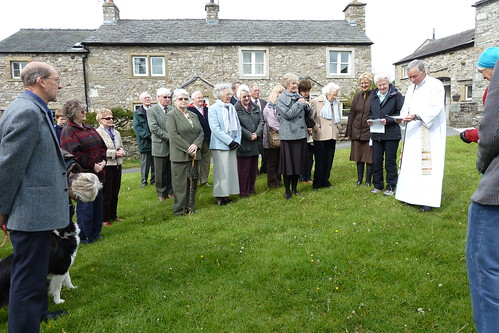
rogation-austwick-20120513a by Judith Allinson
Austwick Parish Church started their Rogation Service at 9.30am - first stop village green, led by Red Ian Greenhalgh. 

Skye, the collie, at Austwick Parish Church Rogation Service, led by Revd Ian Greenhalgh


Rathmell 10.30 Rogation Service held at Rathmell Primary School and playing field.  Revd Hilary Young invites participants to give prayers for people working in their parishes - of Rathmell, Wiggleswort, Giggleswick and Settle,    

.
Rathmell


Revd Bryan Yardy (centre) greets one of the five dogs (a Maltese Terrier) at the Pet Service at St John's Methodist Church Hall 4pm 13th May


Revd Bryan Yardy of Bentham shows people
a photo of Derek Soames first sheepdog
at the Pet service at St John's Methodist Church Hall, Settle


Broughton and Elslack Rogation Service -
 Hymns and prayers at Field Gate. Service started at 7pm 13 May 2012


Broughton and Elslack Rogation Service - Hymns and prayers at Churchyard. 13 May 2012 
A longer report and more pictures are available from the web editor on request

Tuesday, 8 May 2012

£1 a day for food 7-12 May 2012

7 May- 12 May. - time to Live off £1 a day for food
This is part of Live Below the Line

I did this in 2011 too, and you can see what I ate then here:
http://rainforest-save.blogspot.co.uk/2011/05/1-day-for-food.html
The picture on the right is from last year

I have chosen the same diet, more or less, this year - and it is interesting to see how prices have changed. The Potatoes that last year cost me £1-00 for 2.5Kilo have gone up to £1-39. However I was fortunate in seeing a "remaindered" bag for 59p.

The Coop Lentils have gone up from £1-00 to £1-20.
Fortunately the Booths Porridge has gone down 5p

So far I have spent £4-68 of my budget - that leaves me with 32p for "eating out" over the next three and a half days - i.e. accepting cups of tea from friends at 10p a cup.

----------------------------
I am grateful for friends who are sponsoring me.
You can sponsor me online - https://www.livebelowtheline.com/me/judi
One person has sponsored me on the web page - Thank you Margaret!!!
Last night some friends at Speakers Club sponsored me
Several people have sponsored me at church;
Some people from CEL sponsored me
Thank you to all!!

Item                                                     2011                              2012
Porridge 750g (Booths Quick Oat)  £0.95                                     90
1st   500g bag lentils (Coop)                  £1-00 each                             £1-20 each
2nd  500g bag lentils (Coop)                  £1-00 each                             £1-20 each
Potatoes - 2.5 k                               £1.00                                      59
portion of butter                                £0.30                                       0.30
2 tblspoons brown sugar                     0.10                                       0.10
portion of salt                                     0.10                                       0.10
1/20th bottle Cool Earth coffee             0.15                                       0.10
portion of barbecue.chili flavouring        0.10                                      
portion of nutmeg  (2011 only)              0.10 
1/2 a fudge bar given to me (2011only)   0.15
2 cups of tea given to me  (2011only)    0.10
1 slice white bread given   (2011 only)   0.10


1 large crisp after Speakers club (2012)                                             0.4p
1 (old) clementine                                                                           0.15


Monday, 7 May 2012

Green Algal Bloom on River Ribble

Green Algae by the River Ribble Settle - it beautifully matches the green grass and opening leaves - but - is it
  • -a natural sign of spring growth?
  • -a response to air pollution in some way?
  • -a mark of how much the water level in the river has been falling regularly over the past days - So the volume of water is 1/20th or less what it was two weeks ago - and the alga is left stranded?

Opposite Settle hydro - 5 May

See how the green borders the water of the river. Ribble above Langcliffe below the old Paper Mill


Sunday, 15 April 2012

Poa trivialis - Rough Meadow-grass

Grass of the Month for April 2012

(See other months' grasses)

Poa trivialis grows
  • beside woodland footpaths, 
  • in gardens, 
  • in species rich hay meadows, 
  • in damp meadows that have been so heavily fertilised that they hold little else except Ryegrass and Poa trivialis
  • beside streams
  • in nettle patches 
  • on roadside verges
Uploading: 371712 of 972022 bytes uploaded.


Vegetatively, Poa trivialis is easy to recognise.
Well I think so
.
The above plant found on a woodland footpath makes a flattened tuft. If growing in a meadow you might  find just individual fine shoots threading through the sward, with the emerging leaf folded and the blades folded, and the sheaths compressed.

Can you see how the narrow shoots Trail along the ground? - they are Tiny and Trivial.

The shoots are very compressed. They lie flat against the ground and look Trampled on.

The underside of the blades are shiny (when folded, it is only the undersides that you see). With raindrops, they are so shiny they almost Twinkle

Get it?
Tiny, Trivial,  Trailing shoots that look Trampled on and have Twinkling undersides to the blades
Twinkling for Twivialis.

If there is sufficient light, the sides of the sheathsl  facing the light are Terra-cotta coloured (plum coloured), whilst the blades are Tree green  (Tree green means bright mid green - not bluish as in Poa pratensis or whitish as in Poa annua)

Later in the year some of the trailing shoots might root so then they become stolons.

The blades are  Tapering and thus Triangular - like a long isosceles triangle


The above photo of two vegetative blades is useful because as well as showing the tapering nature of the blade, it shows the characteristic vegetative features of nearly all Meadow-grasses:- tramlines (two central grooves) the boat shaped tip (with imagination).

It also show a  SHORT ligule.

"Short ligule?" you ask. "Doesn't Poa trivialis have a long ligule - to distinguish it from the short ligule of Poa pratensis?"

Answer:- the flowering shoot of Poa trivialis has a long ligule, but the vegetative shoots have short ligules.


Poa trivialis growing on the bank of the river Laver
near where it joins the Skell. Note Ground  Elder. see how they trail


The flowers?
They come out in May-July and  have "Christmas-tree panicles, just like the other Poas.  - It is the vegetative trainling shoots that are so distinctive...
But the flowering shoots, which start to grow in April,  grow vertically (even before the flower pokes out), and higher up the shoot they have LONG ligules, and rough sheaths - Hence the name    "Rough Meadow-grass"


Can you remember all the Tr adjectivies for Poa trivialis?
Trilling. Triumphant - Tremendous - trivialis - and the other ones?

(See other months' grasses)

Friday, 6 April 2012

Good Friday Passion Play - Settle - 2012

Churches Together in Settle and District held the Passion Play at Settle,on 6 April 2012 acting scenes leading up to the crucifixion.
See three videos at foot of post.

Come to Settle on 4 April 2015 to see this play in 2015: Starts 10.30am at St John's Methodist church Hall


See pictures from 2013
See pictures from 2012
See pictures from 2011

(We will be doing it again in 2015 on April 4 2015)
Jesus, played by John Bavington washes the disciples feet.
(In the background is a small choir)

Washing the disciples feet

The crowd watches


And in the distance two Roman soldiers and Annas, the  High Priest look on.

The disciples fall asleep in the Garden of Gethsemane


Jesus prays in the garden of Gethsemane


Jesus is arrested

and is marched up to

His trial (in Settle Market Place)

Caiaphas the High Priest hears evidence


Pontius Pilate listens. The crowds shouts "Barabas". Pilate wahses his hands of the affair.

Jesus is crucified.
Three people give moving accounts of the crucifixion, including Mary Magdalene and the Roman Centurion. The choir sings "When I survey the wondrous cross".  It was a moving performance.

 Below is a video clip of Mary Magdalene. click on the arrow


Here the Centurion gives his thoughts


When I survey the wondrous cross

Afterwards there are hot cross buns and coffee in the Parish Church
See pictures from 2013
See pictures from 2012
See pictures from 2011
See pictures from 2009

Tuesday, 3 April 2012

Easter at Settle 2011 videos and upcoming 2012 events

At Settle we have several outdoor events each Easter.
This year we will again have the Passion Play on Good Friday starting at 10pm outside the Catholic Church, with four scenes acted out around town.
 At 6.30am on Easter Sunday there is an open air service at the Millennium Gardens at booths Car Park.
Various individual churches then have special services.
Do join us.

Here are videos from last year:

1. The Centurion:


2. Were the whole realm of nature mine:


3. Easter Sunrise Service at Millennium Gardens:-


4.Settle Methodist Church - Dressing the Cross


Below are photographs of the Good Friday Walk
Pictures from the Passion Play "Journey to the cross" at Settle this Good Friday morning.


Singing the final hymn


Sunday, 25 March 2012

Ten Reasons to Save Brownfield Sites


What is a Brownfield Site? - A brownfield site is any land, which has previously been used for any purpose (e.g. industrial or quarrying) and is no longer in use for that purpose.

We are losing them and we should value them more.

T
his article is just one pebble in encouraging people to value them more for Nature Conservation. It was written the day after after the Yorkshire Naturalists Union Day Conference on Brownfield Sites held at York on 24 March 2012, attended by naturalists from all over Yorkshire


Introduction

  • The biodiversity and nature conservation value of a brownfield sites may be high. 
  • The public mostly has not appreciated this and we are in danger of losing a valuable resource 
  • Each site needs to be considered on a case by case basis. 
  • Greenfield sites in comparison often have very low natural history and wild life interest - a green field of ryegrass or a lawn, or an arable crop, have very low biodiversity value. 
  • We have a large heritage of brownfield sites which are rapidly disappearing - We should value them and save and manage the best, and be aware of the value and potential of new ones that arise.
See the peacock butterfly sunning
itself on the tufa by the stream
Red orange-peel fungus

(Whilst writing this on 25 March I just nipped out to my neighbouring brownfield site - the Hoffmann Kiln and former council waste disposal dump - on this day with mid summer temperatures -


1. What evidence is there they are good for wildlife?
e.g. 12-15% of rare and scarce invertebrates live on brownfield sites - there is great biodiversity per square foot - on a par with ancient woodland


2. Why are they so good for wildlife? (i.e. why do they have so many different plants , mammal, birds, bees, butterflies and other invertebrates?) 

  • complex habitats 
  • nutrient poor, 
  • stressed 
  • disturbed 
  • bare ground give a hot microclimate which insects like 
  • The variety of flowers gives a variety of nectar source for insects 
  • There is spatial variety - different types of substrate 
  • There is temporal variety - different successional stages


3. They mimic habitat associated with many rare species. They mimic grassland, heathland and coastal scrub which are now rare habitats.


4. They mimic successional stages - they ARE successional stages. As the ice retreated 12,000 years ago from UK it would leave bare rock and cliffs and lakes that would silt up - rather like quarries. Special plants and animals would colonise these. Some of these habitats are recreated in quarries and even the concrete of old aerodromes..


5. Why are they under threat?
  • Brownfield sites are undervalued by the public and even by environmental consultants 
  • To keep the vegetation and communities "as it is" - could need a lot of management. 
  • But we can value them as they are whilst they exist in that stage 
  • We can look to find other brownfield sites as quarries and factories are decommissioned - but much of our factory and quarry land was made during the industrial revolution, and already much of the industries and quarries have stopped. The reservoir of future "brownfield land is much less now. 
  • We can lose them by building on them - Brown field sites are built on in preference to greenfield sites 
  • We can lose them by "reclaiming them" - as has happened on many former colliery heaps. The parkland or agricultural land produced is often not at all interesting from a biodiversity standpoint. 
  • Often "reclaiming" involves planting wildflower seed with seeds that are not of native stock - they come form Europe. Or planting with trees that are not suitable for the special soil type. Bare ground is good for insects - but this is lost when the place is covered with thick rich topsoil.
6. Why do the UK nature conservation planning laws not save them?

Is there not a safety net to protect good sites?

Our safety net is:-

  • SSSIs - Sites of Special scientific Interest 
  • Local Wildlife Sites 
  • The planning system should protect most important sites from development 
But new brownfield sites are not given SSSI status. There is just one example of a brownfield site that is an SSSI. (Having said that many SSSIs are "old brownfield sites" such e.g. old quarries - e.g. Quarry Moor at Ripon.) . In planning decisions, greenfield land is protected in preference to brownfield land. Land that has planning permision to be built on has higher monetary value than land that cannot be built on.

Who knows how the laws will be changed next week.

7. Brownfield sites often have historical interest

8. Many current Sites of Special Scientific Interest were once former Brownfield sites.


9. Going to extremes, one could consider all of Britain a complex of former brownfield sites. Simon Warick pointed out, The mesolithic henge at Nosterfield was an early example of a brownfield site.. (he said this after describing the amazing natural wildlife developments at the Nature reserve at Nosterfield in a former gravel quarry)

10. How can we raise awareness?

How can we encourage people to stick up for the biodiversity and wildlife potential of brownfield sites - against the perception that it would be better if it were all planted with ryegrass, or else built on?


The talks from this conference will be put on the YNU web site


Thanks to all the speakers and organisers and especially to Sarah Henshall, Conservation Officer of Buglife, from whose talk I collected many of the above points.

Buglife Website is going to have a section on advice about Brownfield Sites

Phil Wheater led a discussion on Local Nature Partnerships. These are supposed to benefit Nature, People and the Local Economy. There are about 50 of these. They have received some money to meet. but not to do anything. They are committees made up of Health people, Nature people and Business people.


1. I've made this webpage.

2. And at Coffee after Church this morning I raised it in conversation..
WM replied The Dales Hay meadow round here used to be full of colour 50 years ago- they are just green now.

H replied to me "Well brownfield sites should be filled in shouldn't they. They are toxic. I pointed out that the Hoffman Kiln, a local reserve was a brownfield site, she looked surprised. Then we jointly laughed at my efforts to try and publicise the plight of brownfield sites.

Here are some pictures from Saturday's YNU  Conference


YNU Conference on Brownfield Sites
 - Coffee Break
Discussion at YNU Conference
on Brownfield Sites


The Speakers answer questions.
Outside the Natural Centre -
JA holding a
Field Studies Council Program