Sunday, 20 December 2020

Settle Wildflowers - Day 99 - Blue 17: - Trailing Bellflower and Adria Bellflower. Happy Shortest Day


                        HAPPY SHORTEST DAY (21 Dec)

Mon 21 Dec is shortest day: in Settle sun rises at 8.26 and sun sets at 15.48 giving 7 hours 21 min daylight.

(For the sake of my diary I will add that Settle escaped the Tier 4 that London and the south is now locked down at since yesterday. Craven is at High Alert - essentially Tier 2 -  In England Instead of having 5 days we were told that we could meet up on (- and then only 3 bubbles) , everywhere  we are now only allowed to "Meet" on Christmas Day itself. I am organising meals (when requested) for people on Christmas Day who would have liked to have come to Settle Community Christmas Day Meal - which is of course not taking place this year
We are 117 Covid cases per day this week in Craven. Two of my friends ( aged > 80) had a Covid Vaccination last week and three more are booked for this week which is encouraging.)

Back to flowers:

20 December - I will have to work hard to find new flowers. 

I set off to look for two Campanulas I have found on New Year's Day Plant Hunts in the past 2016: (They are garden escapes and come from Jugoslavia as was). In the end I find them.. and four more new flowers.. I will save some of these for "Day 100"  See info on New Years Day Plant Hunt 2021

I will have to work hard because it is the shortest day. Well tomorrow 21st Dec is: Also I have to go to Ingleton to play my accordion in a Drive in Carol Concert by 3pm

Mon 21 Dec is shortest day: in Settle sun rises at 8.26 and sun sets at 15.48 giving 7 hours 21 min daylight.


Campanulas (1) poscharskyana   (2)  portenschlagiana : 

(1)=  Trailing Bellflower 

(2) =  Adria Bellflower


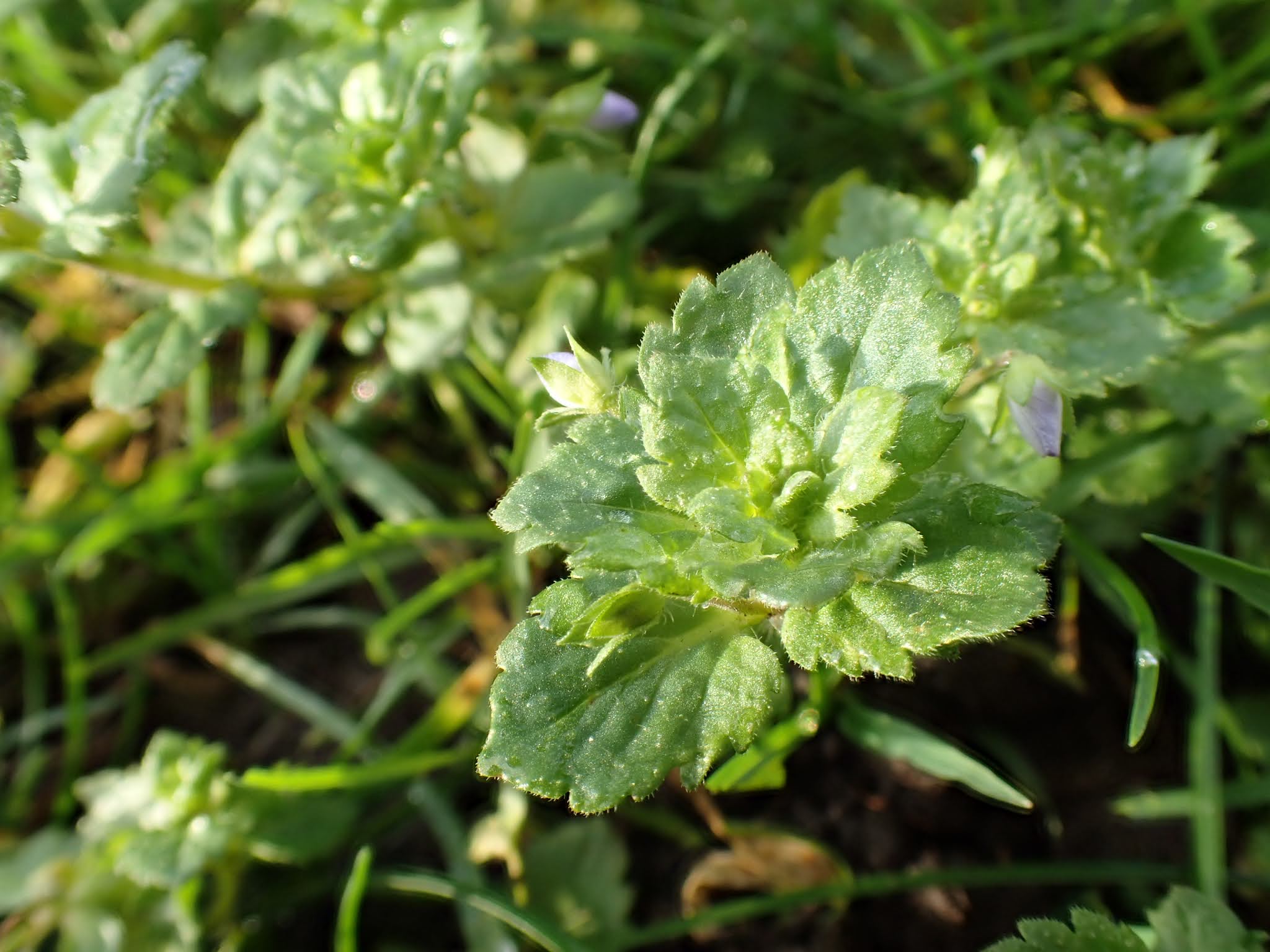
Trailing Bellflower:  Campanula poscharskyana :

Leaves 2-serrate, (It also has cilia on edge of blade that are 0.6mm long and look like fine teeth)

Corolla star shaped from above: diameter at apex equalling length, 

lobed 1/2 to 3/4 way to base 

Corolla slatey-blue

Trailing Bellflower:  
Campanula poscharskyana
 - near Settle Station


Adria Bellflower: C portenschlagiana

Leaves 1-serrate 9 (Though Poland says 2 dentate) It has cila that are 0.1mm long ie too small to see) and some leaves are more kidney shaped.

Corolla funnel-shaped from above: diameter at apex much < length 

lobed 1/4 to 2/5 way to base 

Corolla violet-blue


Back road behind St John's Terrace on Church Street - Railway line ahead.


These were at a different place - the leaves look more incised.                         


                     --------------------------------------------

I continue on Station Road to the Allotments. Here I find, on the verge next to the road in the allotments

Borage.  Borago officinalis

(This is different to Green Alkanet and different to Lungwort)


                         --------------------------------------------

20 m further west, also near the road wall is


Dame's-violet - Hesperis matronalis

The basal leaves of the plant varied from almost non existent to two big clumps.


----------------------------------------

Near by are two more blue flowers - though I have recorded these before - maybe 6 months ago:
Ivy Leaved Toadflax - Cymbalaria hederifolia


And Veronica persica - Common Field Speedwell


--------------------------------------------------------


I find two white flowers - see below - Apart from the red flower I have been saving (do you know what it is?), it means I will have something to write about on .. Day 100


Click here for more  Settle Lockdown Wildflower Walks


Sunday, 6 December 2020

Settle Wildflowers - Day 98 - Orange 6: Wallflower; Green 12: Wood Meadow-grass and Field Garlic leaves on Castleberg Crag

We have very few orange wildflowers in this country; Most insects cannot see the colour orange. So only flowers of other colours are successfully pollinated. 

Here at last, at the foot of Castleberg Crag, I have another orange flower - Wallflower.  Erysimum cheiri.   Like most of the other orange flowered plants, is a garden escape. Wallflowers come out in early spring. and on several New Year Plant Hunts I find one. 

It is December 1st - the first of the month 

The Wallflowers are at the foot of the cliff to the right of the picture.


I make two visits to Castleberg Crag - one on 1st December; then one on 6 December


1. 1st December:

Churches Together in Settle have started doing a "Walk for the climate on the first day of the month" and Castleberg Crag- Settle's "Town Park" is a good place to go for a walk

There are lots of Wallflower plants at foot of the climbing cliff near the top of Castleberg  but I only found one in flower. (I found more on 6th)

I am keen to continue with the tradition (started last month) of going for a walk with Churches Together to take part in the national "Pray and Fast for the Climate" scheme. In Settle we do "Walk for the climate - Litter Picking and Observing Nature and Flowers en route". This time due to Covid Restrictions not allowing groups of bigger than 2, it is myself and Rev Stephen Dawson.  Tuesday morning has an excellent sunny foreecast.

A drawing of the hill from the 1700s shows Castleberg as a grassy (rocky?) but definitely treeless slope, with slabs laid out on the way up to act as a Sundial. 

In. c. 2000  I joined a group from Craven Conservation Group and the Yorkshire Dales Conservation Volunteers led by Russ Turner. We cut down a lot of the young trees and scrub on the slope to let light reach the ground flora. "Don't get sad about cutting the trees and saplings," Russ said. "It will coppice and there will be more trunks than ever."

Quite true. The trees are getting denser. There is not much ground vegetation except periwinkle, and near the entrance Field  Garlic. Allium oleraceum ssp oleraceum (see picture at end)

         In 2008 Churches Together held our traditional "Dawn" or early morning Service on Easter Sunday. It snowed. The all-aged participants - some very elderly - made it up the slope to the flat area near the bottom. That was the last year we held it here. Since then it has been held adjacent to one of the town car parks.


I list the other flowers seen : Smooth Sow-thistle, Golden Oatgrass, Leafy Hawkweed, Wall Lettuce, and Herb Robert - but I'm saving Herb Robert for another day.

Just below the crag a lot of scrub has been cut down - well done - good to open up and area. 

At the summit the sloe bushes which formed a protective thick spiky hedge between the path at the top and the vertical twenty foot plus drop have been removed.

I am concerned about that.

It would be easy for someone to step backwards and fall the 20 foot plus drop.

Worse, someone might say "it is not safe" and then prevent people going up.

The noise of a drill down at roadworks in the street below somewhat disturbs the silence.

From the top we can with the now revealed much better panoramic view see far and wide - including just to the top of Giggleswick Church, almost hidden in the valley behind Settle College (High School) .

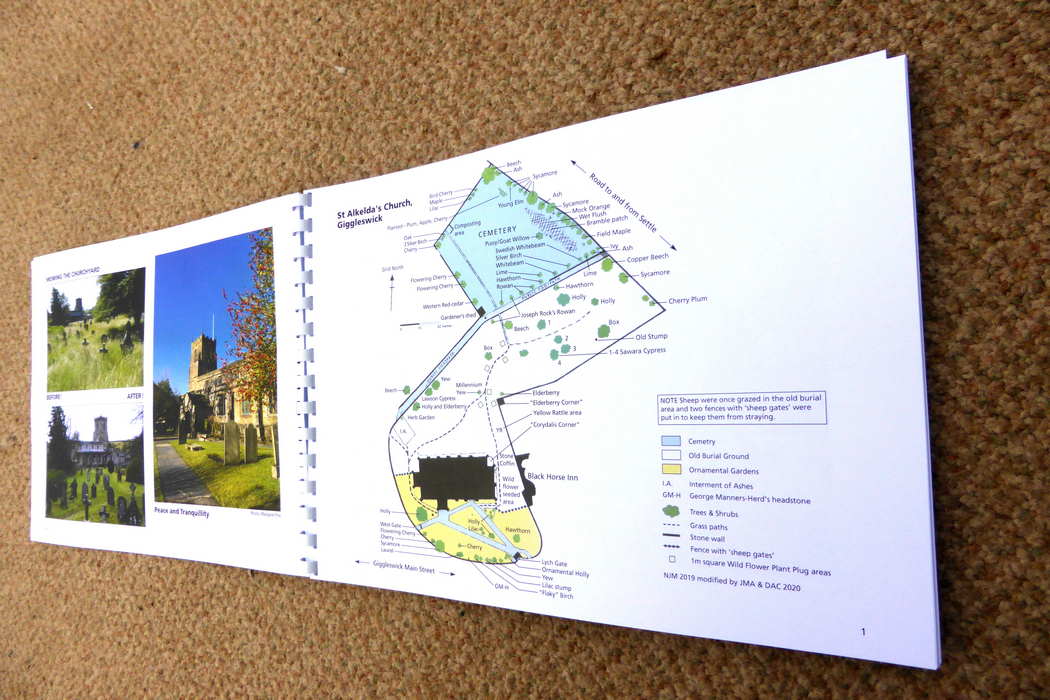
I look at the "Wildlife in a churchyard book" that  my friend Doris Cairns has at last produced about Giggleswick churchyard


View of top of Giggleswick Church Tower from the the top of Castleberg - It is just behind Settle College in the foreground.


There is a Leafy Hawkweed in flower near the flagpole


Round the open area near the bottom,  I see they have planted hundreds of trees. Well maybe a hundred. That is a shame it will block the view here. I wonder if they will make them into a hedge. The surrounding trees are getting so dense there is little space for ground vegetation. And there will be more plastic tree guards rattling around. 


We continue litter picking - it is difficult on the steep slope.


Once back down at the safety of ground level, 
we support a local café, 
meet passers by and enjoy looking at Doris book

2. On Sunday 6 December I return, 

with the aim of photographing Poa nemoralis Wood Meadow-grass, that I had seen on 1 Dec and looking for the plants that I had videod in Jan 2012 nearly nine years ago.. True the flowers are straw coloured, not green - they  have remained since June 2020 - but they are there.

I walk up the gentle path through the "private" woodland at the entrance above the Coop.
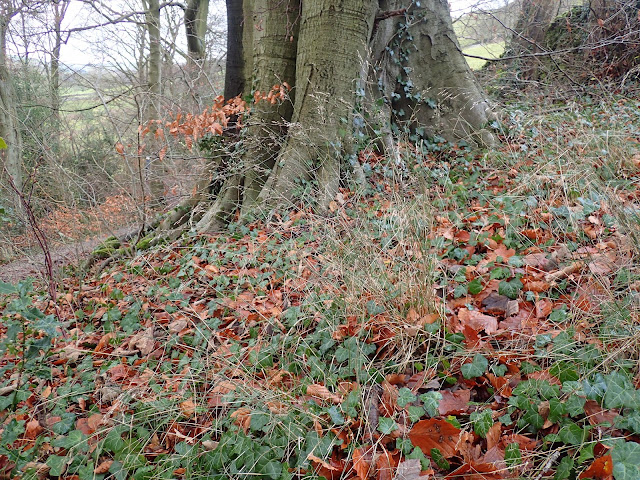


Wood Meadow-grass at the foot of this beech tree.


The video of Poa nemoralis in Castleberg Wood


Shortly after entering the Castleberg Wood I found some (what I think is) Soft Shield Fern Polystichum setiferum - These blog posts are meant to be about flowers, and Ferns don't have flowers. - but I was delighted to find this fern. All the other Shield Fern I have ever noticed around Settle has been Hard Shield Fern, P aculeatum. 


I proceed to the summit. It is quiet today without the noise of the road works.. 
But then I hear voices - climbers below climbing the rock face below me:. and in the distance cheers at the Rugby Club:   - A jackdaw.  - A gull. - an aeroplane, p  road traffic. No not particularly quite. - The clear air allows the sound to travel.


My list of wildflowers extends - as I notice more plants that I had missed on exactly the same path the previous Tuesday.

I see:
White:
a solitary Sloe flower.
Burnet Saxifrage
Bramble
Orange:-
More orange Wallflowers on the cliff
Yellow:
A patch of Rough Hawksbeard
Soft Sow-thistle
Prickly Sow-Thistle
Dandelion
Leafy Hawkweed
Ivy
Golden Oatgrass,
Wall Lettuce,
Red:-
Herb Robert - But I'm saving Herb Robert for another day.

So that is 13 species -  (plus the Poa nemoralis and probably Poa annua) Not bad for 6 December.

A  sloe flower with two petals left on it.


I meet a young couple and enjoy chatting and discussing the view.
And showing them Aspicilia calcarea and Caloplaca flavescens lichens


I descend and enjoy meeting the climbers.  They quickly pick up the names  the Aspicilia calcarea and Caloplaca flavescens. I admire their extendable pole for fixing ropes and carabines though the hooks  Beta Climbing Designs 

Lower down I get to the Field Garlic Site.
I can never remember if it is  Allium oleraceum or Allium vineale. this time I will check using Poland and Clement's Book


It is Allium oleraceum - Field Garlic,
Because:
It has blunt tips to the leaves   (not pointed leaves)
with a whitish area at the tip.
The leaves are solid  for most of their length (not hollow)
They have 3-5 ridges and grooves on the undersurface of the blade. (not a cylindrical blade with 10-18 ridges) .
Apparently they do not have a ligule.

Saturday, 5 December 2020

Wildlife in a Churchyard by Doris A Cairns


Book Review by Judith Allinson:-

Wildlife in a Churchyard - 2020 - by Doris A Cairns

obtainable from Giggleswick Church, C/O David Fox 01729 823 493 £10 a copy (excl postage) or
Yorkshire Dales Millennium Trust - £12-50 incl P&P !! (Bargain it includes the postage of £2-45)
or Limestone Books, the Shambles, Settle

This 112 page A4 landscape book about the wildlife in Giggleswick Churchyard, N Yorkshire, is a "Must" for all who live in Giggleswick and Settle, and for all interested in rural wildlife in the north of England, and for all interested in churchyards. 

I have to profess to a slight interest in having helped Doris with the tree map of the churchyard (page 1) showing the locations of the 30 different species of tree that grow there. I feel it is worth buying the book for that page alone. You can use it to teach yourself to identify trees both in winter and summer. 


The book is illustrated by Doris's delightful photos and watercolour pictures, painted over 2018-2020. She writes in a lively friendly style, with beginners to the different natural history fields in mind. From Birds to Bees, Grasses to Greenfly, Mosses to Moths, Flowers to Ferns and Fungi - there is a wealth of wildlife to be discovered in the churchyard.

The more seasoned botanist will also find  many gems of information on flowers relating to their nomenclature and uses and tips for their identification.

There are guest pages on birds and wild animals by the children of the adjacent Giggleswick Primary School; on Moths by Cynthia Hardyman; and on the Dales Wildflower plots in the churchyard by the Yorkshire Dales Millennium Trust.

Doris deals with the trees by season, starting from winter with tree silhouettes and descriptions of winter buds. So what better Christmas present could you give someone than this book, so that they can start using it straight away.

Doris gives thanks to Nigel Mussett who wrote the forward for the book. He supplied Doris with the original map of the churchyard and also with comprehensive wildflower lists he made whilst at the church. She also thanks Chris Burgon of Lamberts printers, Settle, for carrying out the design and layout of the book.

The book is subsidized by a generous grant from the Yorkshire Dales Millennium Trust and the National Heritage Lottery Fund, through the Stories in Stone Project (see details at end), and supported by the people there, meaning that it is probably selling for half the price it would need to be sold at without this grant. Buy a copy whilst stocks last!!  


Local Anglican Priest Revd Stephen Dawson peruses the book
on 1 December 2020 after Settle Churches Together 
"Walk and Pray for the Climate" event

Doris takes a rest from work on the church steps

Doris on a lockdown nature walk near her home in Summer 2020 -
 Ingleborough in the background, with some flowers
 to be taken home and painted in her box.

Doris points out that growing through
this holly tree in Giggleswick churchyard
are two branches of an elder tree (see the paler colour)

A display was mounted in St Alkelda's Church Giggleswick about Doris' book

Doris, recording the lichens growing on a tombstone at Giggleswick Church.
Readers of the Field Studies Council Publication "Churchyard Lichens"
 will notice this leaflet has been photographed in the foreground
with the almost fluorescent yellow lichen Psilolechia lucida just behind it


Doris spent much of her career teaching science and sports at high school level, then all subjects at primary school in Australia. Since retiring to this area of North Yorkshire she has spent much time developing her painting skills. She is also a keen member of Craven Conservation Group. 
Seven years ago Doris produced the book Wildflowers of the Churchyard with reference to Ingleton and  Chapel le Dale Churchyard. She did this initially so that she could share her paintings with members and friends of the Ingleton Church. That book proved very successful. This book of  Giggleswick churchyard  has completely new paintings and pictures in it, new facts, and includes sections on many other types of wildlife. The pictures and facts apply to many churchyards in the Dales, and much of the UK.


Reading "Wildlife in Churchyard" on top of Castleberg Crag
 and pointing down to Giggleswick church tower
 (which can be seen in the valley behind Settle College) on 1 Dec.


This book has been produced as part of Stories in Stone, a scheme of conservation and community projects concentrated on the Ingleborough area. The scheme was developed by the Ingleborough Dales Landscape Partnership, led by Yorkshire Dales Millennium Trust and supported by the National Lottery Heritage Fund. Visit www.storiesinstone.org.uk for more information.