Sunday, 1 November 2015

Nov 1st - Was it our hottest November day too?

Sunbathing in Settle on 1st Nov:-


It might be 1 November,  
but by 1 pm the mist had gone 
and people were sitting out on 
the Settle pavements, sipping coffee
as in french cafes.
Wales recorded their hottest November Day ever.

The Ribblehead weather station said it reached 15.8 degrees   at Ribblehead today (Sun)

The trees on Castleberg still have some leaves

Golden leaves at Watershed Mill

Golden leaves at Langcliffe
 On the tree trunks in the picture above are lots of lichens. They look very happy today. This morning it was misty and moist, now it is humid and warm - so the lichens are saying yippee.

This is Parmeila sulcata. The Netted Shield Lichen
There are whitish ridges on the thallus called pseudocyphellae.
In this specimen there are lots of soralia (bodies that make the powder like soredia) growing on some of the pseudocyphellae. 

Parmelia sulcata is often infertile - but it is fertile here with the apothecia with a brown centre. and sorediate rims. It can grow in slightly polluted air and grows over all UK on tree trunks.


The church yard a a beautiful globe artichoke.


And a stunning ly beautiful rose. I photographed it from lots of angles


In the background in the house opposite the church, next to the  institute,
the Middletons have been selling potted plants and flowers this year.  Sadly, Maureen died this week.


1 November is All Saints Day 
and at St John's Methodist Church 
we wrote the names of people we 
wanted specially to remember on Post-it notes...

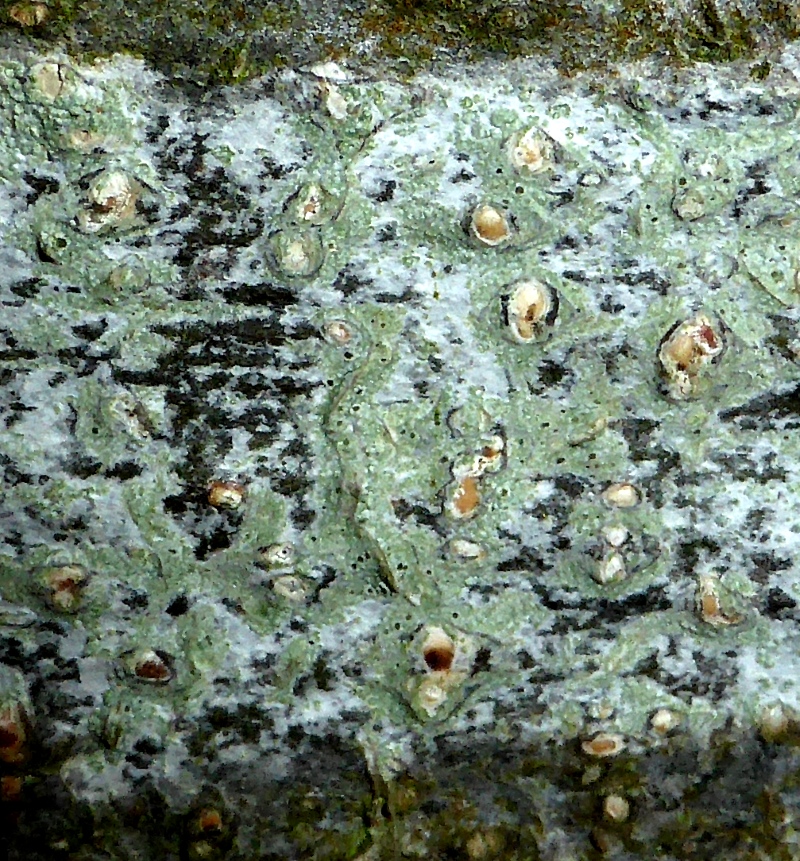
Acrocordia conoidea - in a Settle garden and on Settle - Langcliffe High Road


 Learn your lichens 3.
Learn your Lichens Series
1. Arthonia radiata

I first met this lichen, with its big pale pink thallus and large protruding black fruiting bodies  in Settle, in a friend's garden in Townhead Avenue, on the limestone wall, that was also the lower-side wall of the highroad from Settle To Langcliffe.  (see lower part of this post) - 


To share it with the public - I would have to find it in a public place so I set off from Settle along the High Road  on 30 Oct.

I put my red knife next to a patch.
- view looking back to Settle.
I have barely passed
the gates to Castleberg
In fact there was lots of it, conveniently at eye level. It is distinctive because the black perithecia are 1mm in diameter and regularly spaced. The thallus is pinkish.


Pollution level 6 ( it needs fairly clean air)
It is called Acrocordia because the summit/tip of its fruiting bodies apparently heart shaped.
Certainly this species had relatively cone shaped fruiting bodies - 


Here it is

In fact it was another 100 yards or so till I got to the wall above my friend's house.. and there was lots more on the wall on the upper side of the road, and a tiny patch on the road side of their garden wall.


------------------------------------
Original post:
On 26 October I was wandering round Settle in the late autumn sunlight looking for Lichens in distinctive locations to photograph. "Come and photograph mine" said Barbara A.. So up I went to their house on Townhead Avenue - the garden backs onto the High Road (Highway?) from Settle to Langcliffe. I admired her Hydrangeas and Maiden-hair Spleenwort and almost-over Bloody Cranes-bill and Marjoram.

On the vertical hard limestone rocks of the wall of The High Road are lots of patches of this pinkish lichen with big (1mm) black protruding fruiting bodies:  Acrocordia conoidea

and pale grey green spaces where the fruiting bodies have dropped out.


On the bark of the tree trunk was Melanelixia glabratula


Further round on the trunk was Fuscidea lightfootii (the green one on the right, with large black fruiting bodies)


I think this is Phlyctis argena on the tree bark- I need to go back with some NaOH to check


This is on the footpath in the garden - needs some thought.

Tuesday, 27 October 2015

Caloplaca flavovirescens near Settle


Learn your lichens 2.


Distribution map of Caloplaca flavovirescens in UK

Caloplaca flavovirescens forms big pale yellow  egg-yolk coloured patches (up to 15 or 20cm) and the margin of the patch is whitish. It should be called Fried Egg Lichen.


Around here it seems to grow on cement type substrata.


I have found it in four places:


1. E and J's house doorstep, Stackhouse Lane

2. The Locks, Langcliffe
3. One patch on a stone in the north wall at Horton Churchyard
4. Paving stone beside War Memorial outside Ingleton Churchyard


1. It grows on the front doorstep of a house on Stackhouse Lane overlooking the school 


A drop of  strong alkali  - in this case
sodium hydroxide solution -  turns
 the minute fruiting bodies from orange to crimson


Here, another species of Caloplaca  (Caloplaca holocarpa - grey with orange fruiting bodies) isgrowing next to it,  and prevents the C flavovirescens from making a circular patch


Frank Dobson's Lichens book is placed near the Caloplaca  flavo-virescens,
with a view across the road to the school trees


Reverse view.


Stackhouse Lane in autumn


I was first shown Caloplaca flavovirescens at Ingleton at the war memorial outside the church


Caloplaca flavovirescens


Caloplaca flavovirescens - This turns red with alkali

Caloplaca flavovirescens


-----------------------------------------------------------------------


This morning (27 Oct 2015) I went down to The Locks at Langcliffe to rephotograph the Caloplaca flavovirescens It also on the wall top to the north of the stone "bridge/dam" at the top end of the Locks, and next to the stile opposite. 


This is front right in the picture above,..
though it is on the wall to the left of me above that
Next to the stile


The same ones looking to the bridge


The same ones larger


Finally an autumn view of the river


Wednesday, 21 October 2015

Arthonia radiata at Giggleswick Churchyard and churchyard work parties


Most lichens have disc shaped reproductive bodies. Arthonia radiata has reproductive bodies that look like little black stars or ink blobs
"The thallus (body) of the lichen is a smooth, greyish white crust
with  embedded,  black,  variable  but  usually  irregularly  stellate
apothecia (fruiting bodies) (typically 1-2mm in diameter);"

Arthonia radiata disappeared from areas where there was a lot of sulphur dioxide pollution in the air (during the industrial revolution and up to the smogs of the 1950s. ) However the air has become cleaner with respect to sulphur dioxide and lichenologists are finding it in lots of places now.

Whilst I was there I  met Tony and Wendy Carroll busy strimming and raking the long grass in the churchyard and discovering memorials under the mounds of False Oat-grass. They told me about the team of volunteers from the village (and elsewhere) that has just started meeting on Monday afternoons to maintain the churchyard.


The front is always neatly maintained - Here the holly berries are out in autumn but will be gone by Christmas


2009
Prof Mark Seaward showed me some on a beech tree in this churchyard in 2009, when he ran the lichens day here for the Institute of Biology

I went back to that tree  on 21 Oct 2015 and the patch is still there.


(I think this is the Arthonia .. I am open to correction.. the ink blots do seem to have stretched horizontally somewhat.


2015

2015


2015