Monday, 8 April 2024

Settle Wildflowers 123: Cardamine pratensis April 8 Sycamore buds almost out, dandelions just coming and lots more


 I love this time of year .. every thing is just starting.

This post deals with Ladies Smock, Elm flowers (- fruit), Sycamore buds, Nodding Melick, Dandelions, insects. 

And at the end, from last night - Luzula campestris, Phaeophyscia orbicularis lichen and Aspicilia calcarea


May used to be my favorite month when loads of flowers are coming out in rapid succession.

But the growth is happening now!  April 8th... 

And as my pictures picked up .. the insects!


I took pictures just now or Ladies smock and of  tree buds.. and now at home was impressed to see how many of the pictures also had in insects in the picture - the insects are coming out to make use of the growth.  


I noticed the pink Mayflowers/Cuckoo flower/ Ladies Smock in the field opposite me   has appeared since yesterday . Maybe because the sun is shining - may be because the past two days have had high temperatures (kept low by wind chill factor) 

The rest of the field is flat grassland improved in most years by application of manure, and with no noticeable wildflowers of conservation interest.  (The bank by the river has more of interest).

But Ladies Smock looks pretty!. and the leaves, like the leaves of bitter cress are edible. 

Oh the sun has gone now -- It's raining again!  April Showers. .. making the footpath by the river even muddier.

(Two months from now I may be writing of a drought... let's see.)


I have missed the elm flowers at their prettiest - should have been out a couple of weeks ago - but on these pictures you can still see the (dead?) anthers. and the hairy stigmas and the green fruit jsut starting to grow.


Over the river from the small elm tree you can see the Sloe in full bloom, and behind them on the bank the Beech whose buds have not yet opened.  The white garlic flowers have not yet come out on the bank under the beech.. but I can see the ground is looking very green with their leaves


Cardamine pratensis under the elm.

The sycamore buds on my "Reference Sycamore tree have not quite broken yet.. They break on 16th of april I always say.. but I suspect they will beak before that this year.  there was one bud on the tree that has already broken and has leaves

See that one greenfly has found this bud.


 I looked up and could not see the 36+ year old yellow plastic kite tail . I wonder if it has gone .. will bring my binoculars another day.


Below - pictures from last night. on the pasture limestone slope 200 m horizontal and 50 m vertical above  the Cardamine  meadow.
1


Sunday, 7 April 2024

Settle Wildflowers Day 122 - Snowdrop bulbs Langcliffe Churcn 7 April and Summer Snowflake in flower

Summer Snowflake. Leucojum aestivum 

Summer Snowflake has 3-6 flowers in a cluster and flowers April- May.   

Planted here in Langcliffe Church-yard  - but I see there is a record for our square in BSBI maps It is more abundant in the south coast of England, introduced there too.

(I looked this up:- Spring Snowflake   Leucojum vernum (which this is not) has 1-2 flowers per stem, and flowers Jan-March.)

The genus Leucojum is native to moist woodland and meadows of central and southern Europe, the Caucasus, Turkey and Iran.


At the entrance to the churchyard is a wheelbarrow with bulbs or ordinary Langcliffe snowdrop plants for sale - £3-00 a bag. (photographed 5 April 2024). The repeated heavy rain we have had has washed some of the chalk off the sign. Maybe if you come to buy books at the church you might also like to buy some snowdrops to support church funds.!


Here is Langcliffe Church Snowdrops in 26 Feb 2014 (I was 7 weeks too late to get such a photo today)

See more posts at 
Index of Settle Wildflowers posts


Friday, 5 April 2024

Settle Wildflowers - Day 121 - Settle 2024 - April 5 - Butterbur in the rain


Butterbur beside the path at
Watery Lane. (last year) 19 April 2023
on an Eco-Explorers walk.

First here is a picture from a (yes) sunny day last year on an Eco-Explorers Walk along Watery  Lane. 

It is 5 April 2024. I started posting Wildflowers of Settle 2024  onto Facebook this year on 1st April, posting them daily. 

Butterbur - Petasites hybridus.

We have had damp to very wet weather for the last three - six weeks. Most flowers look rather bedraggled. I took these photos today.

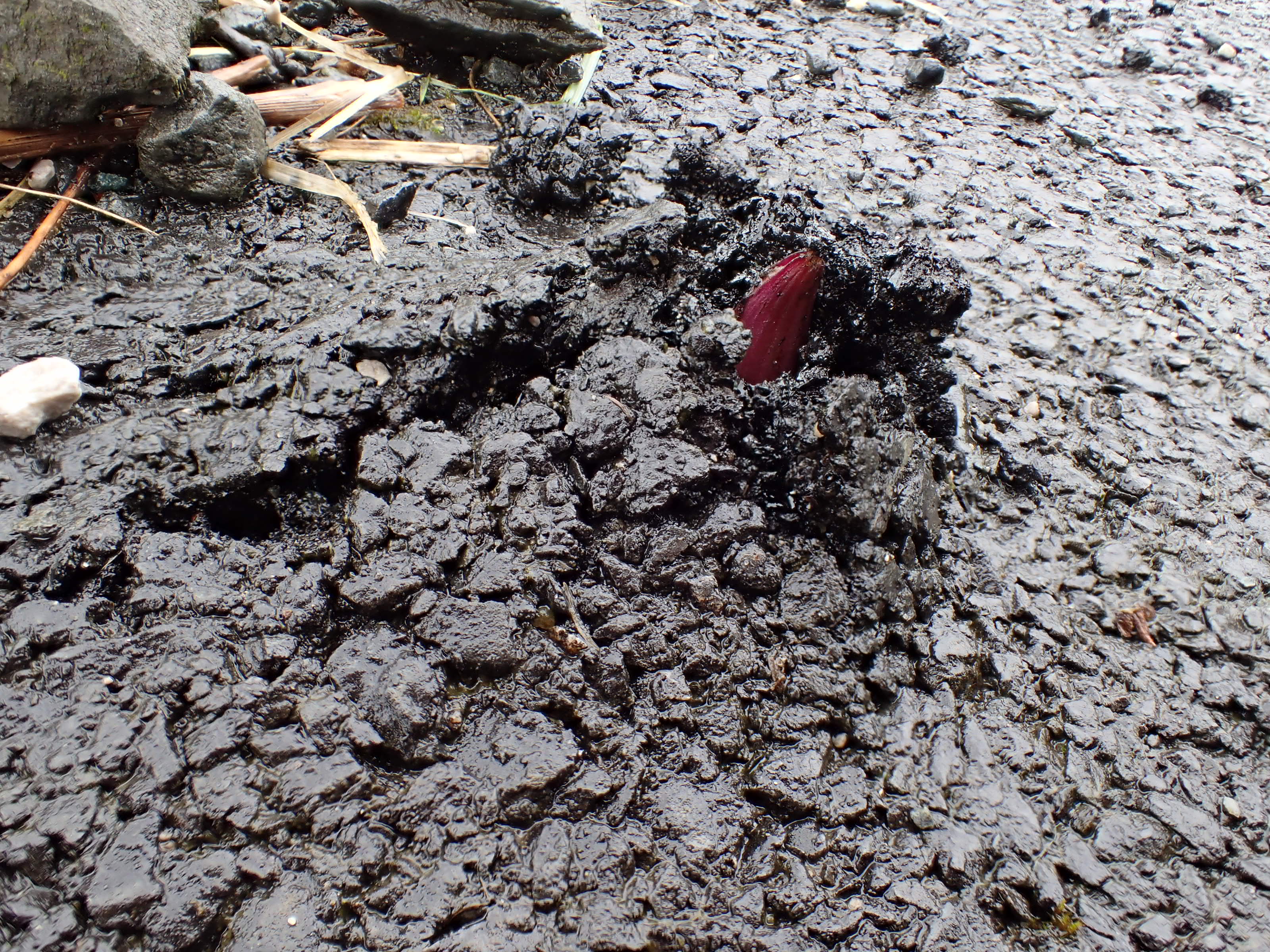
They re-tarmacced the footpath between  Langcliffe and Stainforth last year.  Here Dandelions and a few Butterbur plants have broken through the tarmac. 


Butterbur is said to be dioecious- i.e. some plants have only male flowers (i.e. with anthers) and the other plants have only female flowers (i.e. can make seeds) 

Here are photos from previous sunnier years.


Close-up


Saturday, 30 March 2024

SD8460 Langber: Last monad of year 5 of Lichen Survey of SD86

Today I declare 19th March to be the year end of 2023.

11 March 2019 was my first recording trip for this lichen project  starting shortly after the British Lichen Society Trip meeting at Cober Hill in Feb 2019, but I wrote up the first blog post on it on 3 April 2019.  So 19th March seems a good compromise.

The aim is to do 10 monads in SD86 each year.

New Year's day 2024 came and went - and in February 2024 I made an effort and visited  four monads (all with easy road access)

SD8466:   Cowside Farm; (road at bridge near farm)
SD8467:  The tiny fraction of Henside road near Westside House -  with snowdrift and cattle grid; that fitted into SD8467
SD8468:  The tip of the plantation at Little Catrigg pasture (looking down towards Sannat Hall and Neals Ing;    (Two visits) 
SD8469:  Tiny road stretch-Silverdale Meadow (road to Penyghent)

with scores of 26,23,24 and 19 respectively.

I just need to visit one more monad to keep up my score of visiting 10 monads a year. 

Cleatop Park Wood revisit was one possibility - I have visited Cleatop Park wood and the land below it during Covid.. but can't find the results... I will survey that again when I have more time .. though need to do it soon before the leaves come out.

So on 19 March I set off to visit Langber Lane.. a monad that looks as though it would be easy access, by parking near Scalebar Foss, then walking 2km past Wildshare Plantation. I can walk on the track and keep my never worn before WHITE Salomon Wide Speedcross (fell running) shoes clean.

By the time I have parked the car it is 4.30pm. It is a peaceful afternoon but the sun has retreated behind hazy cloud. I have put all my kit in my old red rucksack (45yr?) that has a decent waist strap and I take my Nordic Walking poles. (Can't take TWO Nordic poles and a shopping bag.

I meet Andy and Carol Evans who were returning from a run... and have a chat.  Andy used to give me lifts to work. Years ago.

1km further I meet a new person for me - Sarah Ryecroft from Kirkby Malham. out to exercise her dogs in an area with no sheep. (It's lambing time.. And ewes get frightened - even if dogs are on a lead)  

I have a chat.

("It is like Covid Walking times again" I think)

 I know - or knew - her mother in law.  Sheila Rycroft - who I learn died 6 years ago. It was good to meet Malhamdale people again. 

I pass the highest point (301m) of my (relatively flat)  journey  (on Pendle Grit) and descended slightly towards Langber Plantation - Woodland Trust (recorded as on Bowland shale - but all the wall stones are grit). I am actually in a slight valley - the valley of Brook Gill Beck - 

The Gritstone walls are very species poor, lichen wise. Parmelia saxatilis was the only foliose lichen on the grit capstones - no Platismatia glauca Parmelia omphalodes or Pseudevernia furfuracea;

These seem to do better in more exposed areas on the top of hills - e.g. Hunter Bark 2km to the west and Scosthrop High Moor (potentially) 2 km to the NE.

I find one record of Hypogymnia physodes on stone, but two on wood posts. 

Some of the walls by the track between Langber Plantation and the stream have a good coating of acid rock loving mosses - including a sheet of Frullania tamarisci  and a few tiny leafy liverworts.

I find some Baeomyces rufus on the wall beside the plantation with what might be a parasite on it - round lichen colonies growing on it. It might possibly be Arthroraphis grisea.  Er probably not it has a line of resistance round the edge - still need to check it.

So

I have now visited 50 monads with scores of 19 or more (i.e. almost 20 or more) ,  but 24 of them have less than 29 species so I would like to visit all those again at least once - and some may need several visits to get their scores up to 30 plus.

The average number of lichens recorded per monad is now down to 32.32 (The highest it ever was was 34)

I have seen 181 different species. (on the BLS website the total number of species recorded for SD86 is 348)


Friday, 8 March 2024

A visitor to Sheffield in Yorkshire.

On 1 March I attended a Green Christian Board Meeting at Sheffield, which included  planning meetings on the Friday afternoon and Sunday morning. On the Saturday we had a Discussion Day with some local Green Christian members held at a church in Sheffield. (St John's Park)

Some statistics I live in Yorkshire (N Yorkshire is England's biggest county) and Sheffield is in Yorkshire (Yorkshire is divided into several counties now)

But both Settle and Sheffield are perched high in the Pennine Hills with no direct route in between. So it was an adventure for me.

There are  c 5 million people living in Yorkshire which is the same as the population of Scotland,  0.6 million of these live in North Yorkshire (big towns Scarborough (0.061) and Harrogate (0.089 million) .  

0.6 million people live in Sheffield (0.68 actually).  0.3 million live in Bradford and 0.46 live in Leeds. In between these are other big Cities and towns of the northern conurbation with population of more than 0.05 million: York, Doncaster, Huddersfield, Wakefield, Barnsley, Castleford, Dewsbury.

In comparison 7.5 million people live in London, or 9 million, according to source - and London is the 37th biggest city in the world.   

There are three parts to the report:

1.  The journey - always an adventure for me.

2. The stay at the Church Army Centre at Sheffield called the Wilson Carlisle Centre (I recommend it as a good place to stay if you are in Sheffield)

3. The lichens and wild plants of the St John's Park Church churchyard, (actually owned by Sheffield Council now I think) - written as a separate blog post  

----

1.  The journey - always an adventure for me. Plus "A sense of place and the rivers of Yorkshire"

The previous week I had travelled by car c100 miles east (ENE) (almost 3 hour driving) across Yorkshire to Cloughton, near Robin Hood's Bay on the East Coast near the source of the River Derwent which flows west inland into the Ouse south of York .   It was for a British Lichen Society Meeting.

Next weekend I will be travelling 40 miles by train to  Leeds for a meeting of the Yorkshire Naturalists Union. (I live seven miles from the source of the river Aire  and Leeds is on the Aire which flows east into the Ouse. (Providing the train runs of course.)


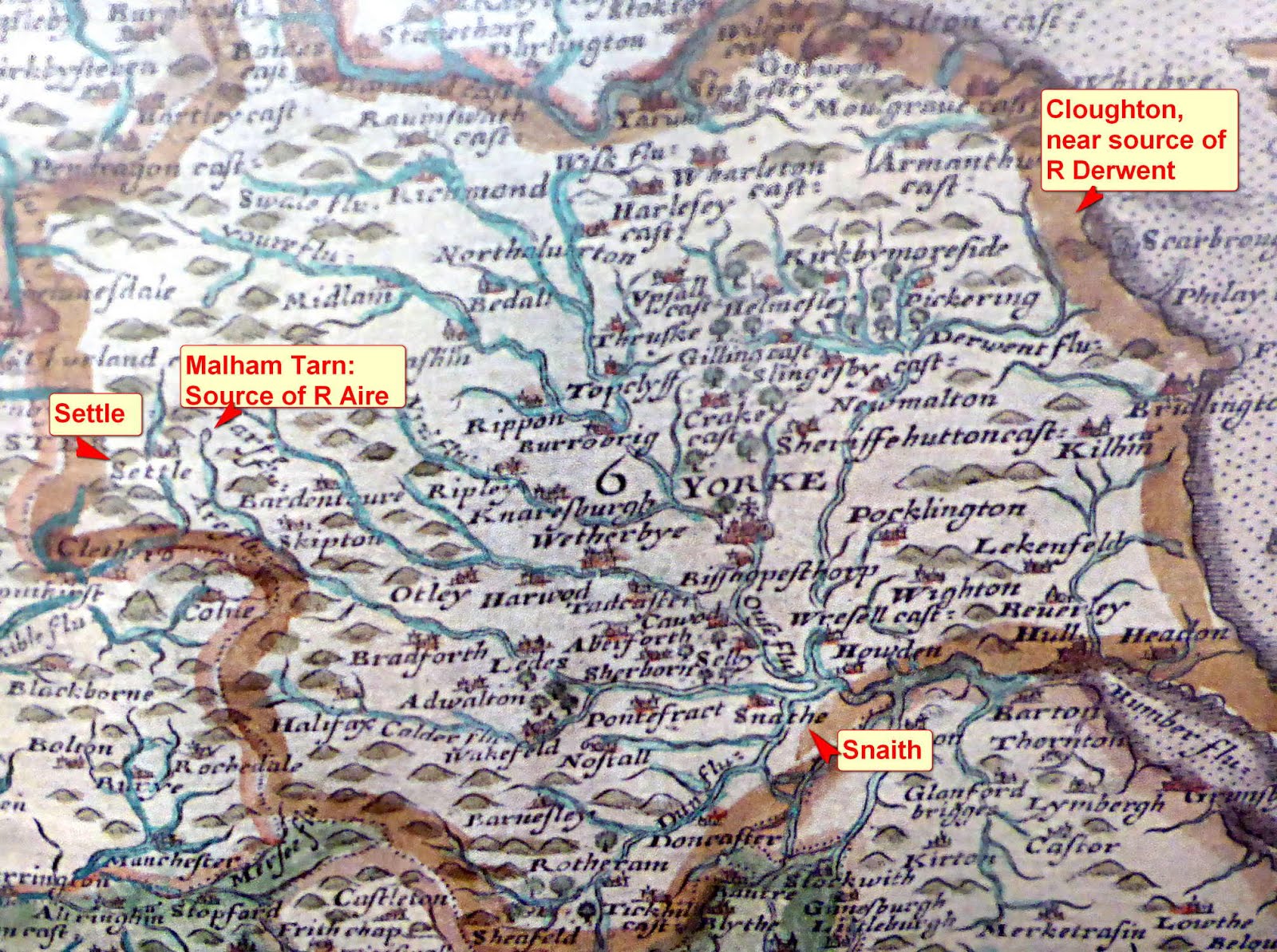
This weekend I travelled across Yorkshire 86 miles out (SE) this time by public transport:  It is about 2.5 hours by car. Today I had planned to go by train . However there was a strike - So It was by bus . Here is a map of Yorkshire printed by Caxton showing the rivers 
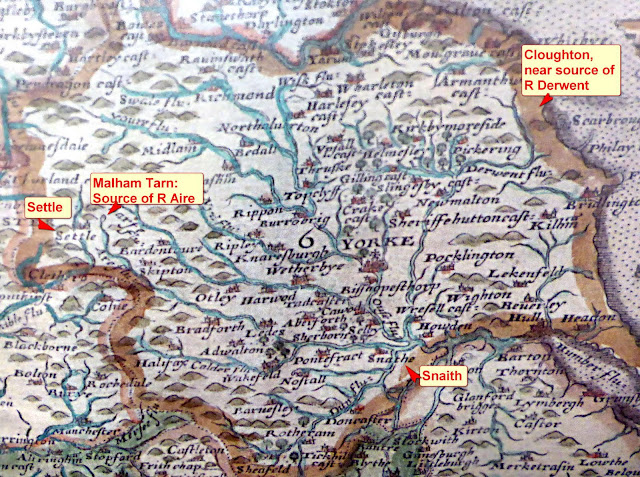
Sheffield is at the centre very bottom of Caxton's map of Yorkshire.. Sheffield is on the River Don which joins the River Aire near Snaith; (which then joins the Ouse a few miles east of where the Derwent joins the Ouse. No wonder there si sometimes flooding at Snaith)


Sheffield is at the centre of the map below about at the place where the capital D or Derwent is written.

I left home at 7.:25. With my red shopping bag, white plastic bag (food rations for the journey) and rucksack. I  walked (very fast) the 1.5 miles to town; caught the 7.55 bus Settle-Skipton  (£2-00); with a  mini gap caught the bus Skipton to Ilkley (£2-00); (I was guided in the transition between buses by Philippa a friend from Settle who just happened to be on the same bus) 

At Ilkley there was a 20 minute gap. This was useful as the bus did not go from the stand as stated on  Google maps.  There were only three stands so it was possible to guard/watch all three stands at the appropriate time.

I caught the bus from Ilkley to Leeds - with 66 potential stops (stop. start. bend ..stop. start. bend.. bend. stop. bend. - so it seemed)  (£0.0 as by now it was past rush hour and  could use my senior citizens pass)  to Leeds. 

Then Luxury! on National Express (£6-00)  from Leeds to Sheffield. Wedged into a comfortable seat, in a warm bus speeding down the motorway with torrential sleet and rain obscuring the view through the big windows. 

At Sheffield, although Google maps told me there was a wealth of public transport to my destination, I put on all my waterproofs and walked. 

Sheffield has a wealth of options of public transport but it is hard for a newcomer to understand. - The following morning I had to use a tram but I could not work out how to get one or where they stop. (One of the other participants turned up late at our meeting because she had got on a tram going the wrong way - so I felt even happier I had arrived walking.

For other newbies to Sheffield this is what a tram stop looks like: 


I actually had an hour and a half to spare now (I had had to build that into my journey in case I messed one of the connections)


So I went to see the Exhibition "Threads of Creation" at Sheffield Cathedral.  I had coffee in the tea room and chatted to a lady there. I met a Canon Richard Walton who told me a little about the history o the cathedral. Their Cathedral has a bronze Eco Church Award. I met another helpful lady who when I asked her took a picture of me standing in front of one of the tapestries.


I used google maps, it took me walking about 270 degrees around the cathedral but eventually sussed where I was and I walked to .. The Wilson Carlile centre. Here I met the committee in time to be shown to my room and then return for the afternoon meeting in a modern committee room.

Wilson Carlile (14 January 1847 - 26 September 1942) was a Christian, an English priest and evangelist who founded the Church Army in 1882


(This is different to the Salvation Army, from Wikipedia:  William Booth had already seen the extreme poverty and need for unorthodox evangelism work, and since 1865 had been developing a similar mission (in 1878 given the name "The Salvation Army"), using similar "Christian soldier" metaphors, also in London slums. Church of England bishops approached Booth about the time Church Army was founded to join in their work in the slums, but he declined.[6] Both the Church Army and the Salvation Army continued to work in the slums; both had some difficulty with their parent churches (Church of England and Methodist) being able to cope with those coming out of the slums as a result of the mission work, and realised the need for alcohol-free refuges.)


They have a useful committee room.


On the Saturday we had a workshop which we held at St John's Park Church. I have written a separate Blogpost about the lichens in the churchyard there


On The Sunday morning we held a service  led by Andrew our chaplain in the Chapel of the Wilson Carlile Centre.


They had a transparent lectern, like the one I saw at Coventry about 10 years ago - I really like it.


We had more committee meetings and then left. I stayed on to browse in their well stocked library.


Grove books