Saturday, 23 January 2016

Lichens at Wallington House in Northumberland with BLS

Sunday 17th Jan was sunny and cold.
After my dawn walk over the Tyne, I had breakfast at the Euro Hostel and then drove c 20 miles NW of Newcastle to Wallington. I parked in an open car park facing the sun. About 25 people eventually arrived.


Janet Simkin our leader and organiser introduced us to Paul? (Red jacket and dog) from the National Trust. He told us it was one of the top 25 most visited properties of the National Trust, and the agricultural estate was 30 sq miles.
 I set off with Allan Pentecost towards the walled garden but before we reached the road we came across some box trees.

On the  box branches we searched for a special rare lichen called Fellhanera bouteillei which we failed to find. But Hey ho - I shall always look out for it on box now.


There was lots of green "grot" alga - Apatococcus lobatus - which is a bit like Desmococcus  (I found Apatococcus on a tree in Coventry.. but it is probably the green grot you see in lots of places)

Then on the leaves there was a special alga called Phycopeltis foliosus. This forms orbicular orange brown patches on evergreen leaves. The filaments are closely packed together and radiate outwards and the plants resemble small upturned mushroom caps. The species are common in the tropics but rare elsewhere. Link

Phycopeltis foliosus


In the walled garden at the top there was a spring/trough which had overflowed
- maybe in the recent floods - there were lots of pea mussels.


Lecidella stigmatea on vertical wall at top of walled garden
Lecidella stigmatea on vertical wall at top of walled garden
Belonia nidarosiensis (Clathroporina calcarea): Thallus a powdery crust orange to red flecked with white.  found on vertical shaded north and east limestone and mortar walls. Some jagged angles at edge of thallus.
Gyalecta jenensis- these are only 1 mm across.

Fairy Foxglove - Erinus- on SW facing wall of walled garden - white stuff includes Diplotomma albo-atrum


Diplotomma albo-atrum


See the yellow patch on the brick wall..


It is Caloplaca citrinum

Tephromela atra or possibly Lecanora ganagleioides on the wall


This is an Opegrapha that Allan took home
Physconia sp.
Physconia sp.


Melanelia..? growing with Parmelia sulata


The Thelotrema lapida growing into the Pertusaria pertusa makes a splendid photo.


Beech tree with Pertusaria pertusa by the lake


Young Pertusaria pertusa on branch of young shrub - growing with concentric rings.


Then we came back onto the lawn at the main house
where people were looking at two lichenocolous fungi


Marchandiomyces-aurantiacus

Marchandiomyces-aurantiacus: This is peach coloured
On a horsechestnut tree nearby was a flourescent ink fungus- Illiosporiopsis christiansenii

Illiosporiopsis christiansenii

Illiosporiopsis christiansenii


The grey lichen on the right with cone shaped pycnidia with whitish tips is
Lecanactis abietina.
The yellowy orangy streak down the centre with black pinheads on stalks is Chaenotheca ferruginea

Chaenotheca ferruginea


Peltigera membranacea - there is whitish felt /powder on the edge of the thallus

Add caption


Sarea resinae - Resin Fungus


Arthonia spadicea - tar spot lichen

A fungus

Thursday, 21 January 2016

British Lichen Society AGM at Newcastle

Leaving Settle for a couple of days and going to the AGM at Newcastle on 16-17 Jan 2016. 

"Please can you tell me where the Agriculture Building is?" I ask a young man. "Lichen Society ?" "He asks.. "I'm going there too". But first we have to stop at the wall outside the Agriculture Building


Caloplaca holocarpa

Lecidella scabra on acid rock.
The drop of KOH solution turns yellowish

he demonstrates how he keeps lichens- stuck on card with Copydex


AGM

AGM
 Fun over bridges


After supper I walk over the high bridge

and look back to see three more bridges

Then come out in early morning 7-30am and walk across the Tyne Road bridge to see the bridges at dawn


After breakfast I will set of for Wallington.. More on that tomorrow

Monday, 4 January 2016

BSBI New Year Plant Hunt Settle 1 Jan 2016 report - results and lots of pictures


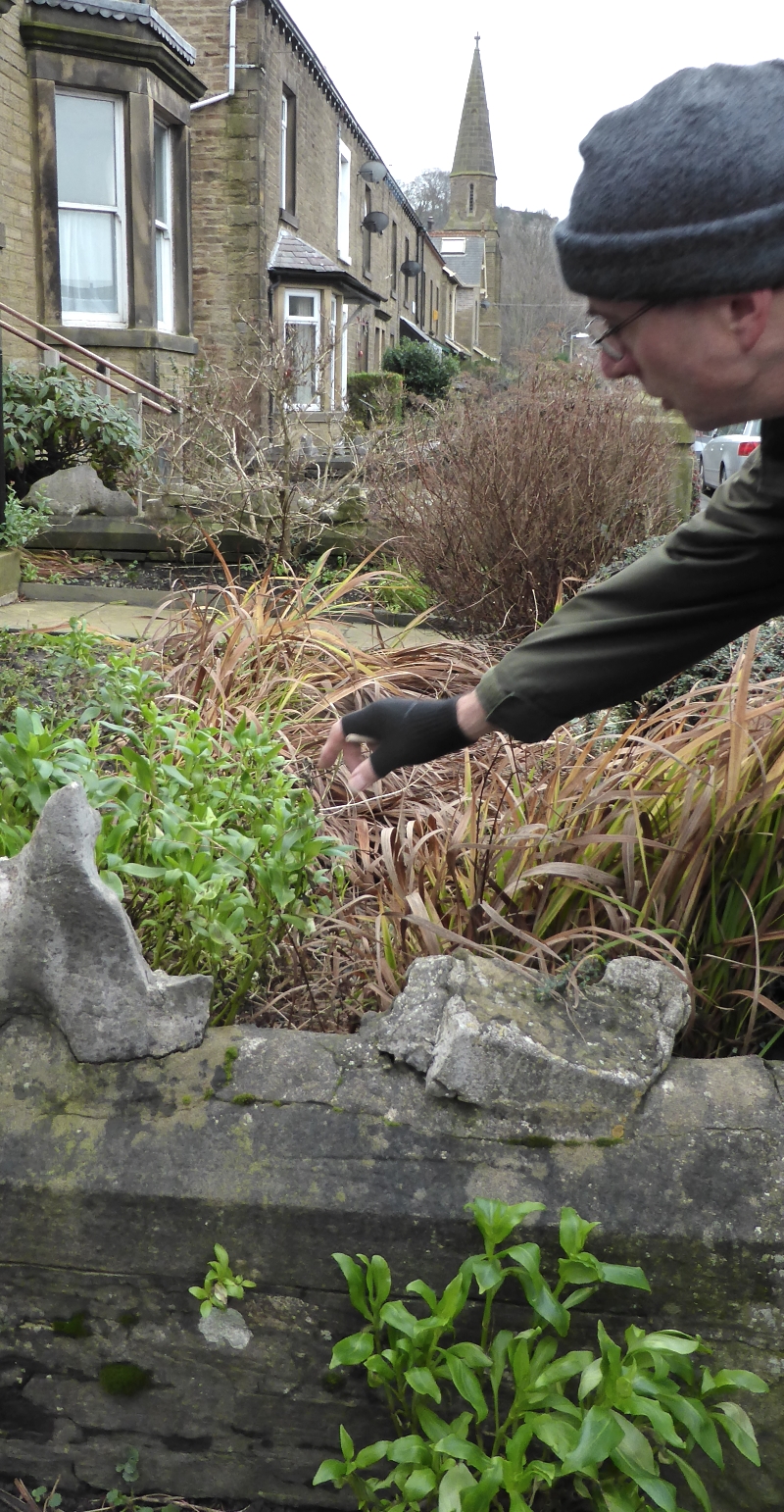
I'm not usually a fan of  street furniture,
but this post on the cobbles  gave protection to
Common Chickweed and
Shepherd's Purse.

You can see how cold  it is by our
woolly hats and white knuckles
Five of us from Craven Conservation Group set off on the bitterly cold afternoon of 1st January to look for wild plants in flower in Settle. 
as part of the fifth BSBI NewYear Plant Hunt

 We found 21 wild plants in flower (17 truly wild, 4 rather "iffy")- which was two more than  last year. 

Five of last year's plants were missing in flower this year and we found 5 extra this year.


Foot of the above post 
with Shepherd's Purse


The  "iffy" flowers were-
1. The wild Primroses were ones that had been planted in  the Anglican churchyard.
2. The beautiful blue garden escape: Campanula portenschlagiana Adria Bellflower, or Wall Bellflower - growing on several walls in Settle
3. Wallflower (planted)
4. Snowdrop (planted)


The 21 Plants were:
(The first 17 are truly wild)
1Annual meadow grassPoa annua
2Common chickweedStellaria media
3DaisyBellis perennis
4DandelionTaraxacum sp
5GroundselSenecio vulgaris
6Hairy BromeBromopsis ramosa
7Herb BennetGeum urbanum
8Herb RobertGeranium robertianum
9IvyHedera helix
10Ivy-leaved toadflaxCymbalaria muralis
11Petty spurgeEuphorbia peplus
12Pineapple-weedMatricaria discoidea
13Rue-leaved saxifrageSaxifraga tridactylites
14Shepherd’s purseCapsella bursa-pastoris
15Sticky mouse-ear chickweedCerastium glomeratum
16Wavy bittercressCardamine flexuosa
17Wild strawberryFragaria vesca

Below: not quite so wild:-
18PrimrosePrimula vulgaris
19Wall Bell-flowerCampanula portenschlagiana
20Wall-flowerErysimum cheiri
21SnowdropGalanthus nivalis 


Pictures shown in order of being taken


This is the Red Red Valerian seen flowering last year
- but just healthy leaves this year.

Further down that "lane behind the houses"
we find our first Petty Spurge and a Wavy Bittercress


Wavy Bittercress


Petty Spurge


Wall (or Adria) Bellflower


Herb Robert behind  the old Methodist Chapel

Wild Strawberry next to the road wall in the Methodist Churchyard


I front is Wallflower -only in bud,
but we see it in flower elsewhere.


Daisy in St John's churchyard lawn -
and then lots more in the Anglican Churchyard


This is a very beautiful Geum in the
Anglican churchyard beside the church
 -but we did not count it as native.

Wild Primroses in the Anglican churchyard- but planted


Not counted on our list -but still blooming beautifully
- a late autumn rose at the Anglican Church


Hairy Brome - under the arches
of the Railway Viaduct, next to the Petrol Station

A type of Garden Spurge (not counted)


Rue-leaved (or fingered) Saxifrage near the Old Library -Delaney Court

Not counted- but Hellebore in road to Greenfoot Car Park garden

Alison Evans pointed out the Dryopteris sieboldii growing in the same shady area - so the other four of us learned a new fern


Rather out of focus Wood Aven ( Herb Bennet)
- but that is wild and was counted)


A blue Periwinkle but not counted because presumed planted

Thank you to the BSBI for holding this, their 5th New Year Plant Hunt, - and to all the other people thourghout the UK who braved the elements to take part this year.

Sunday, 3 January 2016

Lecanora gangaleoides :


Learn your lichens 6:


Lecanora lichens have apothecia (reproductive bodies) that look like jam tarts: In the case of L.gangaleoides  the  "jam tarts" are 1-3 mm across, the "jam" is black, and the thick rims are very pale grey, almost white.


It is growing on a stone in the wall next to the post/tube that may be used for measuring water depth for the Environment Agency at Penny Bridge, Settle
,
This looks like a very similar lichen called Tephromela atra but in L.gangaleoides, if the surface of the thallus is picked away or damaged you can see the orange medulla underneath, as in this picture below:


Quoting from Lastdragon.org:

Thallus generally light grey, warted-areolate, with orange colour in the lower medulla exposed if the surface tissues are picked away (visible at the left of the photograph); apothecia with thick, thalline margins and black discs. Widespread but more common in the north and west and on the coast, on base-poor rocks and stonework. 


Four outstanding events at Craven Speakers Club Mon 4 Jan

Four outstanding events  at Craven Speakers Club on Monday 4th January. The club welcomes visitors to share in the learning and excitement: It is held at 7.40pm at the Soroptimists Rooms, 28 Otley Street, Skipton, BD23 1EW

1) Public speaker and Local Actor Chris Birch will give tips on

how to give an impromptu speech -

 (i.e. when someone gives you a topic and you have to speak on the topic straight away for 3 minutes.)

2) Judith Allinson will run a 20 minute workshop on

"Ways to attract new members to the group"


3) A new club member (a young engineer) will give a

6 minute speech - to be analysed and evaluated by an experienced member 

- so we can all see the good things he did - and  learn ways it could be improved.

4) There will be a

"Topics Session" - Its' fun - it is a bit like "Just a minute" on the radio. 

 in which four members of the club are given topics on which to give an impromptu speech We shall see if they have followed Chris Birch's advice.

http://www.craven-speakers.org.uk

All welcome: First time visitors free